Artwork
English Beggars (Les mendiants anglais)
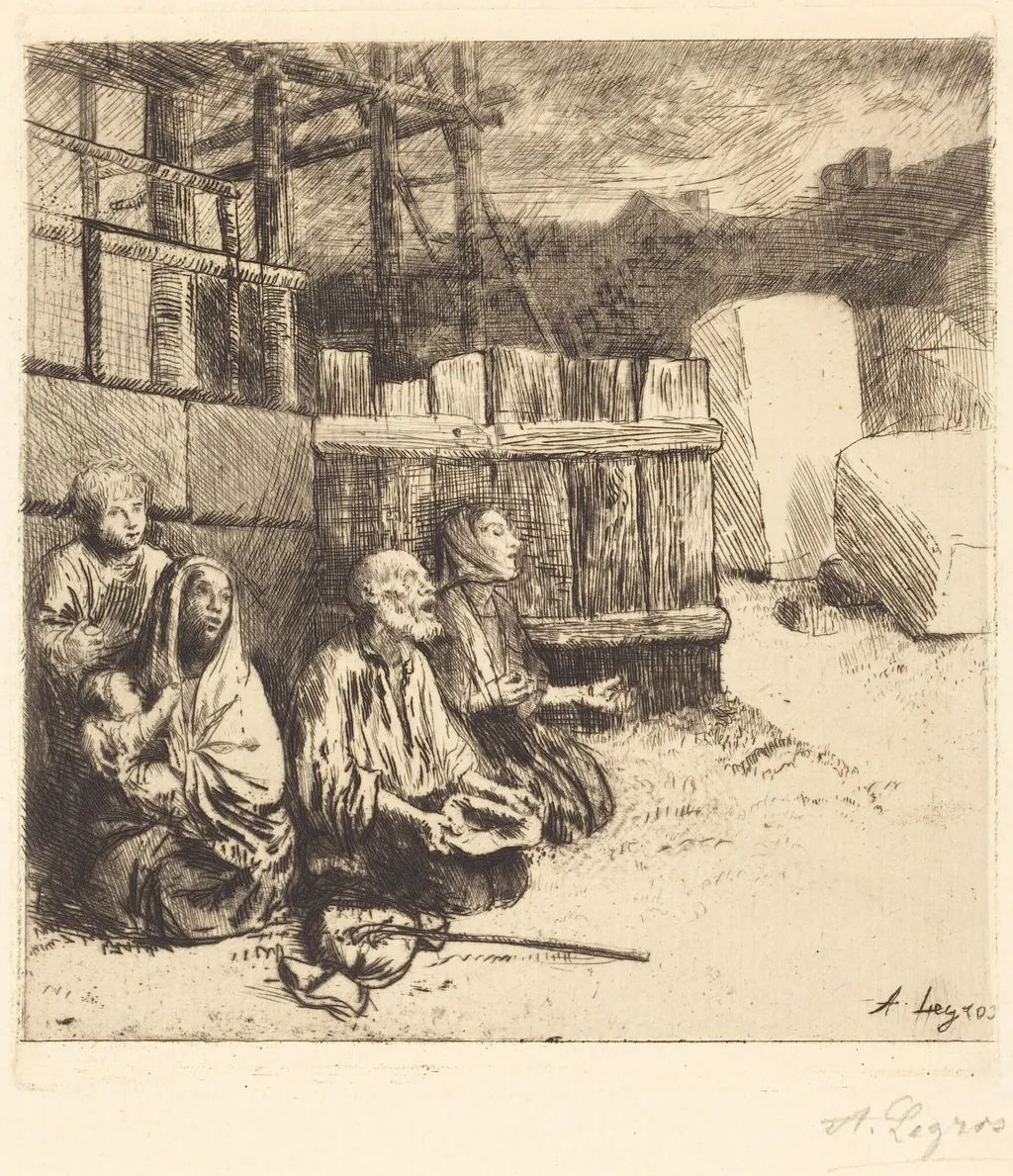
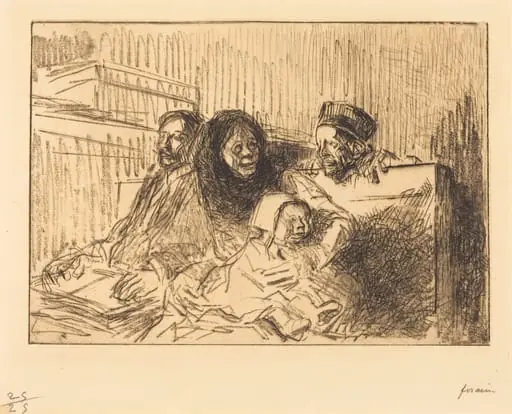
English Beggars (Les mendiants anglais) is an ink print by the Impressionist artist Alphonse Legros. It dates from 1875 and is held in the collection of the National Gallery of Art.
About this work
Overview
Created in 1875 by Alphonse Legros, *English Beggars (Les mendiants anglais)* is an etching and drypoint print made after the artist’s move to London in 1863.
Created in 1875 by Alphonse Legros, *English Beggars (Les mendiants anglais)* is an etching and drypoint print made after the artist’s move to London in 1863. Though French by birth, Legros became a naturalized British citizen and was influential in revitalizing printmaking in England. This work belongs to a body of imagery focused on marginalized urban life, reflecting his commitment to depicting ordinary people with dignity and emotional weight.
Subject & Meaning
The print portrays three destitute figures huddled in a sparse interior: a seated man with a walking stick, a woman, and a child. Their postures convey exhaustion and resignation, while their clothing suggests prolonged hardship. The absence of narrative detail shifts focus to their presence, emphasizing quiet endurance rather than spectacle. The setting, though minimally rendered, implies confinement and deprivation, reinforcing themes of social invisibility.
Technique & Style
Legros employed drypoint to create dense, scratchy lines that capture texture and shadow with immediacy. The rough, rapid strokes define faces and hands as if sketched in real time, avoiding idealization. Etching provided finer contours for the background elements—a bookshelf, fireplace—contrasting the figures’ blurred forms. The tonal density and lack of clean outlines enhance the sense of physical and emotional weight, aligning with the print’s somber subject.
History & Provenance
Made during Legros’s tenure at the Slade School of Fine Art, the print emerged from his broader interest in social realism and print revival. It was likely produced for private circulation or academic study, as few impressions were made. The work remained within British collections after his death in 1911, with no evidence of widespread public exhibition during his lifetime, reflecting its intimate, non-commercial nature.
Context
In 1870s Britain, industrialization and urban poverty drew increasing artistic attention. Legros’s depiction of beggars aligned with broader European realist movements but avoided overt political messaging. His focus on quiet dignity, rather than sensational suffering, distinguished his approach from contemporaries. The work also reflects his training in French academic traditions, adapted to British subject matter through direct observation.
Legacy
Though not widely reproduced, *English Beggars* exemplifies Legros’s role in elevating etching as a serious medium in Britain. His emphasis on expressive line and psychological depth influenced a generation of printmakers. The work remains a quiet testament to his belief in art’s capacity to observe, rather than judge, the lives of the marginalized, leaving a subtle but enduring mark on British printmaking.
Artist & collection

Artist
Alphonse Legros (French pronunciation: ; 8 May 1837 – 8 December 1911) was a French, later British, painter, etcher, sculptor, and medallist.