Artwork
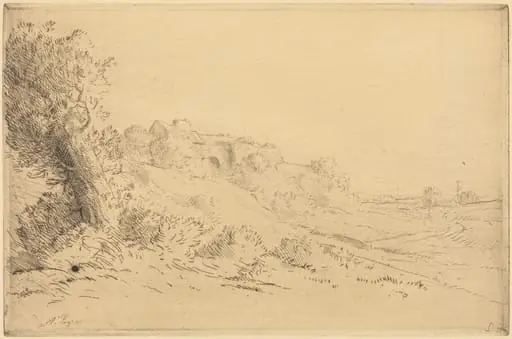
Farm on a Hill (La ferme sur la colline)
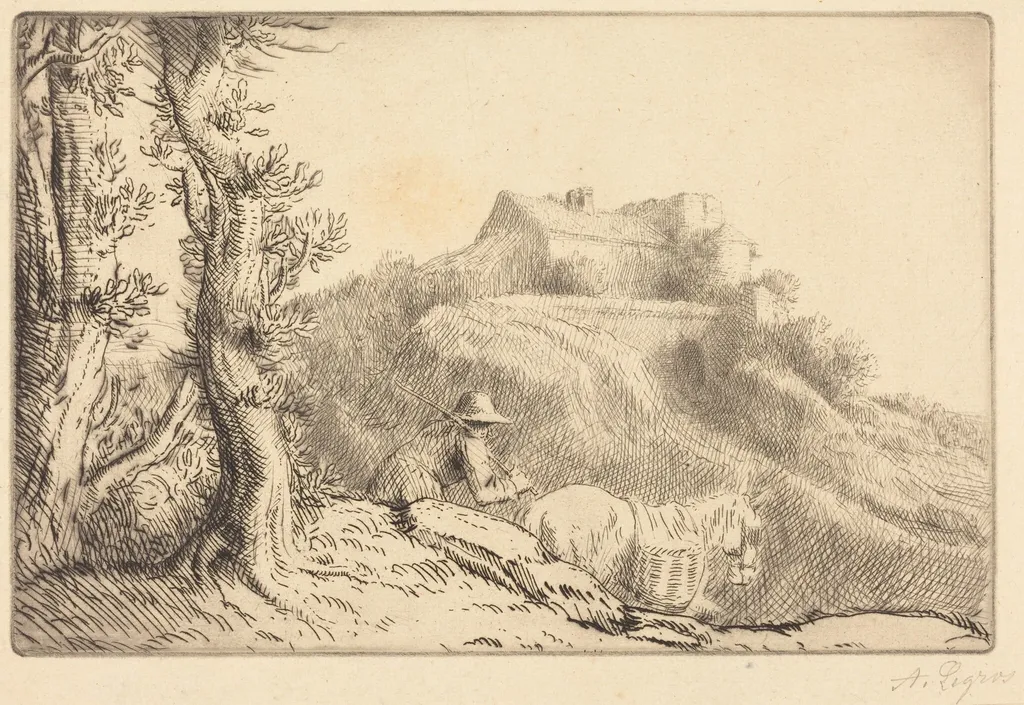
Farm on a Hill (La ferme sur la colline) is an ink print by the Romanticist artist Alphonse Legros. It dates from 1874 and is held in the collection of the National Gallery of Art.
About this work
Overview
The work belongs to a period when Legros was deeply engaged in printmaking and instrumental in revitalizing the medium in Britain.
Created in 1874, *Farm on a Hill (La ferme sur la colline)* is an etching and drypoint by Alphonse Legros, a French artist who relocated to London in 1863 and later became a British citizen. The work belongs to a period when Legros was deeply engaged in printmaking and instrumental in revitalizing the medium in Britain. His technical precision and focus on atmospheric texture distinguish this piece as a quiet yet deliberate exploration of rural landscape through intaglio methods.
Subject & Meaning
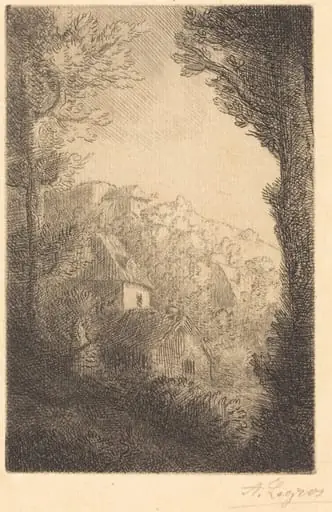
The scene portrays a modest farmhouse nestled into a sloping hillside, surrounded by dense vegetation and partially obscured by larger forms in the distance. A more substantial stone building rises behind it, half-concealed by the terrain. The composition avoids narrative drama, instead emphasizing solitude and the quiet integration of human habitation within nature. The absence of figures or activity reinforces a contemplative tone, typical of Legros’s interest in understated rural life.
Technique & Style
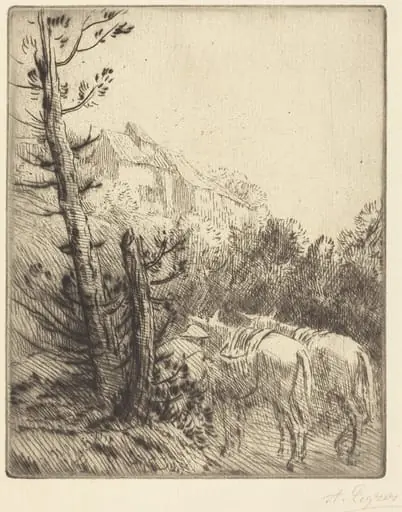
Legros employed etching and drypoint to build the image through layered, incised lines. Drypoint’s rough burr creates soft, velvety darks, while etched lines define finer textures—grass, bark, and stone. The scratchy, energetic strokes suggest movement and natural irregularity, avoiding polished finish in favor of tactile immediacy. This method allowed subtle gradations of tone, capturing the mood of the landscape rather than its precise topography, aligning with 19th-century printmaking’s shift toward expressive realism.
History & Provenance
The print was made during Legros’s early years in London, when he was establishing himself as a teacher and printmaker at the Slade School of Art. Though the specific early ownership of this impression is unrecorded, it reflects the broader revival of etching as a serious artistic medium in Britain, a movement Legros helped lead through both his practice and pedagogy. The work likely circulated among collectors and students familiar with his influence on the British print renaissance.
Context
In the 1870s, British artists were re-engaging with etching as a medium for personal expression, moving away from reproductive prints toward original compositions. Legros, trained in France but active in London, bridged continental traditions with emerging British sensibilities. His focus on rural subjects aligned with wider European interests in peasant life and naturalism, yet his restrained approach distinguished him from more sentimental or picturesque depictions common at the time.
Legacy
Legros’s work, including *Farm on a Hill*, contributed to the legitimacy of etching as a fine art form in Britain. His technical rigor and emphasis on direct observation influenced generations of printmakers at the Slade. Though less widely known today, his prints remain important examples of how 19th-century artists used intaglio techniques to convey quiet, introspective visions of the natural world, shaping the trajectory of British printmaking into the 20th century.
Own this work as a print
Artist & collection

Artist
Alphonse Legros (French pronunciation: ; 8 May 1837 – 8 December 1911) was a French, later British, painter, etcher, sculptor, and medallist.