Artwork
Saint Sigismundus
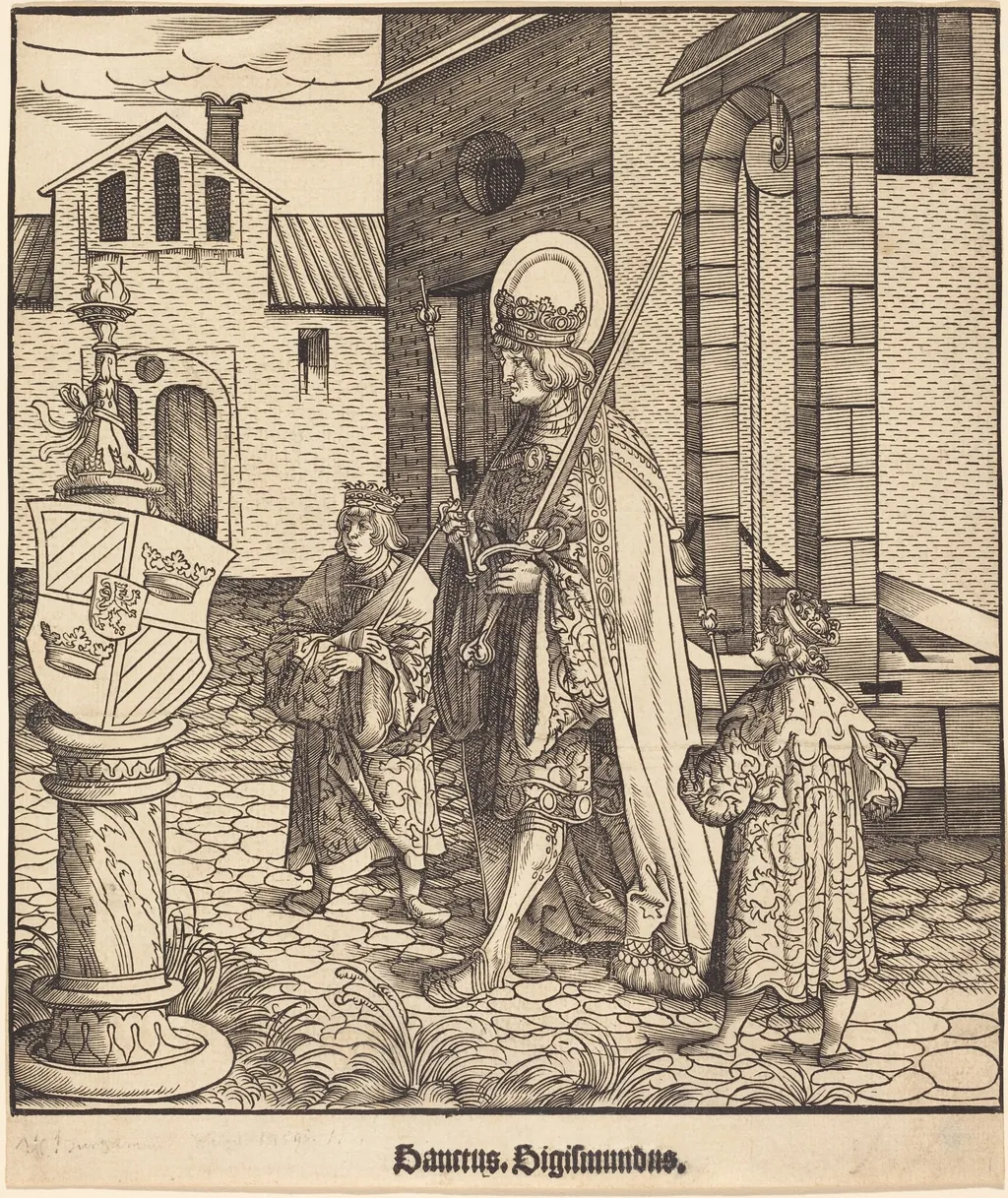
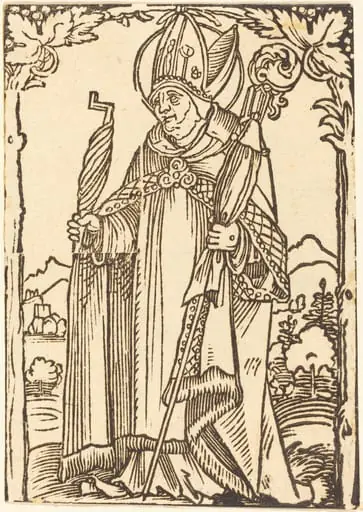
Saint Sigismundus is an ink print by the Renaissance artist Cornelis Liefrinck I. It dates from 1517 and is held in the collection of the National Gallery of Art.
About this work
Overview
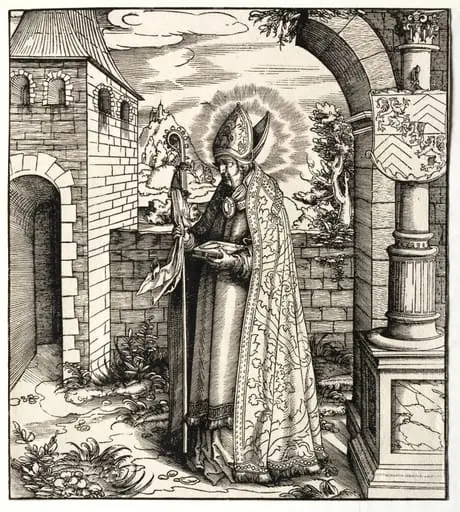
Created in 1517 by Cornelis Liefrinck I, this woodcut depicts Saint Sigismundus, a Burgundian king and martyr, as the central figure.
Created in 1517 by Cornelis Liefrinck I, this woodcut depicts Saint Sigismundus, a Burgundian king and martyr, as the central figure. Rendered in ink on laid paper, the print exemplifies early 16th-century Northern European printmaking. Its detailed line work and controlled shading reflect the technical precision characteristic of the period’s religious imagery, intended for devotional use or educational distribution among literate audiences.
Subject & Meaning
The image portrays Saint Sigismundus, crowned and haloed, holding a sword—symbolizing his martyrdom and royal status. Flanking him are two figures: one crowned, possibly a fellow ruler or patron, and another in clerical robes, suggesting ecclesiastical endorsement. The architectural backdrop, with its arched doorway and stone path, evokes a sacred threshold, reinforcing the saint’s role as an intercessor between earthly and divine realms.
Technique & Style
Liefrinck employed fine, controlled lines to model form and texture, using cross-hatching to suggest volume and depth. The woodcut’s sharp contrasts between light and dark enhance the three-dimensionality of the figures and their garments. Despite the medium’s limitations, the artist achieved a sense of realism uncommon in earlier prints, aligning with Renaissance ideals of naturalism and spatial coherence.
History & Provenance
The print was produced in the Netherlands during a period of growing demand for devotional imagery among the urban middle class. Though few early impressions survive, its existence suggests circulation beyond monastic circles. The work’s survival in institutional collections today reflects its preservation as an example of early Northern printmaking, rather than as a relic of active veneration.
Context
In early 16th-century Europe, woodcuts served as accessible religious tools, especially before widespread literacy in vernacular scripture. Saint Sigismundus, venerated in parts of the Holy Roman Empire, was a fitting subject for such imagery. Liefrinck’s work aligns with contemporaneous prints by Dürer and others, who blended devotional themes with emerging humanist aesthetics and technical refinement.
Legacy
Though not widely reproduced or celebrated in later centuries, this woodcut remains a representative artifact of pre-Reformation religious print culture. It illustrates how Northern artists adapted traditional iconography to new technical possibilities, preserving sacred narratives through mass-producible forms. Its survival offers insight into the visual piety of early modern lay communities.
Artist & collection