Artwork
Landscape
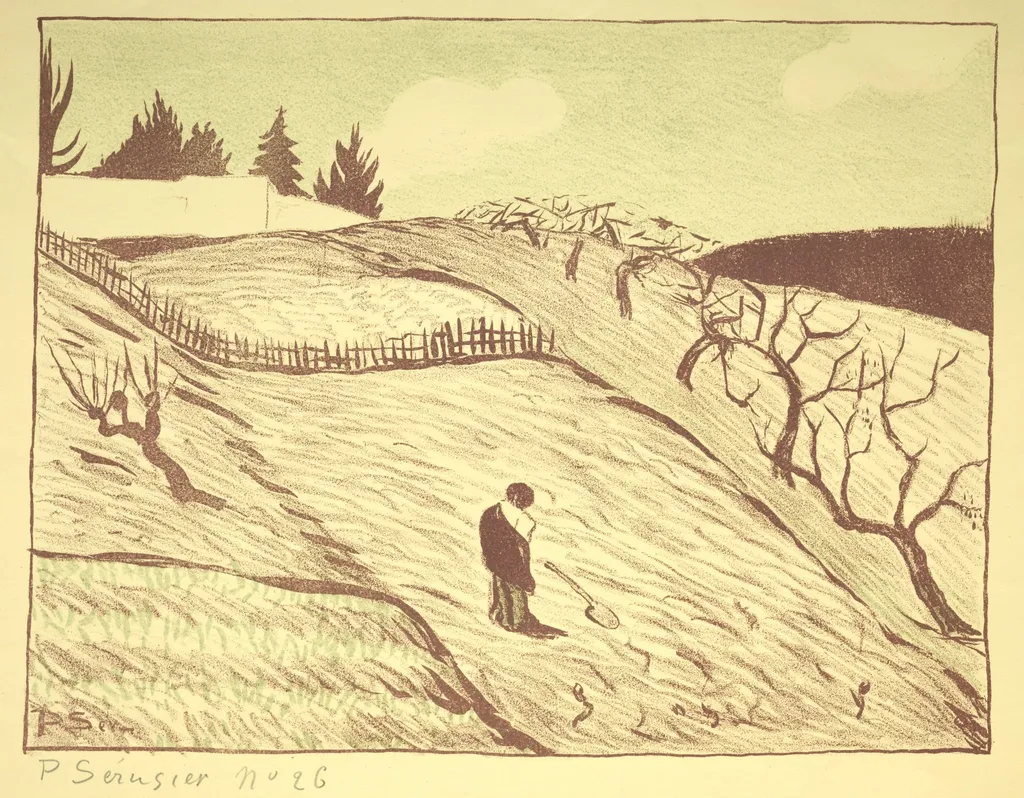
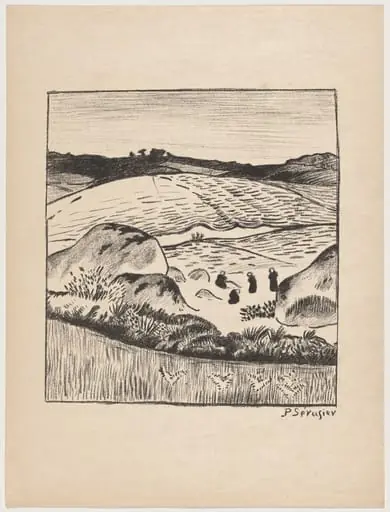
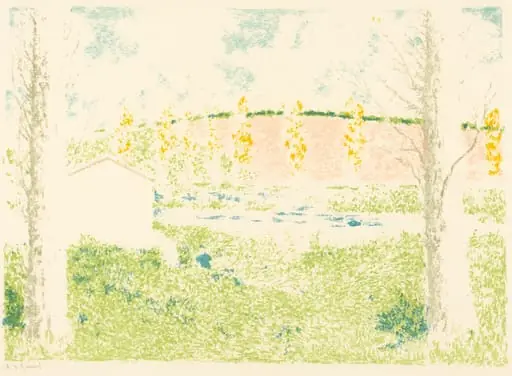
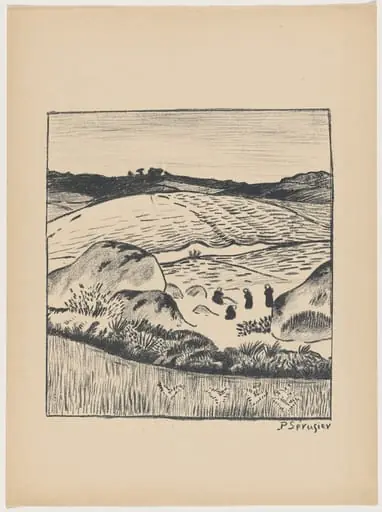
Landscape is a print by the Impressionist artist Paul Sérusier. It dates from 1893 and is held in the collection of the Cleveland Museum of Art.
About this work
Overview
The work emerged from a direct lesson in abstraction, where Gauguin urged him to abandon naturalism in favor of expressive color and simplified form.
Paul Sérusier, then twenty-four, created this small landscape after encountering Paul Gauguin in Pont-Aven, Brittany, in 1888. The work emerged from a direct lesson in abstraction, where Gauguin urged him to abandon naturalism in favor of expressive color and simplified form. Though Sérusier produced few prints, this piece was selected for inclusion in L'estampe originale, a respected 1890s journal dedicated to original graphic work, marking its significance within avant-garde circles.
Subject & Meaning
The scene depicts a rural Breton landscape with rolling hills, a winding fence, and a high horizon line—elements drawn from the local terrain. Yet the subject is secondary to its symbolic function: the painting embodies a departure from observational realism. It signals a spiritual and aesthetic shift, proposing that color and form could convey inner experience rather than external appearance, aligning with the Nabis’ belief in art as a vehicle for metaphysical insight.
Technique & Style
Sérusier employed flat, unmodulated planes of color, rejecting chiaroscuro and perspective. The fields, sky, and fence are rendered as bold, simplified shapes, with unnatural hues that prioritize emotional resonance over accuracy. The composition’s rhythmic lines and elevated horizon echo Gauguin’s Volpini Suite, particularly Breton Women by a Fence. The result is a decorative surface where color relationships, not spatial depth, structure the image.
History & Provenance
Created in late 1888, the work was carried back to Paris by Sérusier, where it became a touchstone for a circle of young artists including Bonnard and Vuillard. These artists, later known as the Nabis, saw the painting as a manifesto of their new direction. It was reproduced in L'estampe originale in 1894, ensuring wider circulation. The Cleveland Museum of Art acquired it in the 20th century, preserving its role as a key artifact of Symbolist printmaking.
Context
In the late 1880s, Parisian artists sought alternatives to Impressionism’s fleeting effects. Gauguin’s synthesis of symbolism, folk art, and non-Western aesthetics offered a new path. Sérusier’s landscape, born in the rural isolation of Brittany, became a conduit for these ideas in urban artistic circles. Its adoption by the Nabis reflected a broader turn toward spiritual abstraction and the elevation of decorative form in fin-de-siècle French art.
Legacy
Though Sérusier’s output was modest, this print endures as a pivotal moment in the transition from Impressionism to modernist abstraction. It helped crystallize the Nabis’ philosophy and influenced later movements that prioritized expressive color and symbolic form over realism. Its inclusion in L'estampe originale cemented its status as a foundational work in the history of original printmaking in France.
Artist & collection
Artist
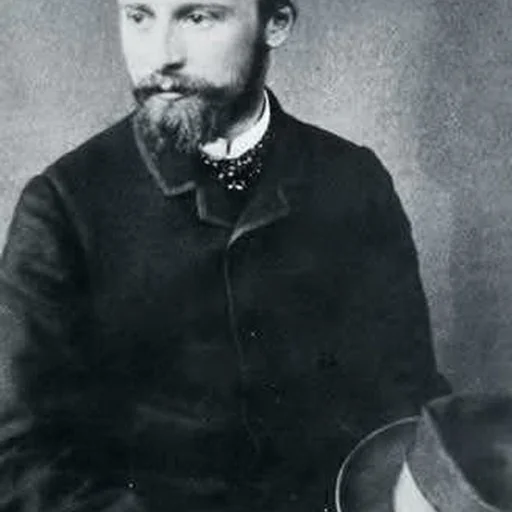
Paul Sérusier was a French painter who was a pioneer of abstract art and an inspiration for the avant-garde Nabis movement, Synthetism and Cloisonnism.