Artwork
The Last Supper
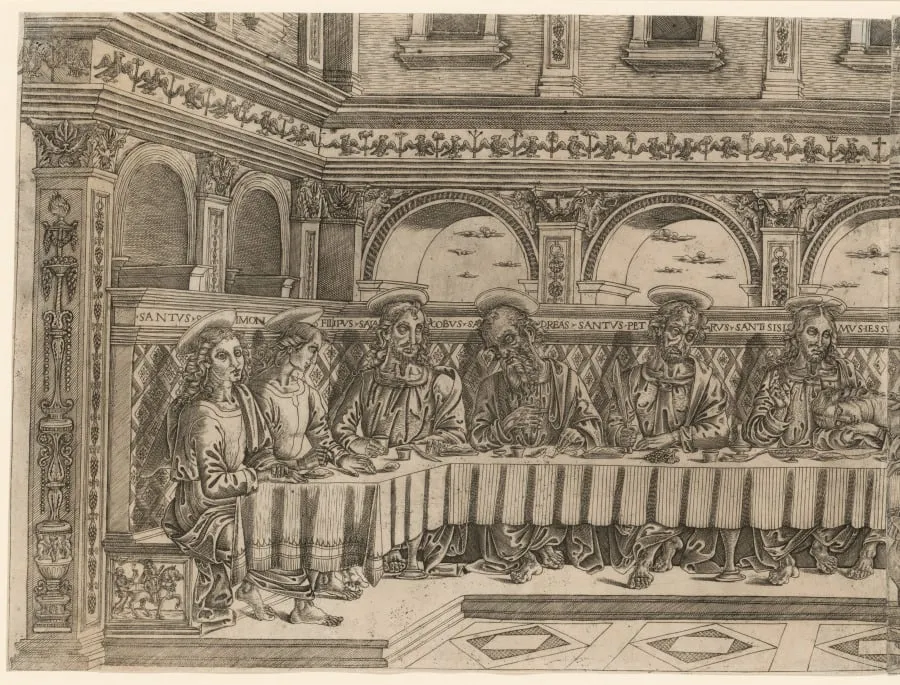
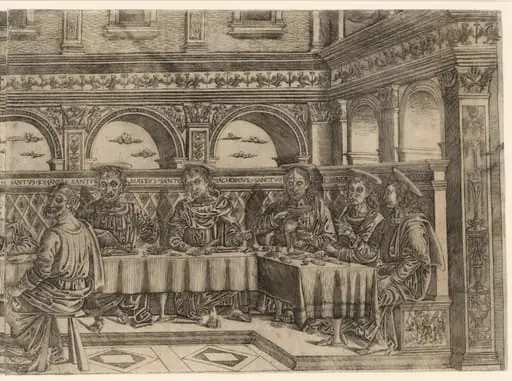
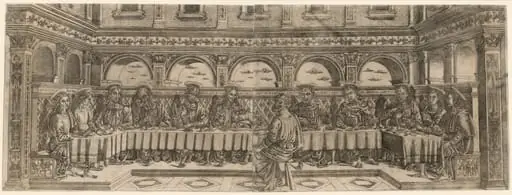
The Last Supper is a print by the Renaissance artist Lucantonio degli Uberti. It dates from 1500 and is held in the collection of the Cleveland Museum of Art.
About this work
Overview
This large-scale print of The Last Supper is a rare survival from the late 15th century, preserved in unusually good condition.
This large-scale print of The Last Supper is a rare survival from the late 15th century, preserved in unusually good condition. Created by engraving two separate plates and printing on two sheets later joined, it was designed for wall display. Its survival contrasts with most contemporary large prints, which were often lost to damage or deterioration. The work reflects the growing circulation of religious imagery through reproductive prints during the Renaissance.
Subject & Meaning
The scene depicts Christ and the twelve apostles gathered at the Last Supper, arranged along a bench behind a table. Judas is isolated, seated on a low stool in the center of the room, turning to face the viewer—an intentional visual cue to his betrayal. Above, architectural elements frame the space, while clouds suggest a divine realm beyond. Two relief panels flanking the bench reference Judas’s arrest and a chivalric emblem, reinforcing the narrative’s moral and historical weight.
Technique & Style
The image was produced using two engraved copper plates, allowing for a larger format than single-sheet prints permitted. Fine linear detail captures architectural ornamentation—eagles, pilasters, putti—and the texture of drapery. The composition mirrors the spatial clarity and balanced symmetry of Perugino’s fresco, adapted into the precise, controlled lines of engraving. The absence of tonal gradation reflects the medium’s reliance on line rather than shading.
History & Provenance
The print is thought to derive from a fresco by Perugino in the convent of San Onofrio, Florence, dated around 1495. Its engraver remains unidentified, though the initials LVC . . . TNO on the left relief panel may indicate authorship or workshop mark. The print’s survival suggests it was valued and carefully stored, possibly in a religious or aristocratic collection. No other known impressions of this exact composition have been documented.
Context
In the late 1400s, religious imagery was increasingly disseminated through prints, making sacred scenes accessible beyond church walls. This work aligns with a trend of translating frescoes into engraved formats for wider audiences. The inclusion of heraldic and narrative reliefs reflects a humanist interest in combining biblical themes with classical and chivalric symbolism, common in Florentine artistic circles of the period.
Legacy
As one of the few large Renaissance prints to survive intact, it offers insight into the technical ambition and devotional purpose of reproductive engraving. While not widely influential in style, its existence demonstrates the demand for monumental religious imagery in domestic or institutional settings. It stands as a testament to the role of print in shaping visual piety before the advent of mass reproduction technologies.
Artist & collection