Artwork
The Last Supper (pair)
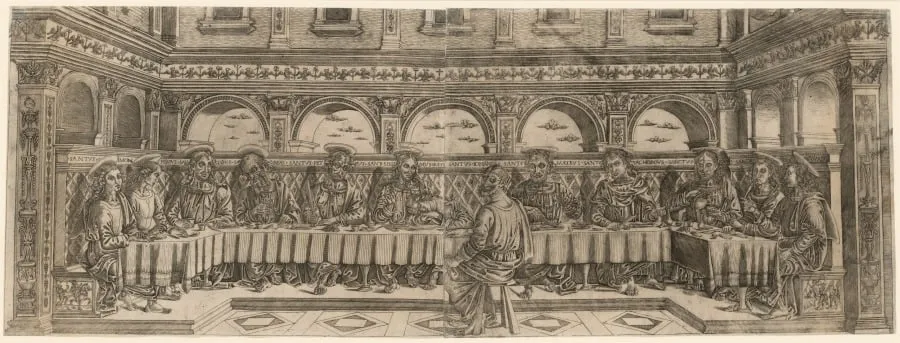
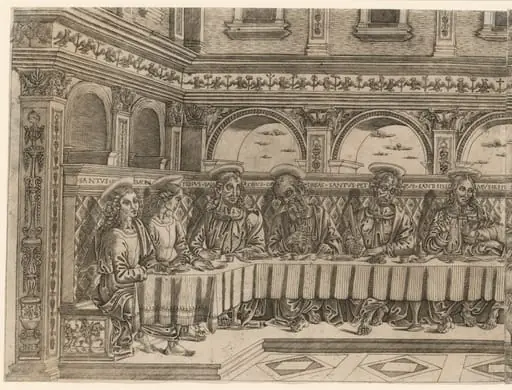
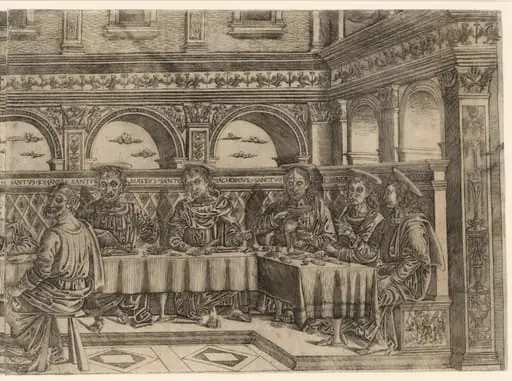
The Last Supper (pair) is a print by the Renaissance artist Lucantonio degli Uberti. It dates from 1500 and is held in the collection of the Cleveland Museum of Art. This large print of The Last Supper survives in unusually good condition, rare for works of its size and era.
About this work
The walls have eagles carved into them, and the scene is split across two sheets of paper.
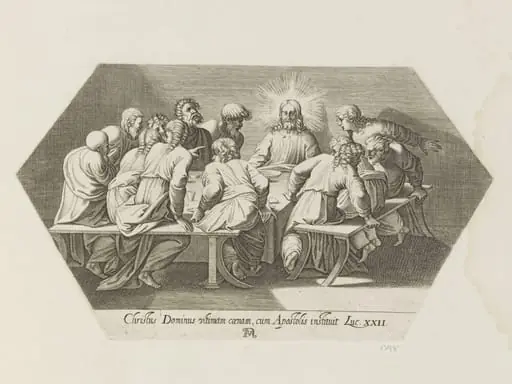
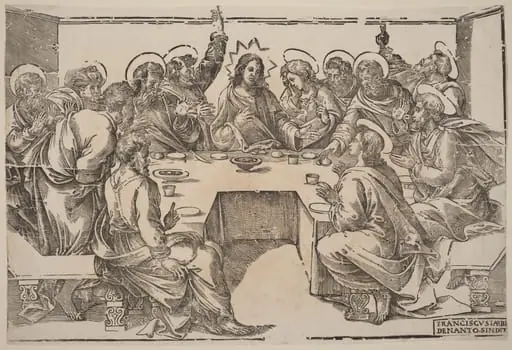
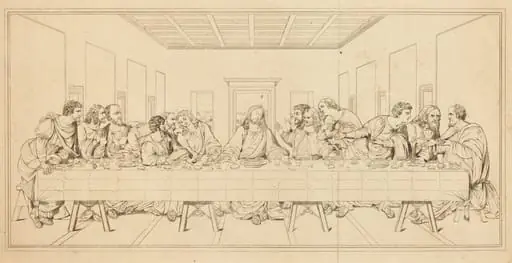
You see Jesus and twelve disciples seated at a long table under an arched room. The walls have eagles carved into them, and the scene is split across two sheets of paper.
This isn’t a painting—it’s a print, made from two engraved metal plates. Most big prints from this time got damaged or lost, but this one survived in great shape. It copies a fresco by Perugino, showing how artists shared ideas across Italy.
To see how prints like this spread art, look up *Italy, 16th century*.
Overview
This large print of The Last Supper survives in unusually good condition, rare for works of its size and era. Created from two engraved copper plates and printed on separate sheets, it was designed for wall display. Its preservation suggests careful handling or limited exposure, contrasting with the typical fate of monumental prints from the late 15th century, which often deteriorated due to light, moisture, or physical wear.
Subject & Meaning
The scene depicts Christ and the twelve apostles seated along a bench behind a table, arranged within a vaulted interior. Judas is isolated on a central stool, turning to face the viewer—a visual cue to his betrayal. Above, arched openings reveal clouds, suggesting a celestial realm. Two relief panels flanking the bench illustrate episodes from Judas’s story and a chivalric figure, possibly symbolizing divine justice or earthly power contrasted with spiritual betrayal.
Technique & Style
The print was produced using two engraved metal plates, a complex method requiring precise alignment. The architectural setting features decorative pilasters, eagles, and putti, rendered with fine linear detail typical of Northern Italian engraving. The inclusion of relief scenes within the composition reflects a hybrid approach, merging architectural framing with narrative vignettes, suggesting the engraver’s familiarity with both fresco and medallic traditions.
History & Provenance
The composition closely follows a lost fresco by Perugino in the convent of San Onofrio, Florence, dated around 1495. The engraver’s signature, partially legible as LVC . . . TNO, appears on the left relief panel, likely indicating the artist’s identity. The print’s survival implies it was owned by a collector or institution that valued its preservation, possibly within a religious or scholarly context in early 16th-century Italy.
Context
This print reflects the circulation of artistic ideas across Italian centers in the late Quattrocento. By translating Perugino’s fresco into a reproducible medium, the engraver enabled wider access to religious imagery beyond the confines of monastic walls. Such prints facilitated the dissemination of compositional models, linking Florentine painting traditions with the growing print culture of Northern Italy and beyond.
Legacy
As one of the few large-scale prints from this period to survive intact, it offers insight into how religious narratives were reproduced and consumed outside of painting. Its detailed architecture and narrative reliefs demonstrate the technical ambition of early printmakers. The work remains a key example of how engraving served as a bridge between monumental fresco cycles and the emerging market for portable religious imagery.
Artist & collection