Artwork
Suicide of Lucretia
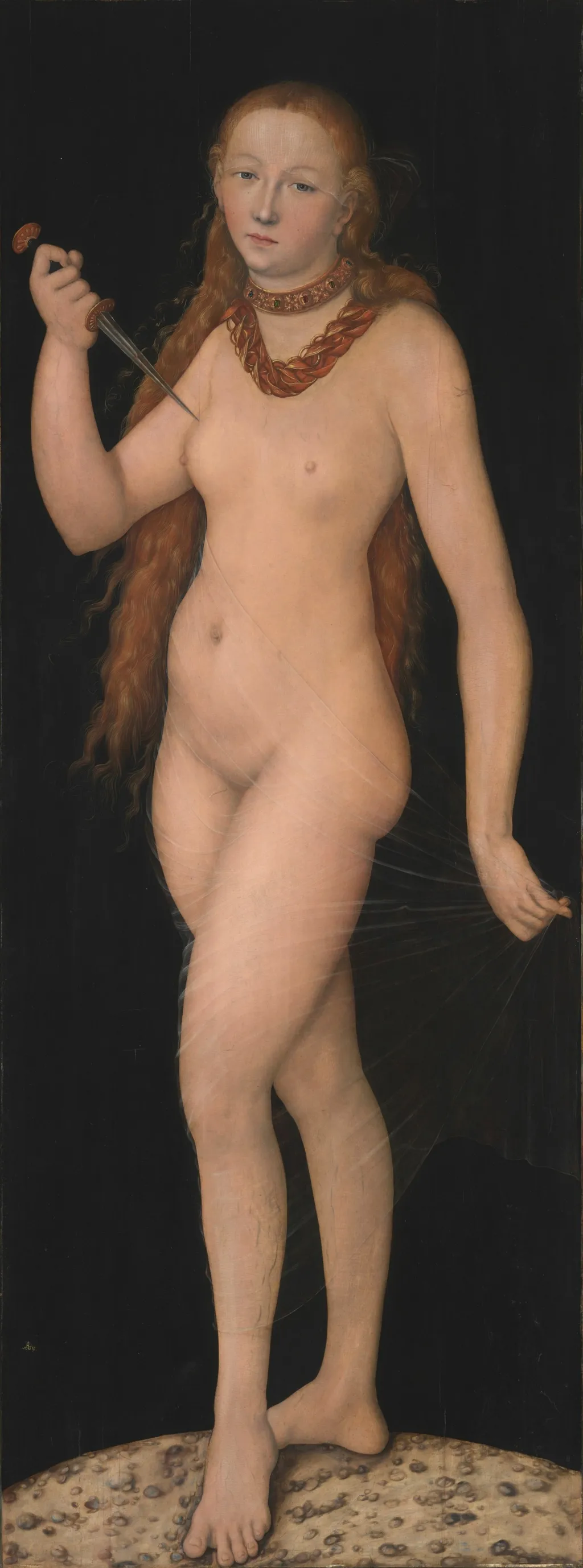
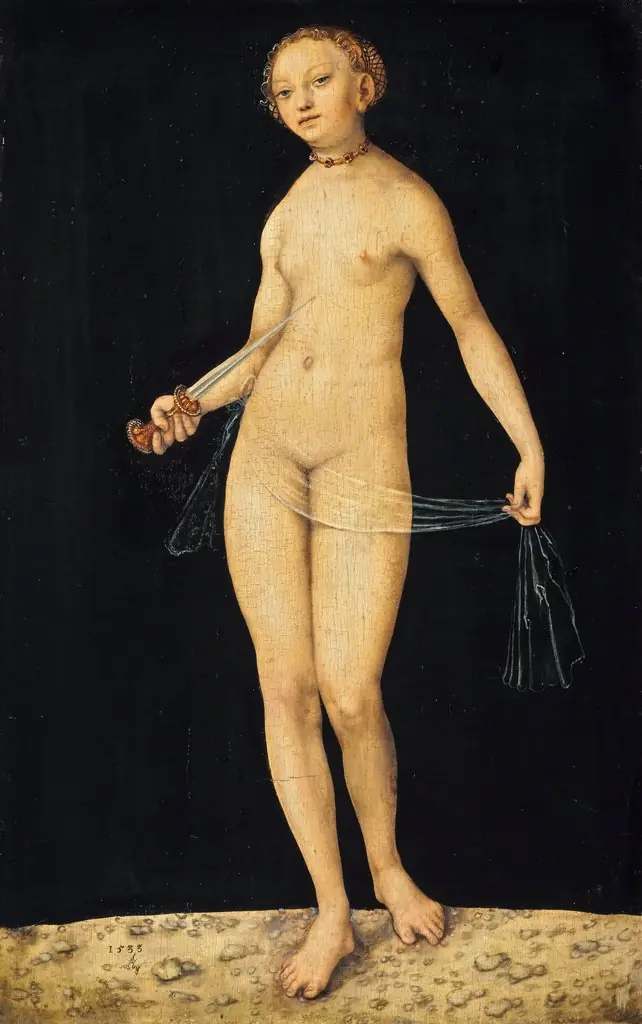
Suicide of Lucretia is an oil painting by the Northern Renaissance artist Lucas Cranach the Elder. It dates from 1530 and is held in the collection of the Alte Pinakothek.
About this work
Overview
Lucretia stands with one foot resting on a textured stone slab, her body angled slightly to the side to reveal the tension in her pose.
Lucas Cranach the Elder's 'Suicide of Lucretia' (1530) depicts the Roman noblewoman Lucretia at the moment of her self-inflicted death, a subject the artist revisited frequently throughout his career. The composition isolates the figure against a stark black background, a technique that heightens the dramatic focus on her pale skin and the gleaming gold of her jewelry. Lucretia stands with one foot resting on a textured stone slab, her body angled slightly to the side to reveal the tension in her pose. She holds a dagger in her right hand, poised to strike, while her left hand grips a small round object, possibly a mirror or a piece of jewelry, symbolizing her virtue or the vanity associated with her tragic fate. Her long, flowing red hair cascades over her shoulder, contrasting with the heavy gold necklace adorning her neck. Painted in oil, the work exemplifies Cranach's mature style, characterized by elongated proportions, smooth modeling, and a refined, almost courtly elegance even in scenes of violence. Created during the height of the Reformation, this painting reflects the artist's continued engagement with classical and moralizing themes, blending humanist interest in antiquity with the expressive intensity typical of German Renaissance art.
Subject & Meaning
The central figure represents Lucretia, a Roman noblewoman whose legendary self‑inflicted death after a sexual assault became a moral exemplar of virtue and honor in Renaissance thought. The knife in her right hand and the small round object she clutches allude to the act of suicide that concludes her story.
Technique & Style
Cranach employs a restrained palette, contrasting the luminous flesh and gold necklace against a flat black background that isolates the subject. The artist’s characteristic linear precision renders the folds of the garment and the texture of the stone slab, while the vivid red hair adds a striking accent.
History & Provenance
Executed in 1530, the painting has remained in German collections, eventually entering the Alte Pinakothek’s holdings. Its provenance reflects the museum’s focus on Northern Renaissance masters, where it is displayed among other works by Cranach and his contemporaries.
Context
Cranach’s treatment of Lucretia aligns with the early 16th‑century German interest in classical moral narratives, often used to comment on contemporary notions of chastity and civic virtue. The work’s stark composition underscores the didactic purpose typical of history paintings of the period.
Own this work as a print
Artist & collection
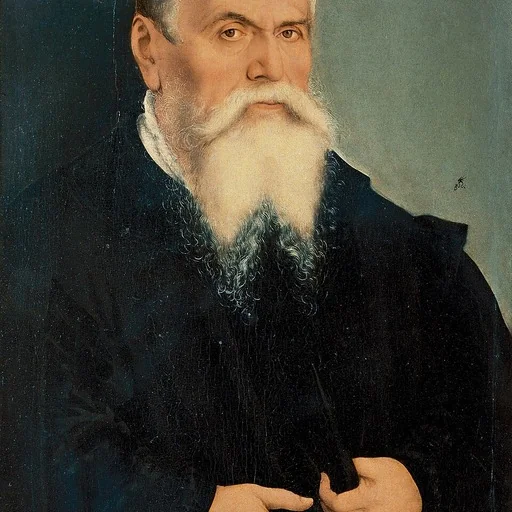
Artist
Lucas Cranach the Elder was a German Renaissance painter and printmaker in woodcut and engraving.