Artwork
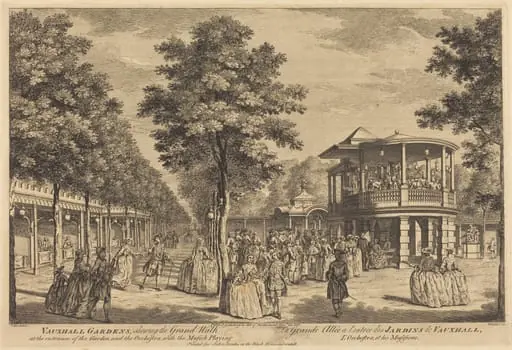
Vauxhall Gardens shewing the Grand Walk at the Entrance of the Garden and the Orchestra with Musick Playing
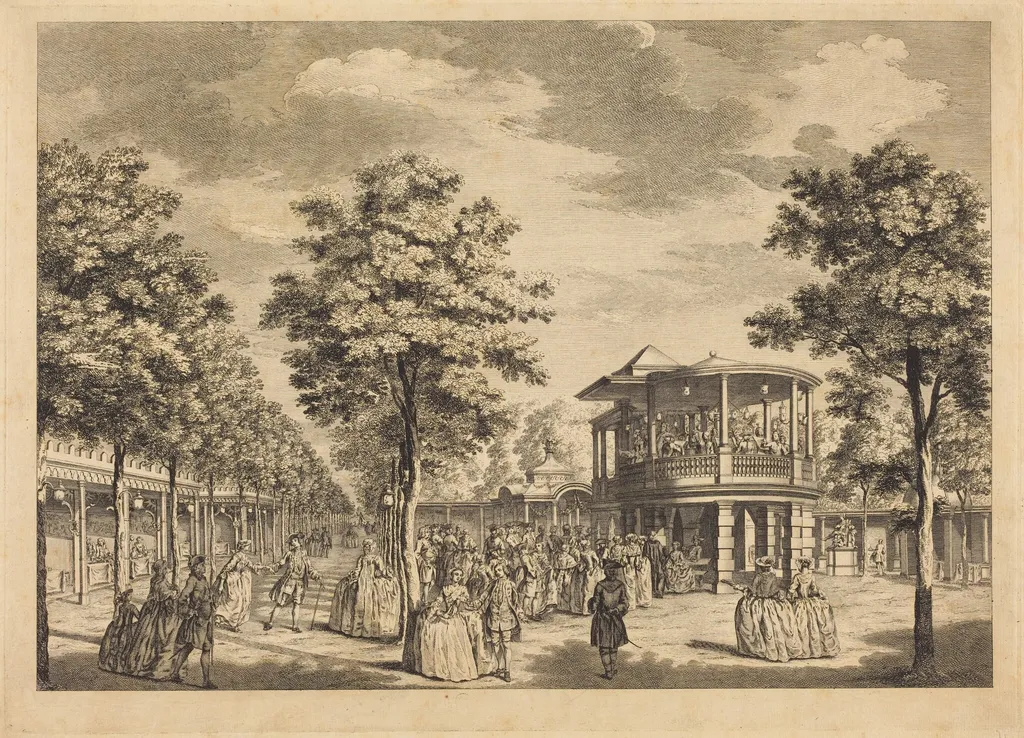
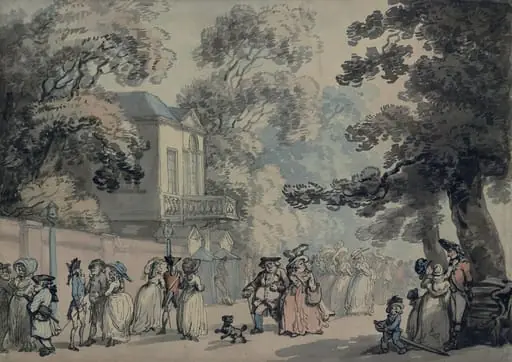
Vauxhall Gardens shewing the Grand Walk at the Entrance of the Garden and the Orchestra with Musick Playing is an ink print by the Romanticist artist Johann Sebastian Müller. It dates from 1751 and is held in the collection of the National Gallery of Art.
About this work
Overview
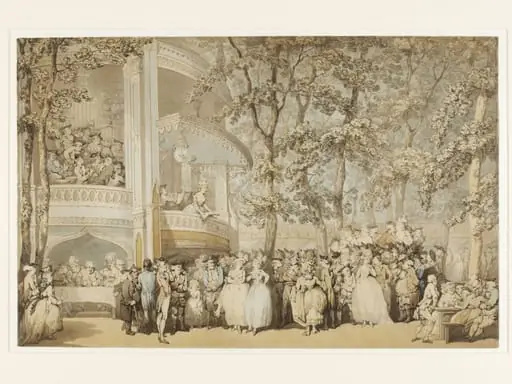
This 1751 print by Johann Sebastian Müller captures a moment at Vauxhall Gardens, a popular London pleasure garden. Rendered in etching and engraving on laid paper, it depicts the Grand Walk, a central promenade lined with trees, leading toward a circular orchestra pavilion. The scene conveys a structured yet animated public space, where leisure and social interaction unfold under open air.
Subject & Meaning
The composition centers on a procession of figures strolling along the Grand Walk, while musicians perform from an elevated gazebo.
The composition centers on a procession of figures strolling along the Grand Walk, while musicians perform from an elevated gazebo. The gathering suggests a cultivated form of public entertainment, blending music, architecture, and social display. It reflects 18th-century urban leisure culture, where such gardens served as democratic venues for mingling across classes, under the shared experience of live performance.
Technique & Style
Müller employed fine linear etching and engraving to define architectural details and the textures of foliage and clothing. The composition is orderly, with receding lines guiding the eye toward the orchestra pavilion. Delicate hatching suggests depth and shadow, while the absence of color emphasizes the precision of draftsmanship typical of topographical prints of the period.
History & Provenance
Created in 1751, the print was likely produced as a commercial souvenir or illustration for a guidebook, documenting one of London’s most frequented entertainment venues. Vauxhall Gardens had been open since the late 17th century and remained a cultural landmark through the 18th century. Müller’s work belongs to a tradition of topographical prints that recorded urban spaces for a growing middle-class audience.
Context
Vauxhall Gardens operated as a hybrid of park, concert hall, and social theater, attracting visitors seeking refined amusement. Its design—tree-lined avenues, illuminated walkways, and musical performances—reflected Enlightenment ideals of public sociability. Müller’s print aligns with contemporary efforts to visually document and disseminate the aesthetics of urban leisure in an era of expanding civic culture.
Legacy
Though Müller is not widely known today, his print contributes to a visual archive of 18th-century British public life. It preserves the layout and atmosphere of Vauxhall Gardens before its decline in the 19th century. As a record of everyday social ritual, it remains a valuable resource for understanding the material and cultural landscape of Georgian London.
Artist & collection