Artwork
Untitled
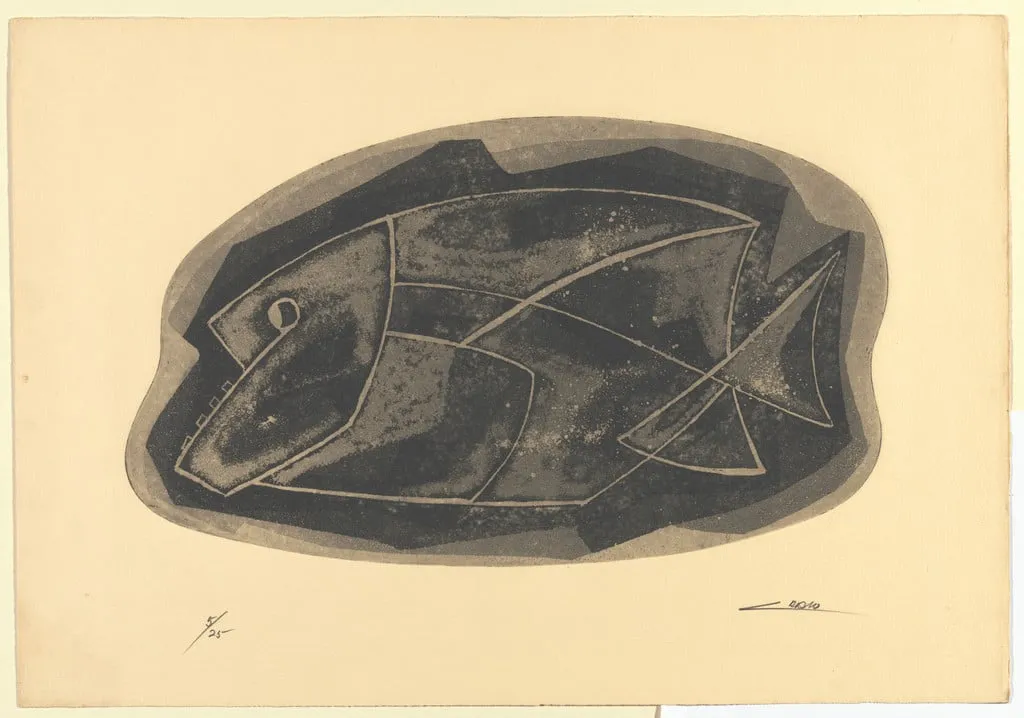
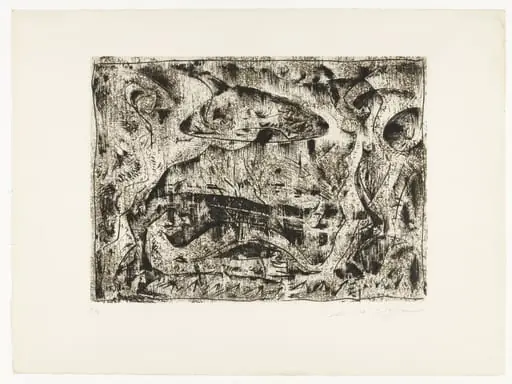
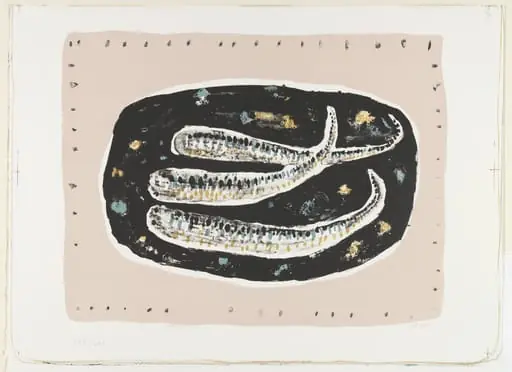
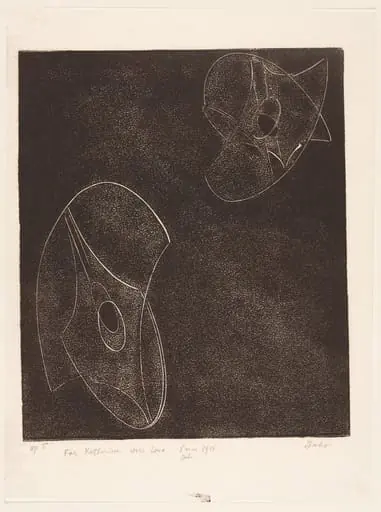
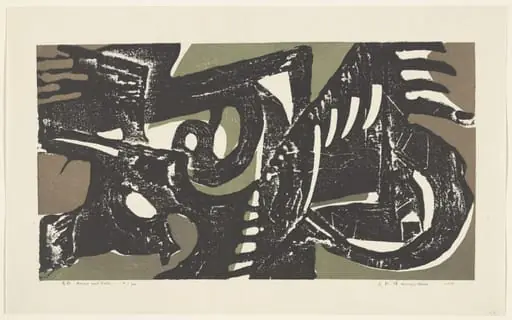
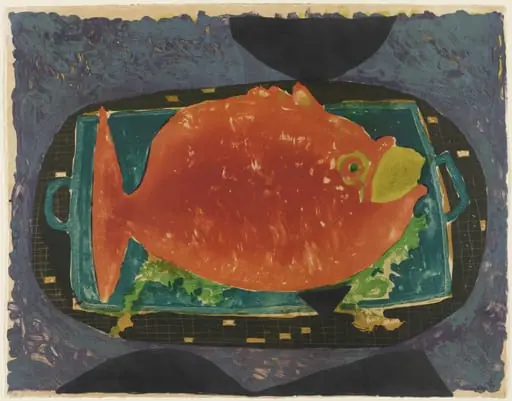
Untitled is an ink print by Mário Cravo Júnior. It dates from 1952 and is held in the collection of the Museum of Modern Art.
About this work
Overview
Its minimalist composition and textured surface reflect Cravo Júnior’s interest in translating organic subjects into geometric, tactile compositions.
Created in 1952, this aquatint by Mário Cravo Júnior is a black-and-white print held in the collection of The Museum of Modern Art. The work belongs to a series of prints from the early 1950s in which the artist explored abstracted natural forms through printmaking. Its minimalist composition and textured surface reflect Cravo Júnior’s interest in translating organic subjects into geometric, tactile compositions.
Subject & Meaning
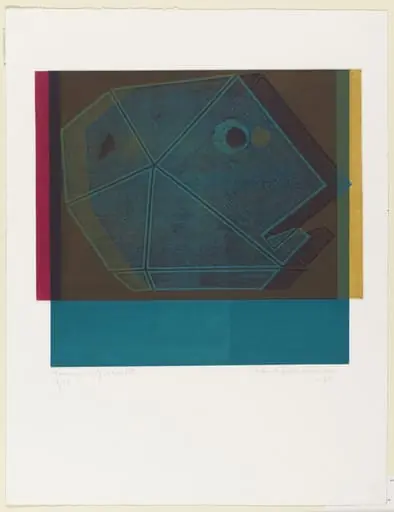
The subject is a stylized fish, rendered not as a literal representation but as an assembly of sharp, angular lines resembling fractured surfaces. The form suggests movement and tension, evoking both vitality and vulnerability. Rather than depicting biological accuracy, the artist uses the fish as a symbolic vessel to convey fragility and resilience, qualities often associated with life in coastal Brazilian communities.
Technique & Style
Aquatint was employed to achieve a granular, tonal depth in the print, allowing subtle gradations between solid black and hazy gray. The fish’s body is constructed from jagged, intersecting lines that contrast with the soft, atmospheric background. This interplay between harsh contours and delicate texture creates a visual paradox: the form appears both sharply defined and delicately eroded, enhancing its emotional resonance.
History & Provenance
The print was made during a period of intense experimentation in Brazilian printmaking, when artists sought to develop a visual language distinct from European traditions. Acquired by The Museum of Modern Art in the mid-20th century, it became part of a broader effort to document Latin American modernist practices. Its inclusion in the museum’s collection reflects its significance within postwar Latin American art.
Context
Cravo Júnior worked in Bahia during a time of cultural reawakening in Brazil, where artists drew inspiration from Afro-Brazilian traditions and coastal life. This print aligns with a regional movement that fused folk motifs with modernist abstraction. The fish, a common symbol in Bahian culture, is reimagined through a formalist lens, bridging local identity with international artistic trends of the era.
Legacy
This work exemplifies Cravo Júnior’s contribution to the evolution of Brazilian printmaking, influencing later generations who embraced abstraction rooted in cultural specificity. Its inclusion in major collections helped elevate the status of Latin American prints within global modernist discourse. The piece remains a quiet but persistent reference point in discussions of texture, symbolism, and regional modernism.
Artist & collection
Artist
Mário Cravo Júnior was a Brazilian sculptor, designer, and painter. He was part of the first generation of plastic artists in the city of Salvador, along with artists such as Carybé and Genaro de Carvalho. He worked as…