Artwork
The King's Sons Shooting at their Dead Father's Body
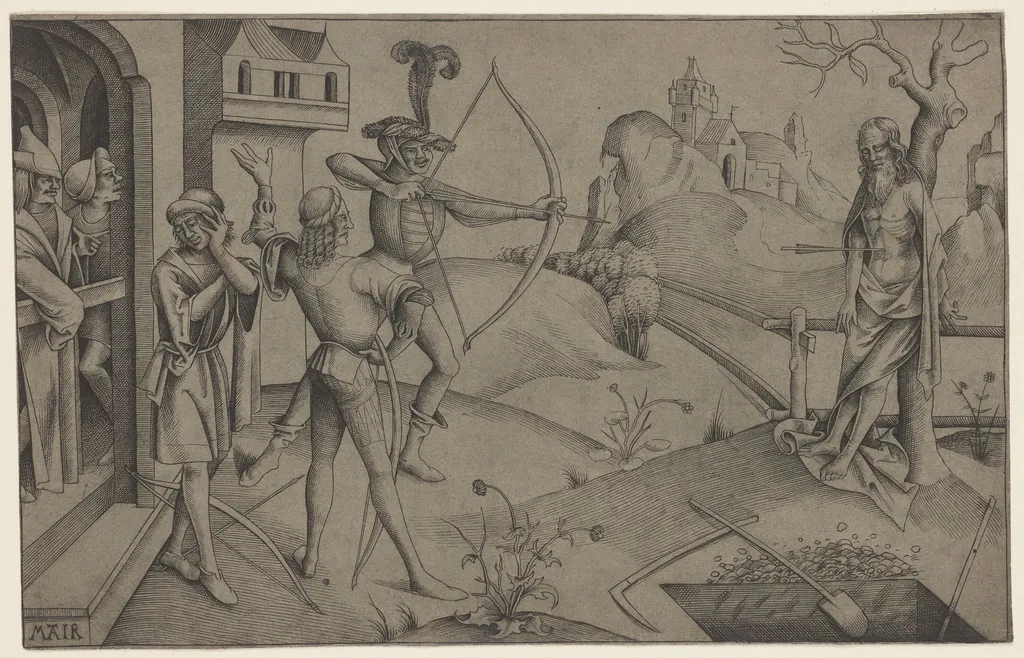
The King's Sons Shooting at their Dead Father's Body is a print by the Renaissance artist Mair von Landshut. It dates from 1500 and is held in the collection of the Cleveland Museum of Art.
About this work
Overview
Created in 1500 by Mair von Landshut, a Bavarian engraver active from the late 1480s through the early 1500s, this black‑and‑white print depicts a stark courtyard scene in which three unclothed figures observe a fourth man firing arrows at a corpse lying on the ground.
Subject & Meaning
The composition presents a ritualized act rather than random violence: the dead figure is positioned deliberately, while the archers display composed, almost ceremonial demeanors, suggesting an allegorical or moral narrative rather than a literal battle.
Technique & Style
Executed with fine incised lines and strong chiaroscuro contrasts, the print employs deep shadows to model forms and heighten drama, a characteristic of German printmaking at the turn of the sixteenth century.
History & Provenance
Mair, who worked in Freising, Munich and his native Landshut, signed most of his limited output—22 engravings and three woodcuts—with the monogram MAIR. This work belongs to that small, documented corpus and reflects his activity at the close of the fifteenth century.
Context
The image aligns with the narrative‑driven tradition of early German prints, which often illustrated moral tales, historical episodes, or biblical stories for a literate audience familiar with symbolic visual language.
Artist & collection

Artist
Mair von Landshut (active c. 1485–1504 or later) was a German engraver, painter, and designer of woodcuts, who worked in Bavaria. He probably came from Freising near Munich, and worked in both towns, as well as…

 Knight and the Servant
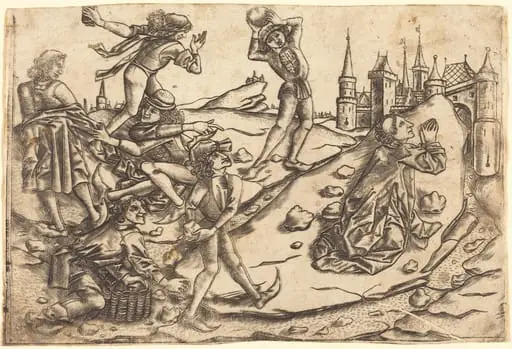 The Stoning of Saint Stephen
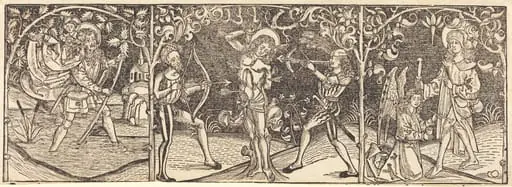 Saints Christopher, Sebastian, and Roche
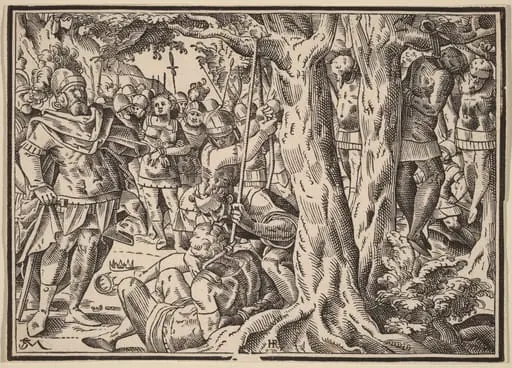 Christ Tells His Disciples of the Last Judgment
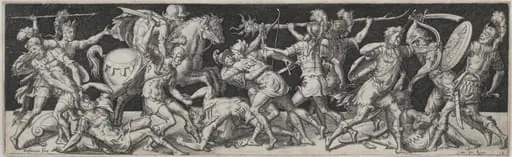 Combats and Triumphs No. 10
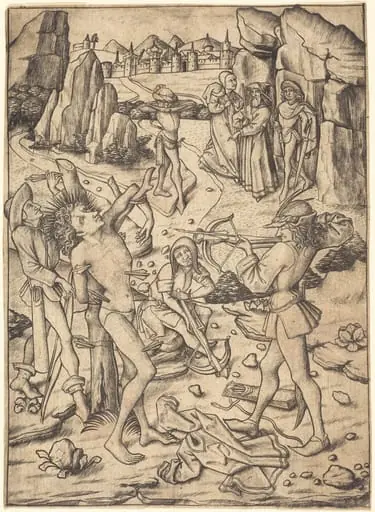 Martyrdom of Saint Sebastian
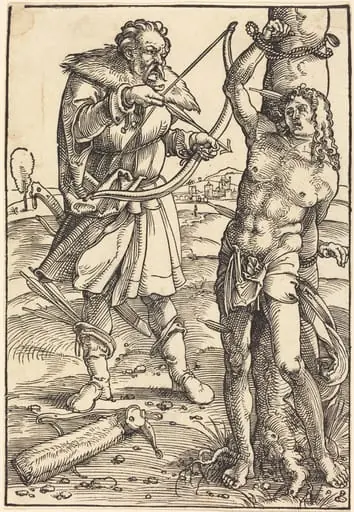 The Martyrdom of Saint Sebastian
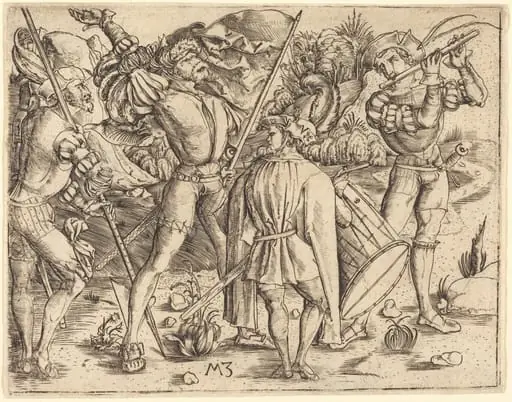 Four Soldiers
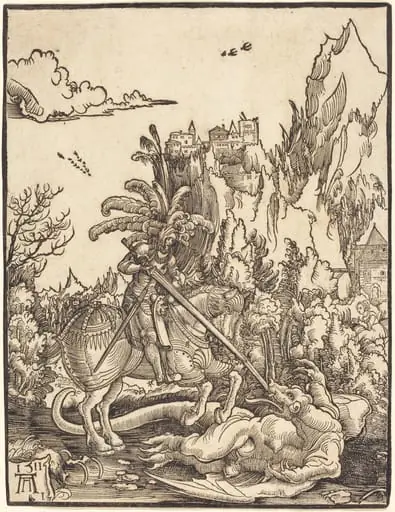 Saint George Slaying the Dragon
 Christ Tells His Disciples of the Last Judgment
 Marter des Hl. Sebastian
 The Testing of the King's Sons