Artwork
Polichinelle
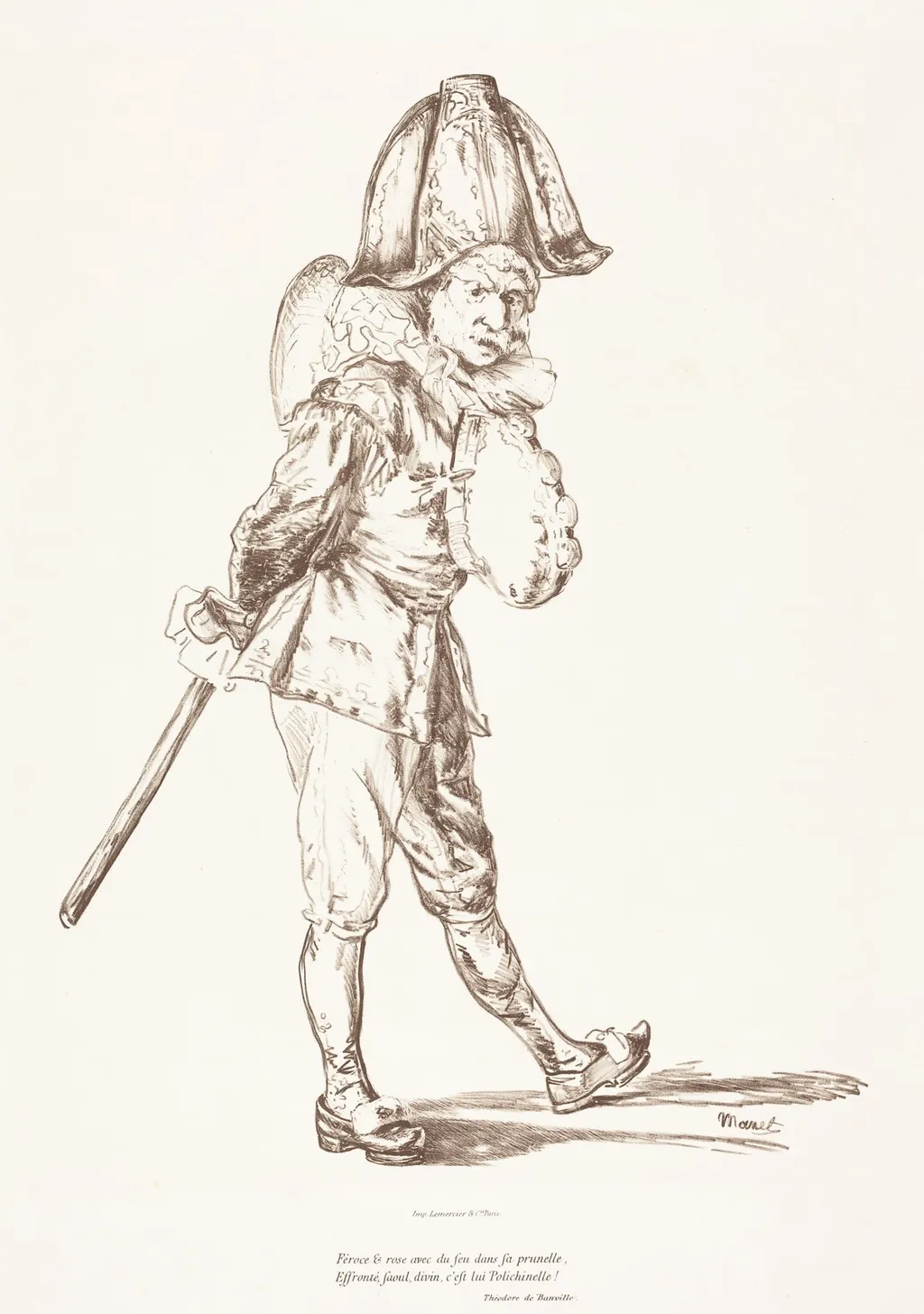
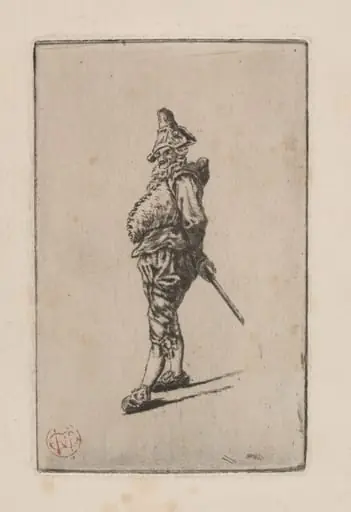
Polichinelle is an ink print by the Impressionist artist Edouard Manet. It dates from 1874 and is held in the collection of the National Gallery of Art.
About this work
Overview
It captures a solitary figure in exaggerated 18th-century attire, rendered with loose, rapid strokes that suggest movement and spontaneity.
Created in 1874, Polichinelle is a lithograph by Édouard Manet, executed in brown-black ink on white wove paper. It captures a solitary figure in exaggerated 18th-century attire, rendered with loose, rapid strokes that suggest movement and spontaneity. The work belongs to a series of prints Manet produced during a period of experimental engagement with printmaking, reflecting his interest in popular theater and caricature.
Subject & Meaning
The figure is identified as Polichinelle, a stock character from Italian commedia dell'arte known for his mischievous, clownish nature. Dressed in a tilted hat, oversized coat, and loose scarf, he stands with one hand on his hip, exuding a theatrical nonchalance. Manet’s portrayal subtly satirizes aristocratic fashion, transforming the figure into a witty critique of pretension through exaggerated costume and posture.
Technique & Style
Manet employed lithography to achieve a sketch-like immediacy, using only shades of brown and black to define form. The lines are fluid and uneven, suggesting gesture over precision. The absence of tone or shading emphasizes contour and rhythm, aligning the work with drawn studies rather than polished prints. This approach reflects his broader interest in capturing transient expressions and informal moments.
History & Provenance
This print is a proof pulled from the original stone, likely made for Manet’s personal review before any edition. It was not widely distributed during his lifetime and remained within private collections until later 20th-century institutional acquisitions. Its status as a proof underscores its role as an experimental step in Manet’s printmaking process rather than a commercial product.
Context
In the mid-1870s, Manet turned increasingly to printmaking as a means to explore themes outside his large-scale paintings. Polichinelle reflects his fascination with popular culture, particularly theatrical archetypes that challenged social norms. The figure’s costume, outdated even in 1874, positions him as a relic—inviting viewers to consider the persistence of performance in everyday life.
Legacy
Polichinelle exemplifies Manet’s quiet but persistent engagement with graphic arts, influencing later artists who valued the expressive potential of lithography. Though less known than his paintings, this work reveals his ability to distill character and satire into minimal lines. It remains a significant example of how 19th-century painters used print media to extend their visual language beyond canvas.
Artist & collection

Artist
Édouard Manet didn’t have much time to make his mark—he died at 51—but he used every year.