Artwork
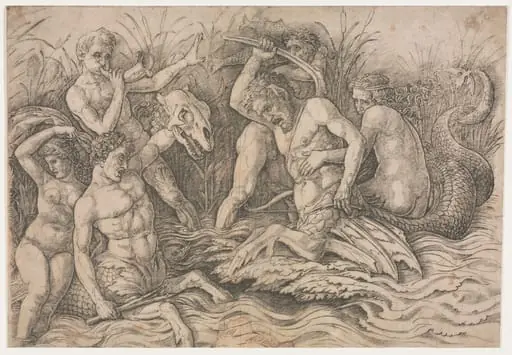
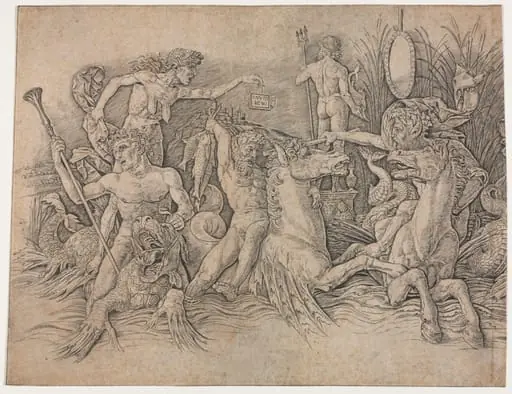
Battle of the Sea Gods [left half]
![Battle of the Sea Gods [left half], by Andrea Mantegna, ink, 1481](https://artifactworldgallery.com/img/andrea-mantegna--battle-of-the-sea-gods-left-half--2510247af42f8c24-w1024.webp)
Battle of the Sea Gods [left half] is an ink print by the Renaissance artist Andrea Mantegna. It dates from 1481 and is held in the collection of the National Gallery of Art.
About this work
If you like this chaotic style, look up engraving to see how artists carved these lines into metal.
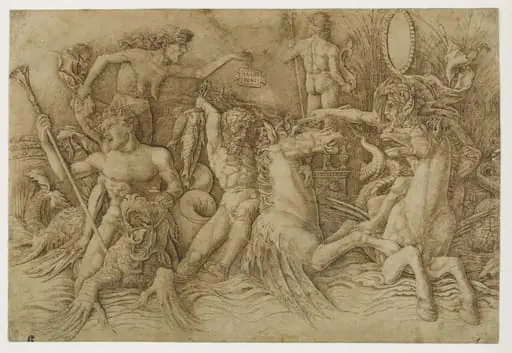
This engraving shows a wild underwater fight. Half the scene is missing, but you can still see tangled bodies, fish, and seaweed. Some figures are twisting in pain, others are grabbing weapons or each other.
Notice the tiny text on a broken column—it reads "INVID 2C 1481." That might be a date or clue, but it’s hard to read.
If you like this chaotic style, look up engraving to see how artists carved these lines into metal.
Overview
This engraving, dated 1481 and attributed to Andrea Mantegna, is one half of a larger composition depicting a mythological sea battle. Executed on laid paper, it reflects the artist’s mastery of engraving as a medium for complex narrative scenes. The fragmented state of the work suggests it was once part of a paired image, with only the left section surviving. Its intricate linework and dense composition reveal Mantegna’s interest in translating sculptural forms into printed imagery.
Subject & Meaning
The scene portrays a chaotic naval conflict among sea deities, drawing from classical mythology. Twisting figures, aquatic creatures, and tangled seaweed suggest violent struggle, possibly representing divine rivalry or the untamed forces of the ocean. The inclusion of inscribed text on a fragmentary column—'INVID 2C 1481'—may reference the year or a symbolic phrase, though its full meaning remains uncertain. The imagery aligns with Renaissance humanist interests in reviving ancient myths through visual storytelling.
Technique & Style
Mantegna employed fine, controlled engraving lines to model muscular forms and textured surfaces, creating a sense of volume and movement. The composition is densely packed, with overlapping bodies and organic elements that guide the eye through the turmoil. His use of low horizons and exaggerated poses enhances the monumentality of the figures, echoing his painting style. The precision of the lines reveals a deep understanding of metal engraving, a technique he helped elevate in northern Italy.
History & Provenance
Created in Venice around 1481, the engraving emerged during a period when Mantegna’s workshop was instrumental in advancing printmaking as a vehicle for artistic dissemination. The work likely circulated among collectors and artists, influencing the spread of classical themes. Its survival in partial form suggests it may have been separated from its counterpart over time, though no definitive record of its original pairing exists in contemporary sources.
Context
In late 15th-century Italy, artists increasingly turned to classical antiquity for subject matter, blending archaeological study with imaginative reconstruction. Mantegna, influenced by his exposure to Roman ruins and antiquities, translated this scholarly interest into dynamic compositions. Engraving allowed his designs to reach wider audiences beyond painted altarpieces, contributing to a broader cultural revival of mythological themes in visual art.
Legacy
Mantegna’s engraving helped establish printmaking as a serious artistic medium in Renaissance Italy, moving beyond mere reproduction to convey complex narratives. His technical rigor and mythological focus influenced later engravers and the development of the Northern Renaissance print tradition. Though only half survives, the work remains a key example of how classical themes were reimagined through the precision of the burin.
Artist & collection
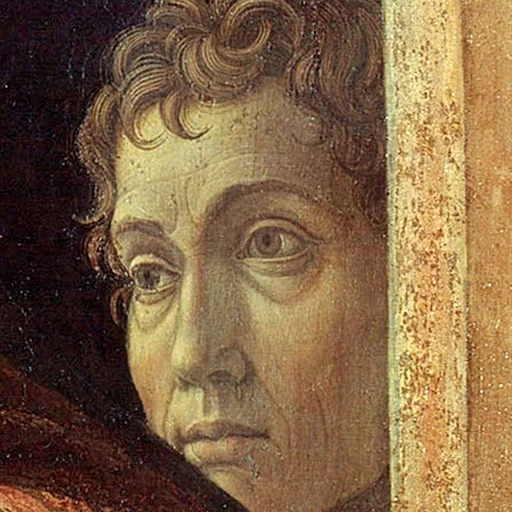
Artist
Andrea Mantegna (UK: , US: ; Italian: ; c. 1431 – September 13, 1506) was an Italian Renaissance painter, a student of Roman archaeology, and the son-in-law of Jacopo Bellini. Like other artists of the time, Mantegna…

![Battle of the Sea Gods [left half], by Andrea Mantegna](https://artifactworldgallery.com/img/andrea-mantegna--battle-of-the-sea-gods-left-half--084dd803fb0016b2-w320.webp)
![Battle of the Sea Gods [right half], by Andrea Mantegna](https://artifactworldgallery.com/img/andrea-mantegna--battle-of-the-sea-gods-right-half--7515c85934d3d1e9-w320.webp)