Artwork
The battle of the sea gods
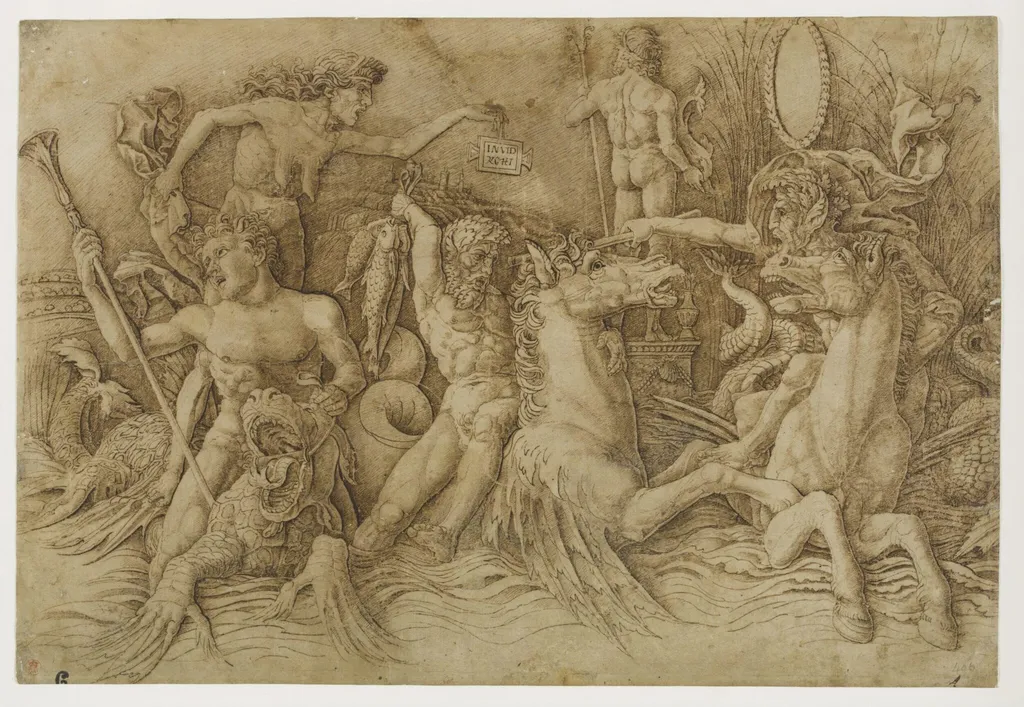
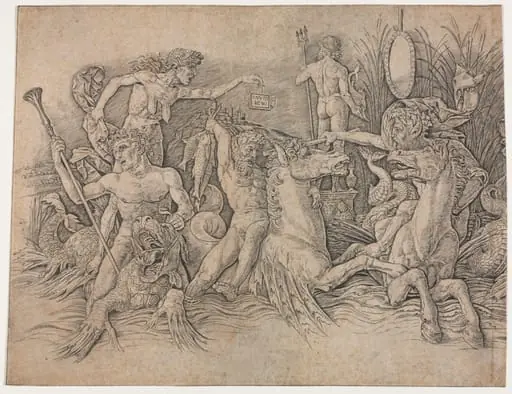
The battle of the sea gods is a drawing by the Renaissance artist Andrea Mantegna. It dates from 1475 and is held in the collection of the Victoria and Albert Museum.
About this work
Overview
This drawing is a precise replica of the left half of Andrea Mantegna’s lost frieze, The Battle of the Sea Gods. Executed in ink, it mirrors the original’s dynamic composition with remarkable fidelity. Though once attributed to Mantegna himself, scholars now believe it was made by a skilled assistant within his workshop, likely as a study or record of the larger work.
Subject & Meaning
The scene depicts a chaotic clash among mythological sea deities—Tritons, Nereids, and other aquatic figures—entangled in violent motion amid crashing waves. The subject draws from classical mythology, evoking the untamed forces of the ocean. Unlike narrative-driven works, the focus lies in the physicality of struggle, emphasizing movement and muscular tension over story.
Technique & Style
The drawing employs fine, controlled linework characteristic of Mantegna’s draftsmanship, with sharp contours and dense hatching to model muscular forms.
The drawing employs fine, controlled linework characteristic of Mantegna’s draftsmanship, with sharp contours and dense hatching to model muscular forms. The figures are rendered with anatomical precision, their limbs twisting in complex, interwoven poses. The technique suggests direct observation of the original frieze, executed with the same meticulous attention to detail found in Mantegna’s engravings.
History & Provenance
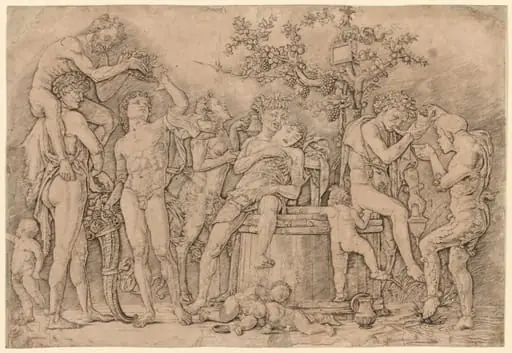
Created shortly after Mantegna’s Bacchanalian prints, the drawing likely served as a preparatory or archival copy of a larger, now-lost composition. Its close resemblance to the original suggests it was made in the artist’s studio, possibly by a trusted assistant. No record of the full frieze survives, making this fragment a crucial witness to Mantegna’s unfinished project.
Context
The work responds to contemporary rivalries in Renaissance printmaking, particularly Antonio del Pollaiuolo’s Battle of the Nude Men, which emphasized heroic anatomy in motion. Mantegna’s version shifts the theme to mythological waterscapes, extending his interest in classical themes and complex figural arrangements. It reflects a broader trend of artists using print to explore and disseminate dynamic compositions.
Legacy
Though the original frieze is lost, this drawing preserves key elements of Mantegna’s vision, offering insight into his approach to large-scale narrative composition. It stands as evidence of workshop practices in 15th-century Italy, where assistants played vital roles in documenting and reproducing a master’s designs. The work remains a valuable reference for understanding the transmission of form in Renaissance art.
Artist & collection
Artist
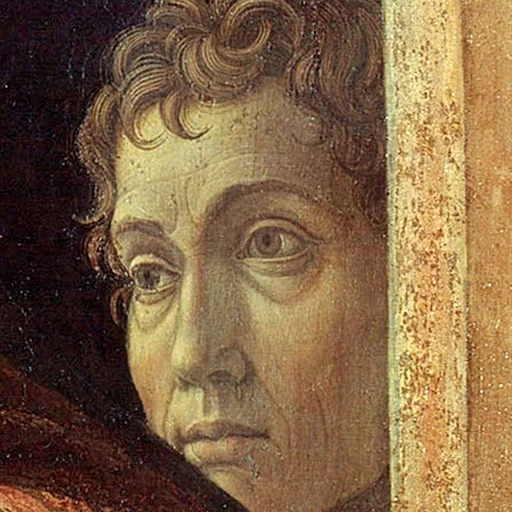
Andrea Mantegna (UK: , US: ; Italian: ; c. 1431 – September 13, 1506) was an Italian Renaissance painter, a student of Roman archaeology, and the son-in-law of Jacopo Bellini. Like other artists of the time, Mantegna…

 Battle of the Sea Gods - left portion
![Battle of the Sea Gods [left half], by Andrea Mantegna](https://artifactworldgallery.com/img/andrea-mantegna--battle-of-the-sea-gods-left-half--084dd803fb0016b2-w320.webp) Battle of the Sea Gods [left half]
Battle of the Sea Gods [left half]![Battle of the Sea Gods [left half], by Andrea Mantegna](https://artifactworldgallery.com/img/andrea-mantegna--battle-of-the-sea-gods-left-half--2510247af42f8c24-w320.webp) Battle of the Sea Gods [left half]
Battle of the Sea Gods [left half]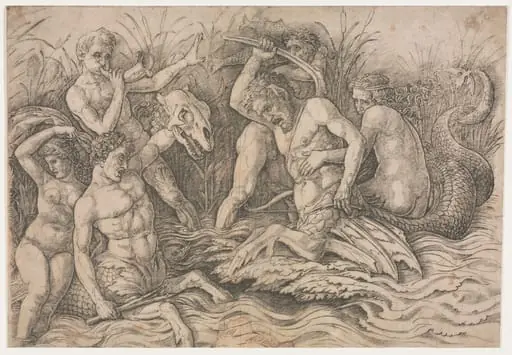 Battle of the Sea Gods - right portion
![Battle of the Sea Gods [right half], by Andrea Mantegna](https://artifactworldgallery.com/img/andrea-mantegna--battle-of-the-sea-gods-right-half--7515c85934d3d1e9-w320.webp) Battle of the Sea Gods [right half]
Battle of the Sea Gods [right half]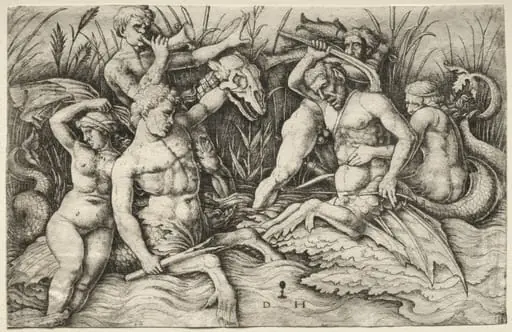 Two Tritons fighting - Battle of the Sea Gods (right portion)
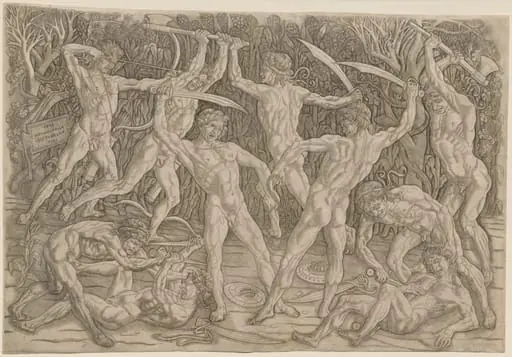 Battle of the Nudes
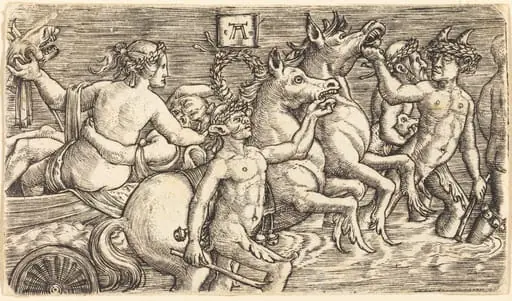 Triumph of the Sea-Gods
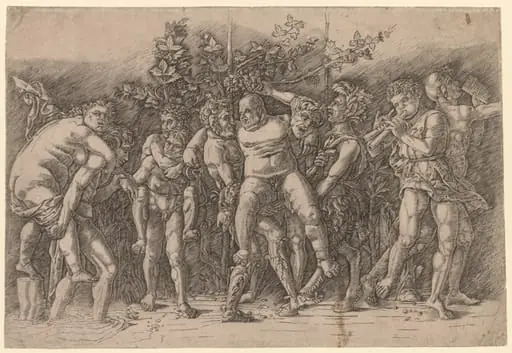 Bacchanal with Silenus
 Bacchanal with a Wine Vat