Artwork
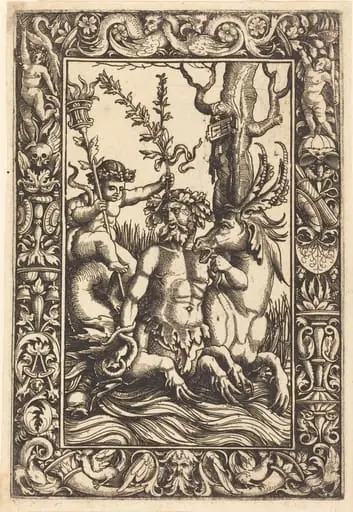
Two Tritons fighting - Battle of the Sea Gods (right portion)
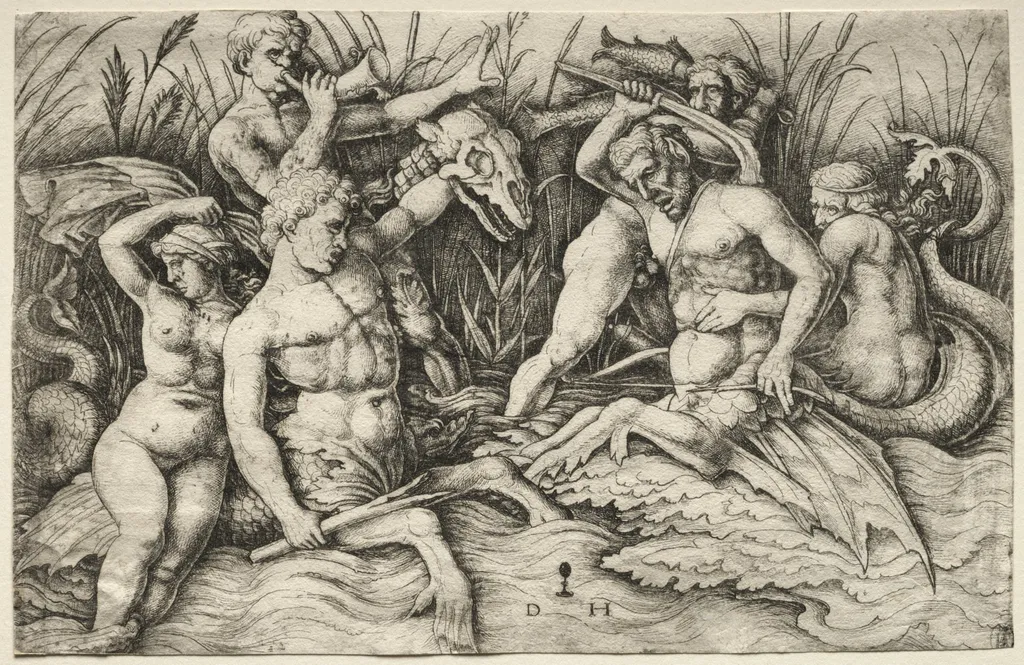
Two Tritons fighting - Battle of the Sea Gods (right portion) is a print by Daniel Hopfer. It dates from 1513 and is held in the collection of the Cleveland Museum of Art.
About this work
Overview
Hopfer, known for his innovations in printmaking, applied techniques learned from armor engraving to iron plates, producing intricate, high-contrast images.
Created around 1513 by the German artist Daniel Hopfer, this etching depicts a fragment of a mythological sea battle. Hopfer, known for his innovations in printmaking, applied techniques learned from armor engraving to iron plates, producing intricate, high-contrast images. The work is part of a larger composition, now surviving only in portions, and resides in The Cleveland Museum of Art’s collection as an early example of etching as a narrative medium.
Subject & Meaning
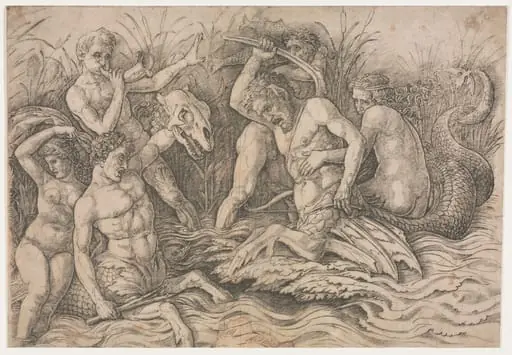
The scene portrays two Tritons—mythical sea deities with human torsos and fish tails—engaged in violent combat. One lies wounded, clutching his head, while the other looms above with a spear. Surrounding figures, some armed, others reacting in alarm, suggest a broader conflict among sea gods. The chaotic arrangement evokes primal struggle, possibly symbolizing the untamed forces of the ocean or divine rivalry, rendered without clear narrative resolution.
Technique & Style
Hopfer used etching on iron, a method he adapted from his work in armor decoration. Fine, sharp lines define muscular forms and turbulent textures, while deep shadows enhance the drama of the figures’ poses. The dense background of tangled seaweed and jagged rocks amplifies the sense of disorder. The fusion of human anatomy with aquatic features is rendered with precise, almost mechanical detail, emphasizing both physicality and otherworldliness.
History & Provenance
This print is one of several surviving fragments from a larger, now-lost composition. Hopfer’s workshop produced multiple versions of sea battle scenes, likely commissioned for private collectors interested in classical themes. The Cleveland Museum of Art acquired the work in the 20th century, recognizing its significance as an early and technically advanced example of etching in Northern European printmaking.
Context
In early 16th-century Germany, artists began exploring classical mythology through print, making such imagery accessible beyond elite patrons. Hopfer’s use of etching allowed for finer detail than woodcut, aligning with a growing interest in naturalism and dynamic composition. His background in metalwork gave him unique insight into line and surface, distinguishing his prints from contemporaries working in other media.
Legacy
Hopfer’s innovations in etching influenced later printmakers across Europe, helping establish the technique as a serious artistic medium. His ability to convey motion and emotion through line and shadow set a precedent for narrative prints. Though his larger series is incomplete, surviving fragments like this one remain key to understanding the evolution of printmaking in the Renaissance.
Artist & collection

Artist
Daniel Hopfer (c. 1470 – 1536) was a German artist who is widely believed to have been the first to use etching in printmaking, at the end of the 15th century. He also worked in woodcut. Although his etchings were…

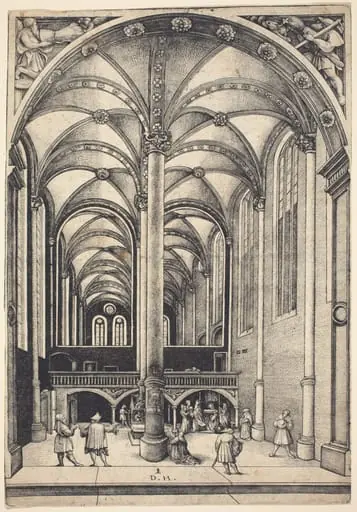 Interior of the Church of Saint Maria Magdalena with the Parable of the Offering of the Widow
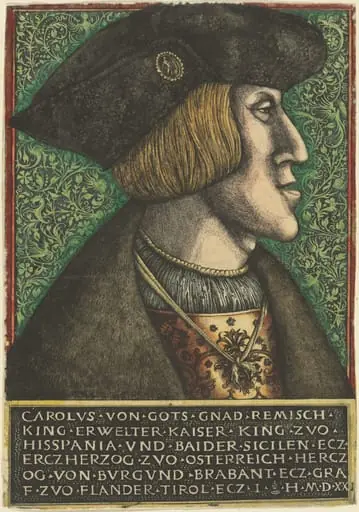 Emperor Charles V
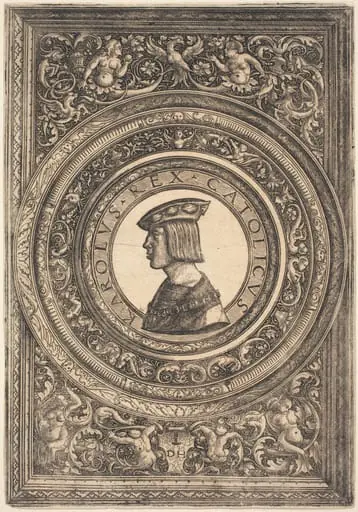 Emperor Charles V
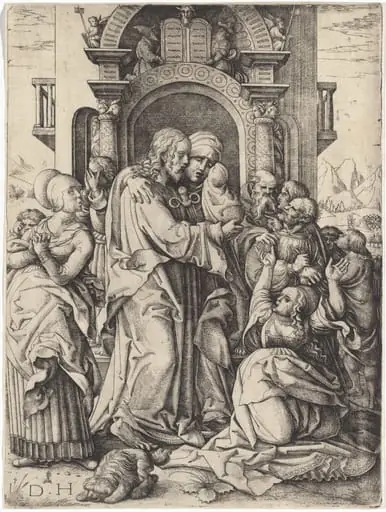 The Virgin Mary Taking Leave of Christ
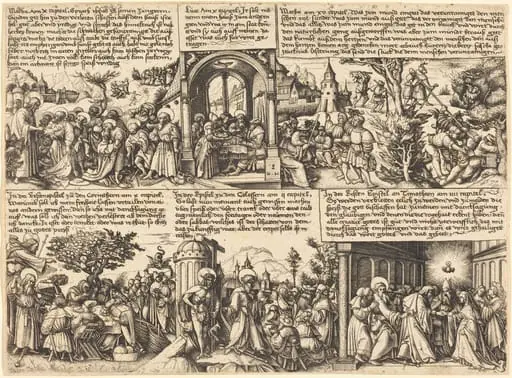 Jesus Christ Giving the Mission to the Apostles and Other New Testament Scenes
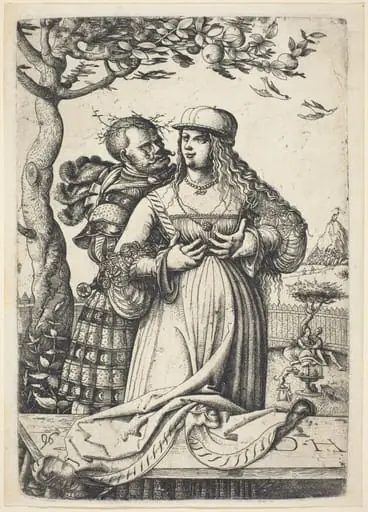 Soldier Embracing a Woman
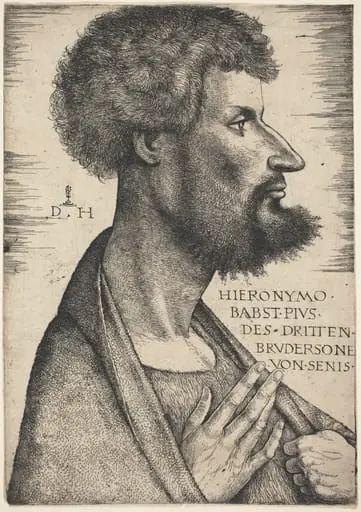 Girolamo da Siena
 The Virgin and Child with Saint Anne by a Portal
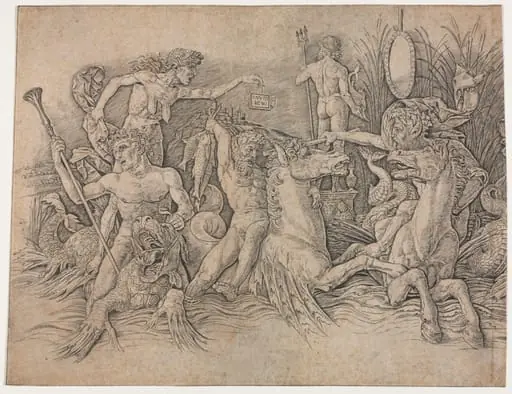
![Battle of the Sea Gods [right half], by Andrea Mantegna](https://artifactworldgallery.com/img/andrea-mantegna--battle-of-the-sea-gods-right-half--7515c85934d3d1e9-w320.webp)
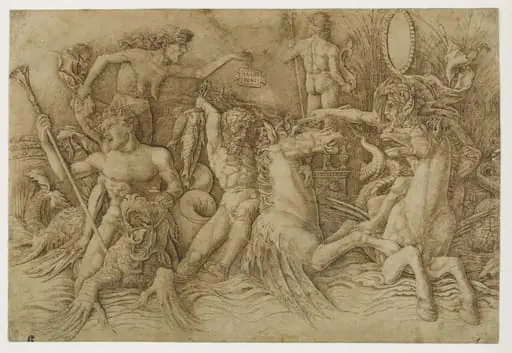
![Battle of the Sea Gods [left half], by Andrea Mantegna](https://artifactworldgallery.com/img/andrea-mantegna--battle-of-the-sea-gods-left-half--2510247af42f8c24-w320.webp)
![Battle of the Sea Gods [left half], by Andrea Mantegna](https://artifactworldgallery.com/img/andrea-mantegna--battle-of-the-sea-gods-left-half--084dd803fb0016b2-w320.webp)