Artwork
Edme-Sebastien Jeaurat
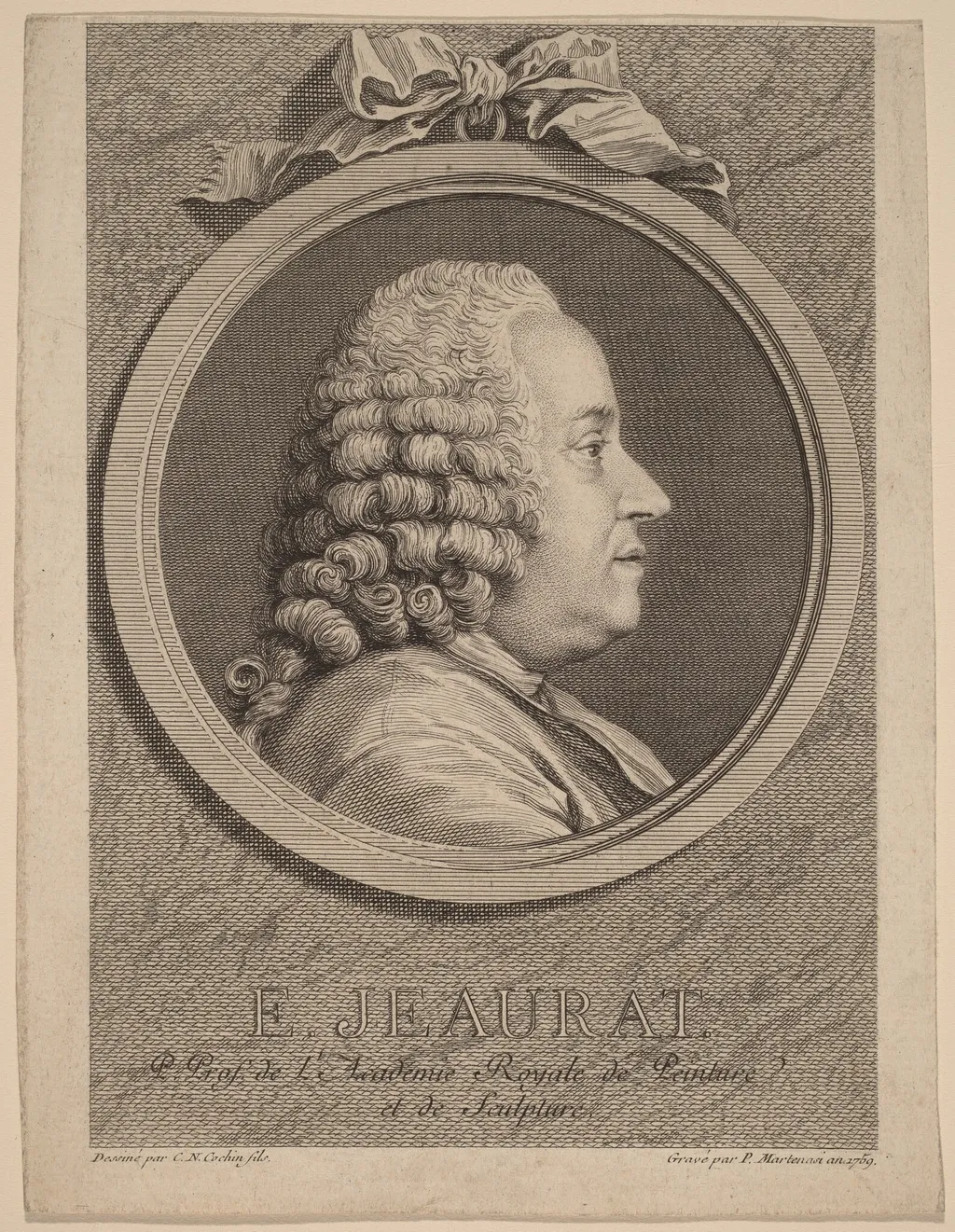
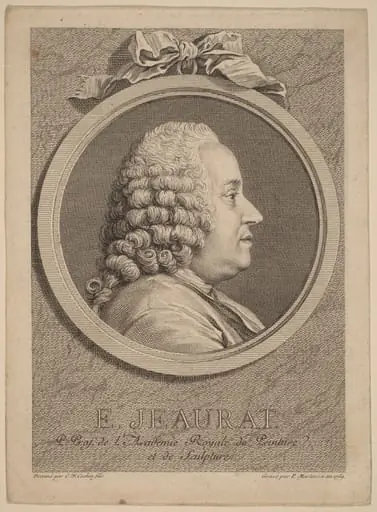
Edme-Sebastien Jeaurat is an ink print by the Romanticist artist Pierre Francois Martenasie. It dates from 1759 and is held in the collection of the National Gallery of Art.
About this work
The name "Jeaurat" is written below the portrait, and the artist’s signature says it was made in 1759.
This is a black-and-white portrait of a man with curly white hair tied back. He’s wearing a fancy wig with curls framing his face. The background is plain, but his outfit looks formal, with a high collar and a bow at the neck.
The name "Jeaurat" is written below the portrait, and the artist’s signature says it was made in 1759. The image is an engraving, which means it was carved into metal and printed.
Next, check out etching to see how this kind of print was made.
Overview
This print is a portrait of Edme-Sebastien Jeaurat, executed in 1759 by Pierre François Martenasie. Produced through engraving with etching on laid paper, it presents a monochrome likeness of its subject. The work adheres to conventions of eighteenth-century portraiture, emphasizing clarity and detail in the representation of the sitter’s features and attire.
Subject & Meaning
The portrait depicts Edme-Sebastien Jeaurat, an individual identified solely by his name inscribed beneath the image. His formal dress—marked by a high collar and bow—suggests a figure of some social or professional standing. The plain background directs attention to the subject, reinforcing the portrait’s function as a record of identity rather than a narrative or allegorical composition.
Technique & Style
The print combines engraving and etching techniques, methods that involve incising lines into a metal plate for ink transfer. This process allows for fine detail and tonal variation, evident in the rendering of the sitter’s wig, facial features, and clothing. The restrained, linear style reflects the precision valued in reproductive printmaking of the period.
History & Provenance
Created in 1759, the print bears the artist’s signature, confirming its attribution to Pierre François Martenasie. As an engraved portrait, it likely served as a means of dissemination, allowing the likeness of Jeaurat to circulate beyond immediate circles. The work’s survival on laid paper indicates its preservation through subsequent centuries.
Context
Portrait prints of this kind were common in eighteenth-century Europe, often commissioned to document individuals of note or to accompany published texts. The absence of contextual elements in the background aligns with the era’s preference for straightforward, unembellished representations. Such works contributed to the broader culture of printmaking as a vehicle for both information and artistic expression.
Artist & collection