Artwork
St. Martin
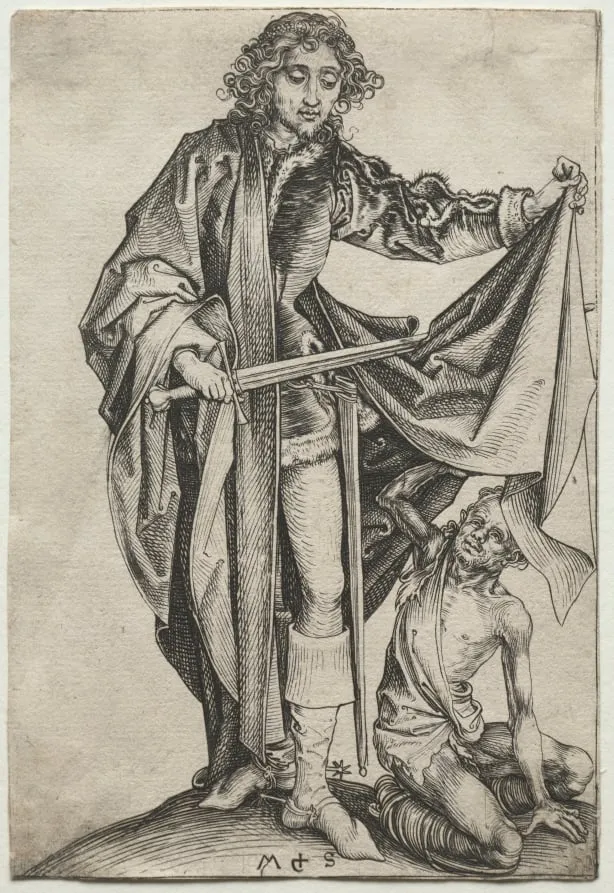
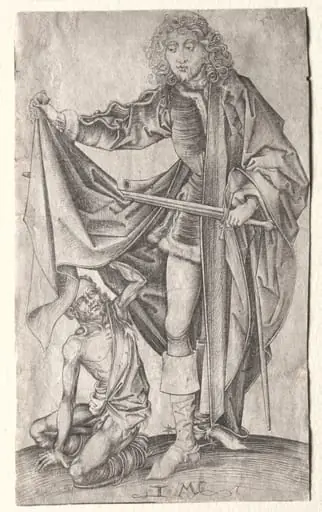
St. Martin is a print by the Renaissance artist Martin Schongauer. It dates from 1488 and is held in the collection of the Cleveland Museum of Art.
About this work
Overview
This early engraving by Martin Schongauer depicts the legendary episode in which Saint Martin, a Roman soldier, divides his fur cloak to clothe a destitute figure. The composition centers on a youthful, curly‑haired rider who, with a sword, cuts the mantle in half while a kneeling beggar receives the portion. The scene captures the moment of charitable exchange that defines the saint’s narrative.
Subject & Meaning
The work illustrates the Christian motif of self‑sacrifice: Martin’s act of sharing his garment is later interpreted as an encounter with Christ, revealed to him in a dream. The gesture signifies humility and compassion, qualities that led to his baptism and eventual appointment as Bishop of Tours, reinforcing the moral lesson of generosity toward the needy.
Technique & Style
Schongauer employed copper engraving, incising the image into metal to produce multiple impressions. The fine, cross‑hatched lines render the texture of the fur, the tension of the horse’s muscles, and the folds of the cloth with a high degree of realism. The chiaroscuro effect emerges from the dense line work, creating depth without the use of color.
History & Provenance
Created in the late 15th century, this print belongs to Schongauer’s series of saintly subjects, among the earliest extensive uses of engraving for narrative illustration. The metal plates allowed the image to circulate widely across Europe, influencing subsequent printmakers and contributing to the spread of devotional imagery during the Northern Renaissance.
Artist & collection

Artist
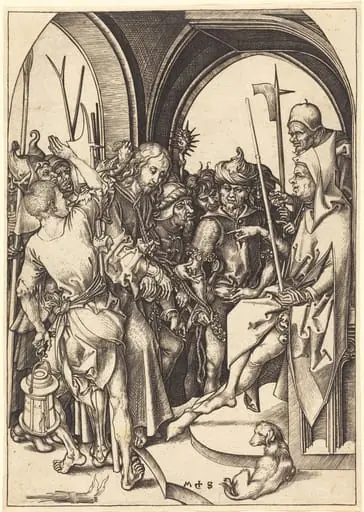
Martin Schongauer, also known as Martin Schön or Hübsch Martin by his contemporaries, was an Alsatian engraver and painter.