Artwork
St. Martin Dividing His Cloak for a Beggar
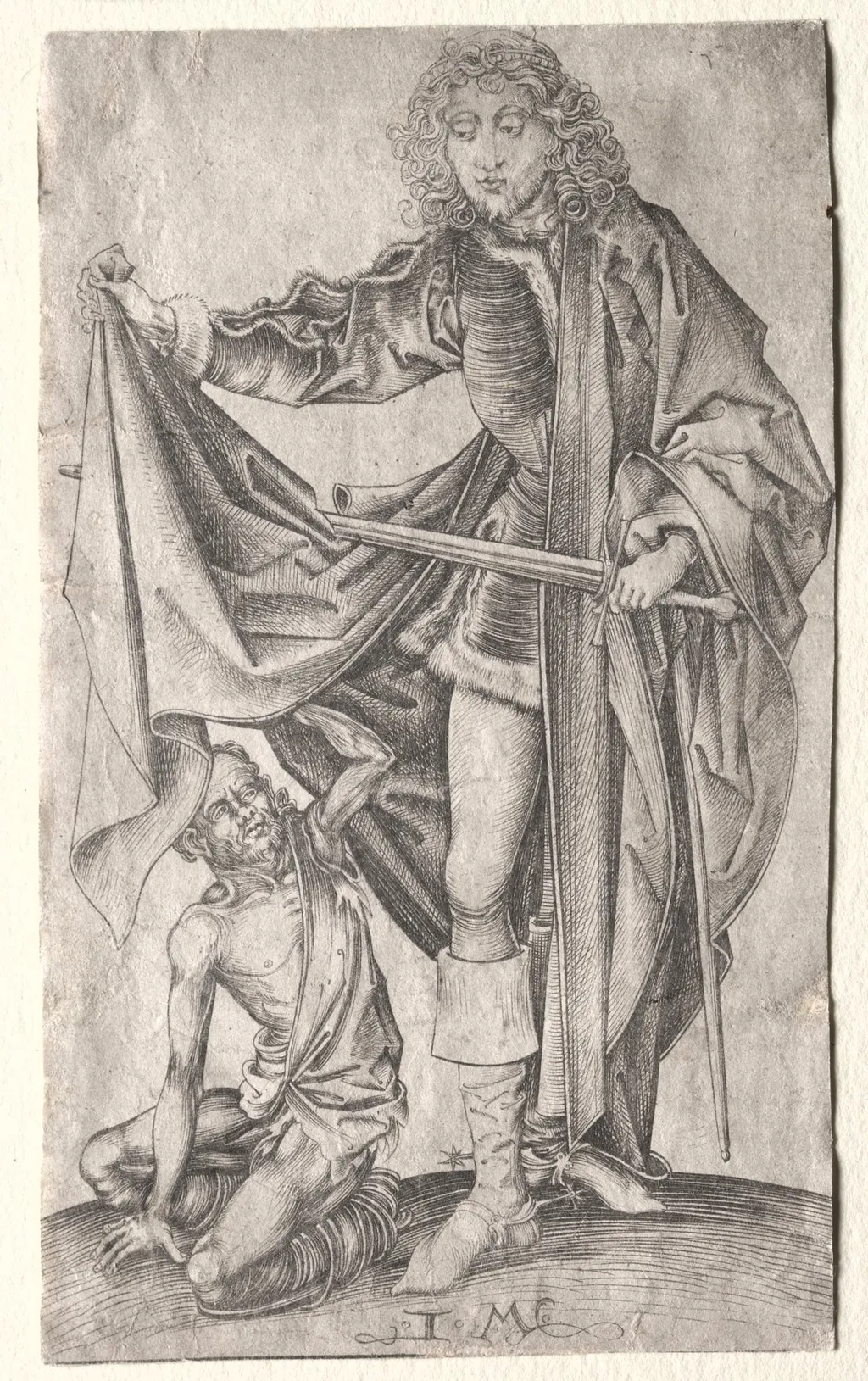
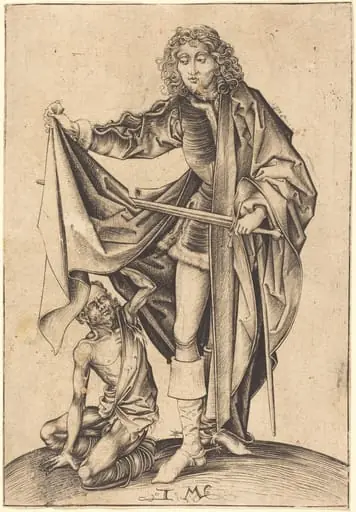
St. Martin Dividing His Cloak for a Beggar is a print by the Renaissance artist Israhel van Meckenem. It dates from 1488 and is held in the collection of the Cleveland Museum of Art.
About this work
Overview
Van Meckenem, among the most productive printmakers of the 15th century, produced over 600 engravings, often reinterpreting existing compositions.
Created around 1488 by Israhel van Meckenem, a German engraver and goldsmith, this print illustrates the legendary act of Saint Martin of Tours sharing his cloak with a beggar. Van Meckenem, among the most productive printmakers of the 15th century, produced over 600 engravings, often reinterpreting existing compositions. This work is one of his many religious subjects, executed in the detailed linear style typical of Northern European printmaking of the period.
Subject & Meaning
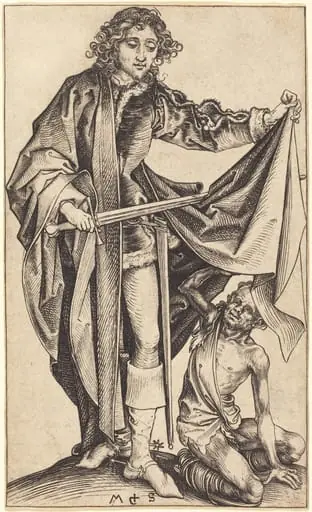
The scene depicts Saint Martin, a Roman soldier turned Christian bishop, dividing his military cloak with a destitute man at the city gate. The moment, drawn from the saint’s hagiography, symbolizes Christian charity and humility. The kneeling beggar’s upward gaze and the saint’s restrained gesture emphasize spiritual compassion over display. The absence of background detail focuses attention on the moral act, aligning with devotional imagery intended for private contemplation.
Technique & Style
Van Meckenem employed fine, precise engraving lines to define forms and textures, particularly in the folds of the cloak and the figures’ garments. The figures are rendered with a sculptural solidity, their poses clearly delineated against a flat, unadorned ground. The use of cross-hatching for shadow and volume reflects the technical refinement of late 15th-century engraving, while the composition’s clarity and economy reflect the influence of earlier Netherlandish models.
History & Provenance
The print entered the collection of the Cleveland Museum of Art as part of its broader holdings in early European prints. While its specific ownership history before the 20th century is not fully documented, it aligns with the widespread circulation of devotional prints in late medieval and early Renaissance Europe. Van Meckenem’s prints were often sold as affordable religious images, making them accessible to a broad audience beyond elite patrons.
Context
In the late 15th century, religious prints like this one served both devotional and educational purposes, especially in regions with limited access to painted altarpieces. The story of Saint Martin was popular in Northern Europe, where monastic communities promoted his example of charity. Van Meckenem’s reproductions helped standardize such imagery, contributing to a shared visual language of piety across urban and rural communities.
Legacy
Van Meckenem’s prolific output helped establish engraving as a medium for disseminating religious narratives. His version of Saint Martin, though not original in composition, became one of the most widely circulated depictions of the scene. His technical precision influenced later printmakers, and his works remain key to understanding how religious imagery was reproduced and consumed in the decades before the Reformation.
Artist & collection
Artist
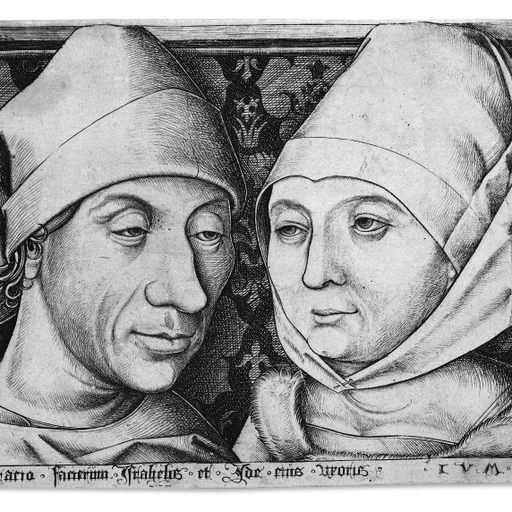
Israhel van Meckenem (c. 1445 – 10 November 1503), also known as Israhel van Meckenem the Younger, was a German printmaker and goldsmith, perhaps of a Dutch family origin. He was the most prolific engraver of the…

 Saint Martin
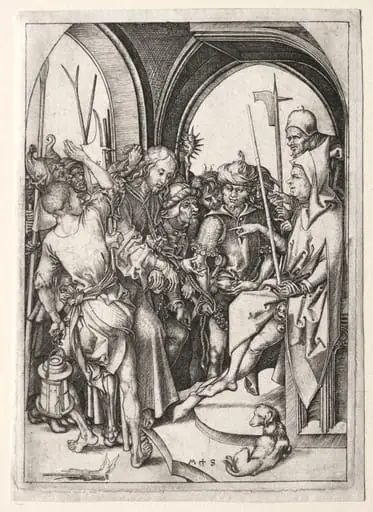 The Passion: Christ Before Annas
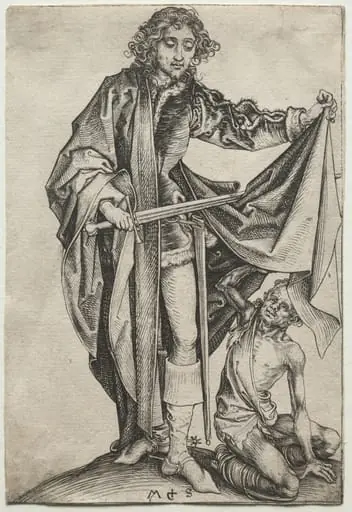 St. Martin
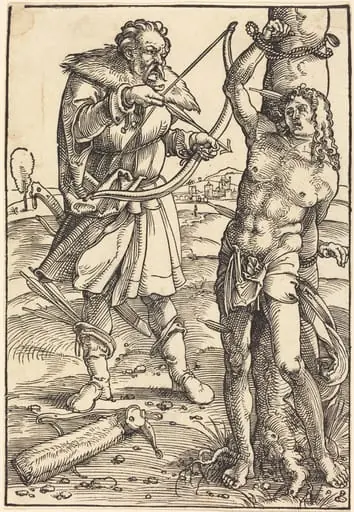 The Martyrdom of Saint Sebastian
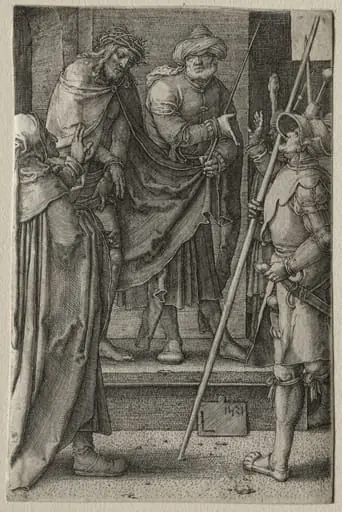 The Passion: Christ Presented to the People
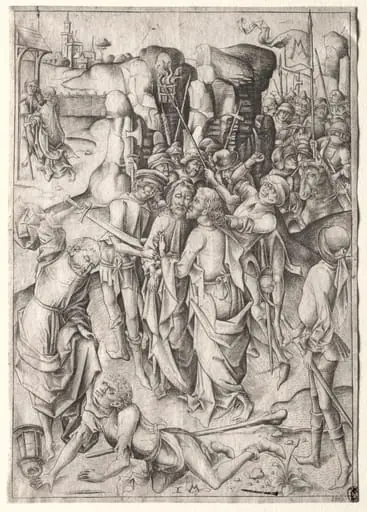 The Passion: Christ Taken Captive
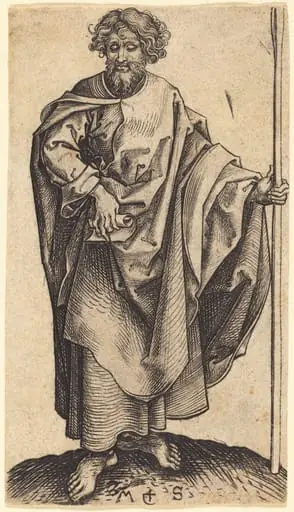 Saint Thomas
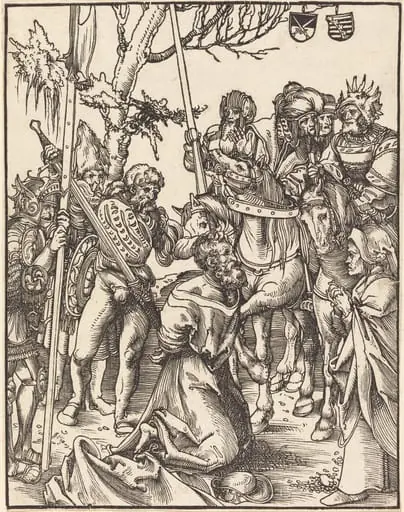 Saint James the Greater
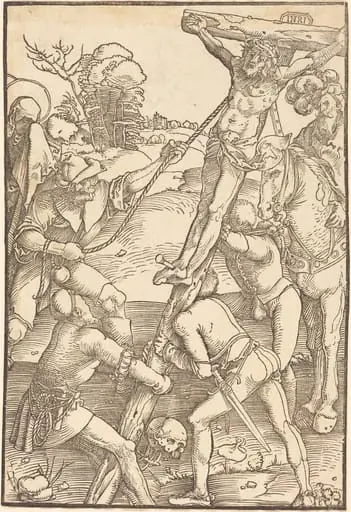 Christ Raised on the Cross
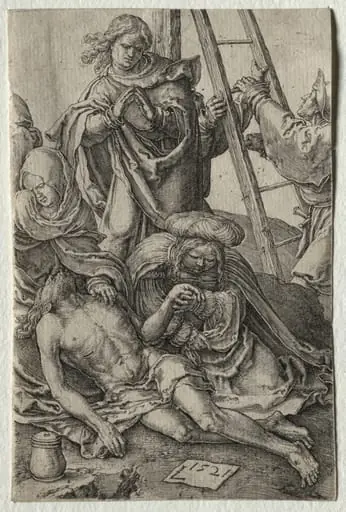 The Passion: Descent from the Cross
 Saint Matthias (?)
 Saint Martin Dividing His Cloak