Artwork
The Archangel Michael Piercing the Dragon
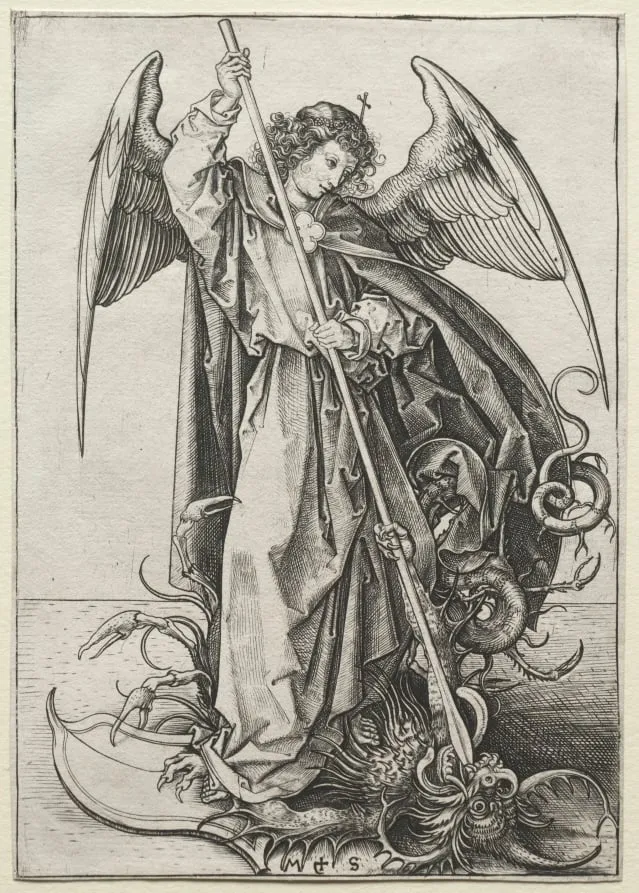
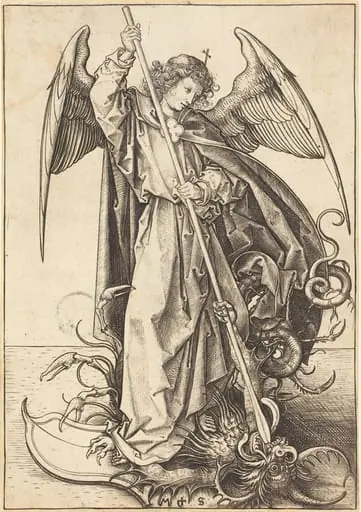
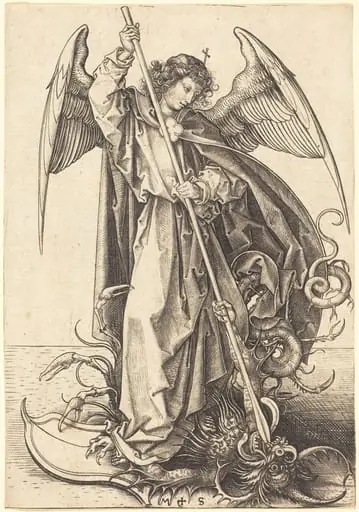
The Archangel Michael Piercing the Dragon is a print by the Renaissance artist Martin Schongauer. It dates from 1475 and is held in the collection of the Cleveland Museum of Art.
About this work
Overview
This engraving by Martin Schongauer depicts the Archangel Michael in the act of defeating a monstrous dragon, a scene drawn from the Book of Revelation.
This engraving by Martin Schongauer depicts the Archangel Michael in the act of defeating a monstrous dragon, a scene drawn from the Book of Revelation. Executed in metal using precise incised lines, the print was designed for reproduction and widespread distribution. The composition focuses solely on the two figures against an empty ground, emphasizing the drama of the confrontation through contrast and detail rather than setting.
Subject & Meaning
The image illustrates Michael’s role as divine warrior, triumphing over Satan symbolized by the dragon. In late medieval Christian belief, such depictions served as spiritual safeguards, invoking protection against malevolent forces. The moment captured is one of decisive victory—Michael’s spear pierces the beast while his foot crushes it—affirming divine order over chaos and evil.
Technique & Style
Schongauer employed engraving, a technique requiring lines to be meticulously carved into a metal plate in reverse. Fine, controlled hatching creates texture in the angel’s flowing robes and the dragon’s composite body. The contrast between Michael’s elegant, feathered wings and the dragon’s jagged, hybrid form—part bird, reptile, and crustacean—heightens the tension between grace and monstrosity.
History & Provenance
Created in the late 15th century, this engraving was part of a broader tradition of devotional prints circulating across Europe. Schongauer’s technical mastery made his works highly sought after, and this image in particular was widely copied and distributed. Its survival in multiple impressions suggests significant demand, likely tied to its use in private devotion and religious instruction.
Context
During the late Middle Ages, visual representations of Michael’s victory were common in churches, manuscripts, and prints, reflecting widespread anxiety over spiritual corruption and the need for divine intervention. Schongauer’s version, stripped of narrative background, aligns with a growing trend toward focused, emotionally intense imagery suited for personal meditation and protection.
Legacy
Schongauer’s engraving influenced generations of Northern European artists, setting a standard for the depiction of celestial combat in print. Its clarity of form and technical precision helped elevate engraving from a craft to a respected artistic medium. The image remained a reference point for religious iconography well into the Renaissance.
Artist & collection

Artist
Martin Schongauer, also known as Martin Schön or Hübsch Martin by his contemporaries, was an Alsatian engraver and painter.