Artwork
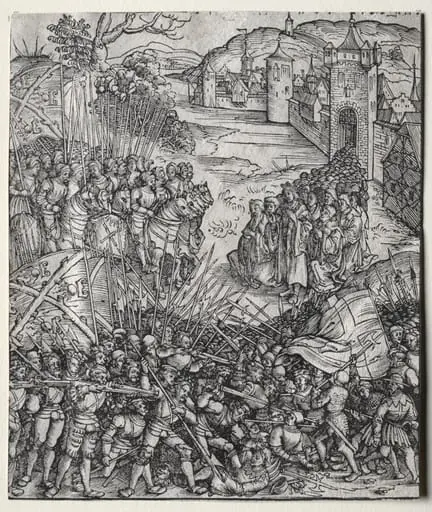
The Two Armies at the Battle of Ravenna
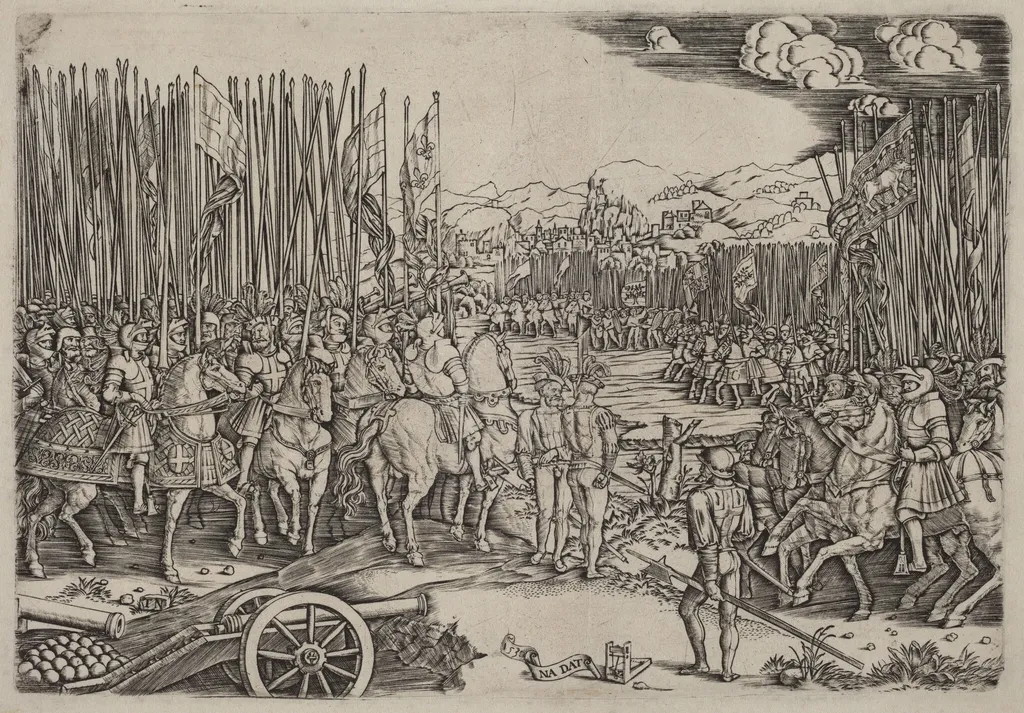
The Two Armies at the Battle of Ravenna is an ink print by the Renaissance artist Master NA.DAT with the Mousetrap. It dates from 1512 and is held in the collection of the National Gallery of Art.
About this work
Overview
The work titled *The Two Armies at the Battle of Ravenna* is a black‑and‑white engraving produced around 1512. Attributed to the anonymous printmaker known as Master NA.DAT, the piece was created in collaboration with the workshop identified as the Mousetrap. It belongs to the early‑Renaissance tradition of narrative prints that documented contemporary military events.
Subject & Meaning
The image captures a tumultuous clash between two opposing forces.
The image captures a tumultuous clash between two opposing forces. Mounted troops and infantry engage with swords, shields, and early artillery, while one side is distinguished by full armor and helmets and the other by feathered headgear and exposed torsos. A group of onlookers occupies a hillside, and a distant cityscape frames the battlefield, suggesting both public interest and the broader civic stakes of the conflict.
Technique & Style
Executed with fine incised lines and subtle cross‑hatching, the engraving achieves a sense of depth through graduated shading rather than color. The close‑up focus on combatants and the meticulous rendering of armor, weaponry, and terrain are characteristic of Renaissance printmaking, where the emphasis lay on precise detail and the reproducibility of the image.
History & Provenance
Created circa 1512, the print likely circulated among patrons interested in current events and military affairs. Its association with the Mousetrap workshop indicates a production context in which collaborative workshops produced multiple copies for distribution, a common practice before the advent of photography.
Context
The Battle of Ravenna (1512) was a significant episode in the War of the League of Cambrai, pitting French forces against a coalition of Papal and Spanish troops. Prints such as this served both as visual records of the encounter and as propaganda tools, reinforcing contemporary narratives about valor, defeat, and political alliances.
Artist & collection


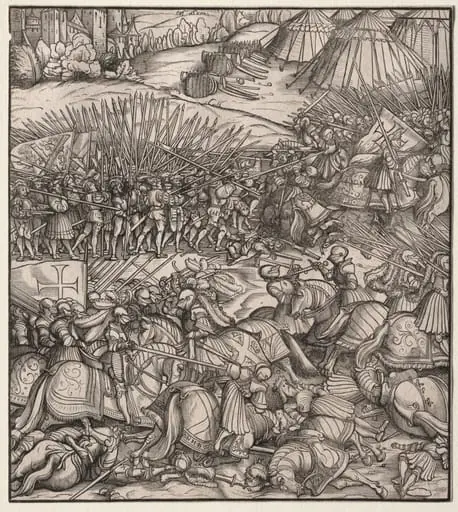 How the French King made war on the King of Feuereisen in his realm and how the King of Feuereisen died in the battle
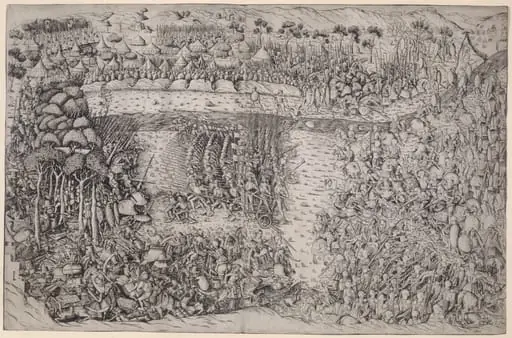 The Battle of Fornovo
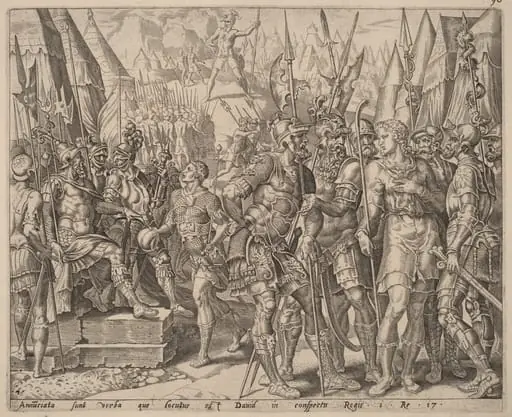 David's Brother Relating to Him Goliath's Challenge
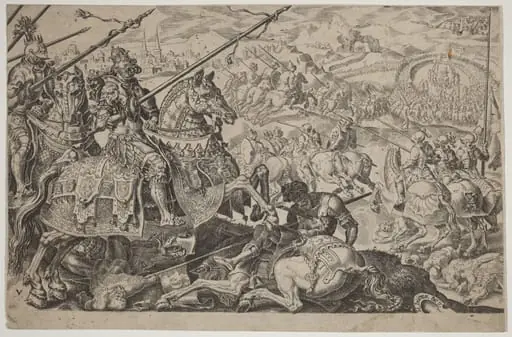 Suleiman the Magnificent Forced to Raise the Siege of Vienna
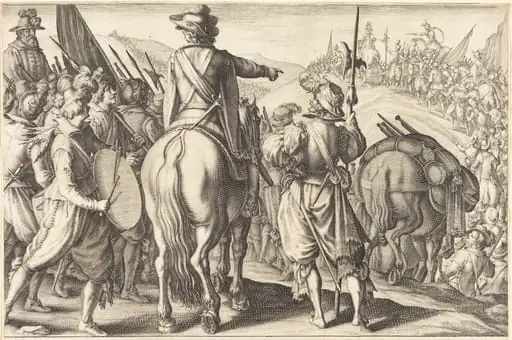 The Troops on the March
 Landscape with Battle Scene
 Herberstein's Journey to Denmark
 Untitled
 Triumphal Entry of Margaret of Austria
 First Flemish Rebellion