Artwork
The Battle of Fornovo
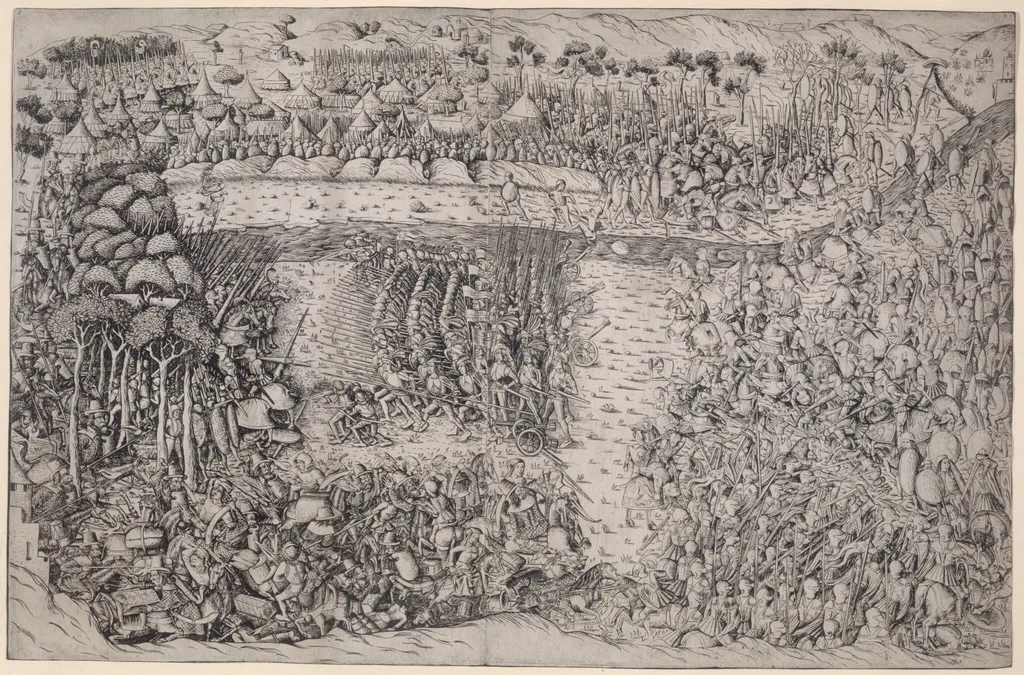
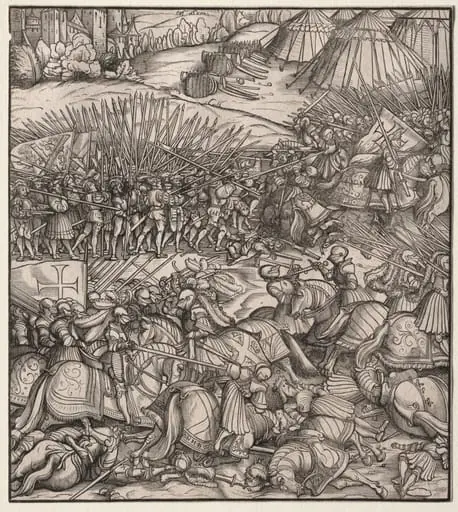
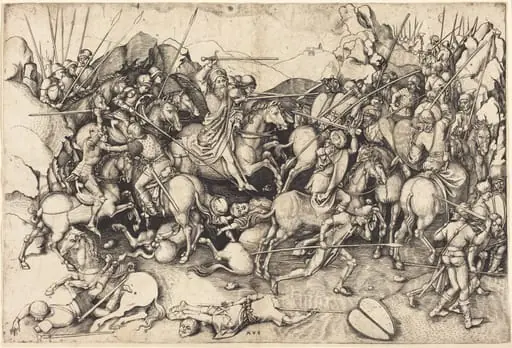
The Battle of Fornovo is an ink print by the Renaissance artist Master of the Battle of Fornovo. It dates from 1500 and is held in the collection of the National Gallery of Art.
About this work
Overview
The artist employed precise cross-hatching to model form and suggest spatial depth, creating a sense of movement and volume within the crowded battlefield.
This engraving, produced around 1500, depicts the Battle of Fornovo through two joined sheets of laid paper. It presents a dense, dynamic confrontation between armed forces, rendered in fine linear detail. The composition avoids clear directional focus, emphasizing disorder over triumph. The artist employed precise cross-hatching to model form and suggest spatial depth, creating a sense of movement and volume within the crowded battlefield.
Subject & Meaning
The scene captures the chaotic clash of French and Italian forces in 1495, without identifying clear victors or heroes. Figures are interwoven in close combat—soldiers, horses, and weapons blur into a single turbulent mass. The absence of narrative clarity suggests a focus on the nature of conflict itself rather than political outcome. Trees and distant structures frame the chaos, grounding the violence in a recognizable landscape.
Technique & Style
The artist used sharp, controlled lines and intricate cross-hatching to build texture and shadow across armor, terrain, and animal forms. The density of lines increases in areas of shadow, enhancing the illusion of three-dimensionality. No single figure dominates; instead, the composition relies on rhythmic repetition and overlapping forms to convey scale and intensity. The technique reflects a meticulous, almost documentary approach to depicting warfare.
History & Provenance
Attributed to an anonymous printmaker known as the Master of the Battle of Fornovo, the work likely originated in northern Italy shortly after the 1495 engagement. It was printed on two sheets, joined at the center to accommodate the expansive scene. Few contemporary records survive, but its technical precision suggests it was made for an audience familiar with military events and print culture of the period.
Context
Created during the Italian Wars, the engraving reflects the widespread interest in documenting contemporary military conflicts through visual media. Unlike heraldic battle scenes, this work avoids glorification, instead presenting warfare as a disordered, visceral event. Its production aligns with a growing trend in printmaking to render real events with observational accuracy, catering to educated patrons seeking news and commentary.
Legacy
The engraving stands as an early example of printmaking used to convey the complexity of real-time warfare without romanticization. Its influence is seen in later Northern European battle scenes that prioritize chaos and realism over symbolic triumph. Though the artist’s identity remains unknown, the work contributed to the evolution of documentary printmaking in Renaissance Europe.
Artist & collection


![The Siege of Breda [plate 6 of 6], by Jacques Callot](https://artifactworldgallery.com/img/jacques-callot--the-siege-of-breda-plate-6-of-6--2a4732053c4510b6-w320.webp)