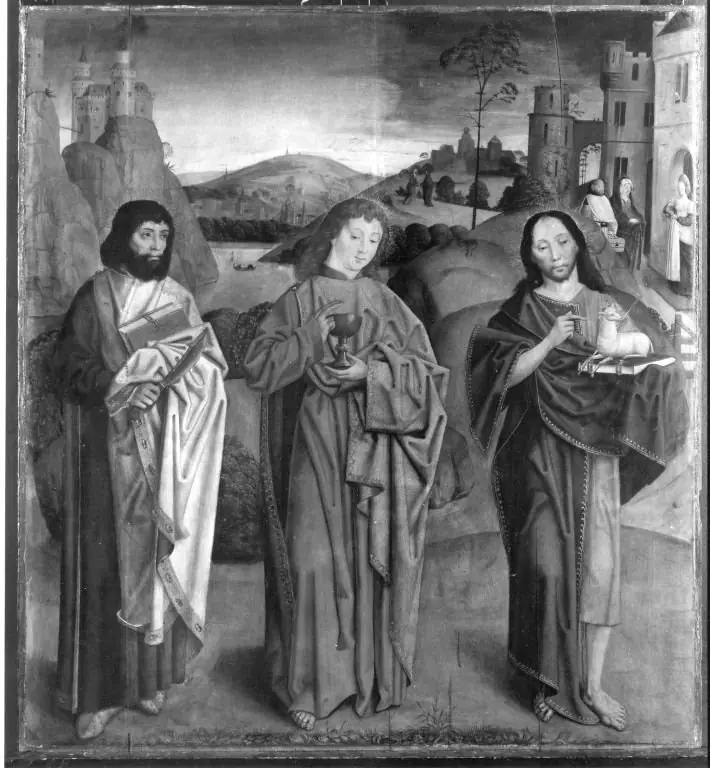
Artwork
Legend of the Holy Ermite Anthony
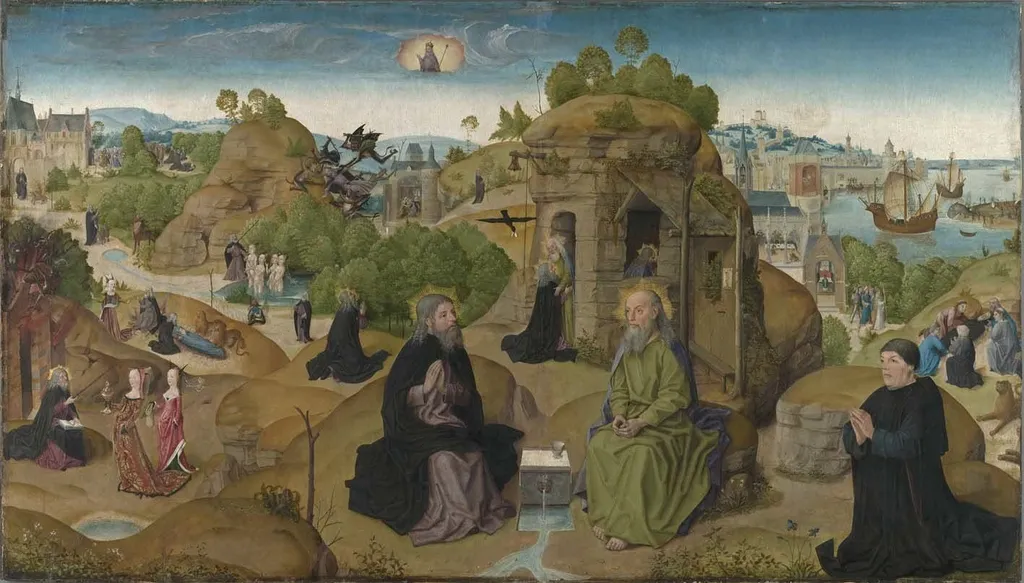
Legend of the Holy Ermite Anthony is an oil painting by the Northern Renaissance artist Master of the Holy Kinship the Elder. It dates from 1410 and is held in the collection of the Bavarian State Painting Collections.
About this work
Overview
Created in 1410, this oil on panel by the Master of the Holy Kinship the Elder portrays a desert tableau centered on two ascetic figures. The work is part of the collection of Munich’s Alte Pinakothek, where it remains on display as an example of early‑15th‑century devotional painting.
Subject & Meaning
The composition brings together Anthony the Great and Paul of Thebes, two seminal hermits of early Christian monasticism. Their presence in a barren landscape underscores themes of spiritual isolation and divine favor, while the surrounding travelers and distant city suggest the contrast between worldly life and the hermits’ withdrawn devotion.
Technique & Style
The artist employs a vivid palette for the figures’ garments—brown and green robes accented with bright hues—against a more subdued, earthy desert background. Detailed rendering of rocks, sparse vegetation, and a distant waterfront city creates a realistic foreground, while the luminous figure in the sky introduces a symbolic, otherworldly element.
History & Provenance
Attributed to the Master of the Holy Kinship the Elder, the painting entered the Alte Pinakothek’s holdings during the museum’s 19th‑century acquisitions of German medieval art. Its attribution rests on stylistic parallels with other works by the same hand, linking it to a workshop active in the early 1400s.
Context
Depictions of Anthony the Great and Paul of Thebes were common in medieval art, reflecting the growing veneration of desert fathers as models of piety. The inclusion of a bustling city and ships hints at the expanding trade routes of the period, juxtaposing the hermits’ solitude with contemporary societal activity.
Artist & collection
Artist
Master of the Holy Kinship the Elder
This late medieval painter made small devotional panels, usually on oak, filled with saints and family scenes.