Artwork
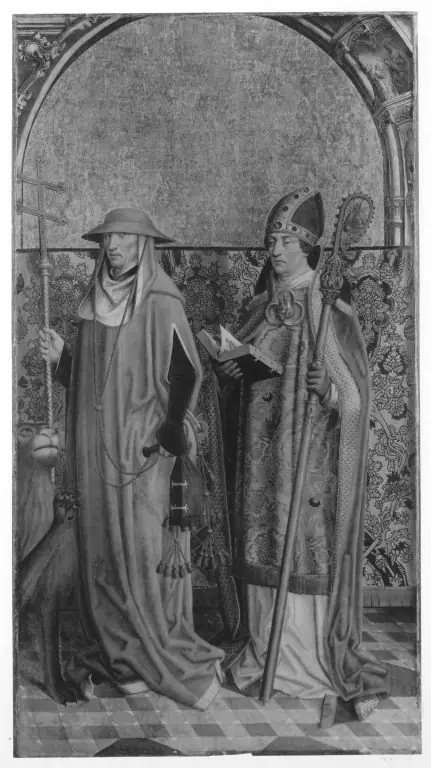
Beschneidungsaltar: Die hll. Bartholomäus, Johannes Ev. und Johannes d. T.
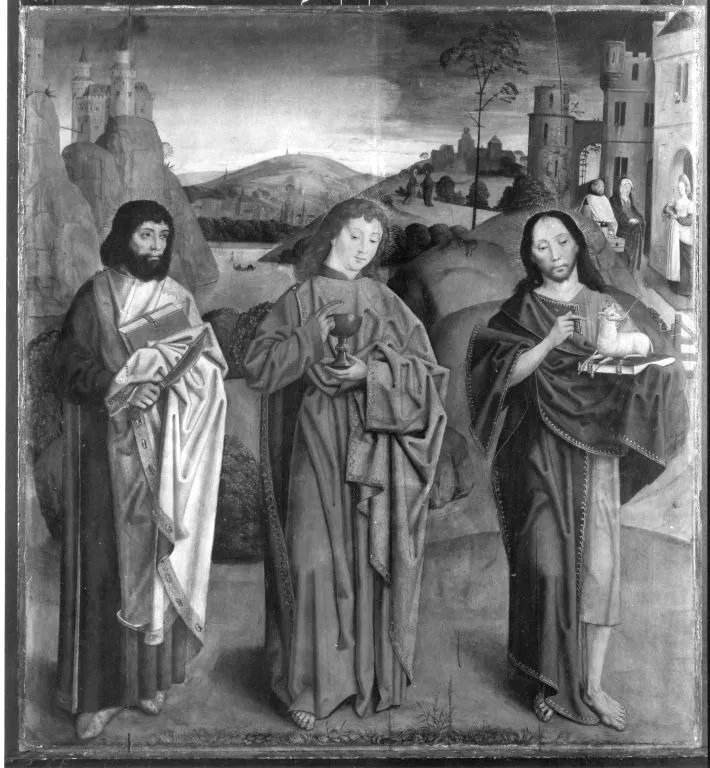
Beschneidungsaltar: Die hll. Bartholomäus, Johannes Ev. und Johannes d. T. is an unspecified painting by Master of the Holy Kinship the Elder. It is held in the collection of the Bavarian State Painting Collections.
About this work
Overview
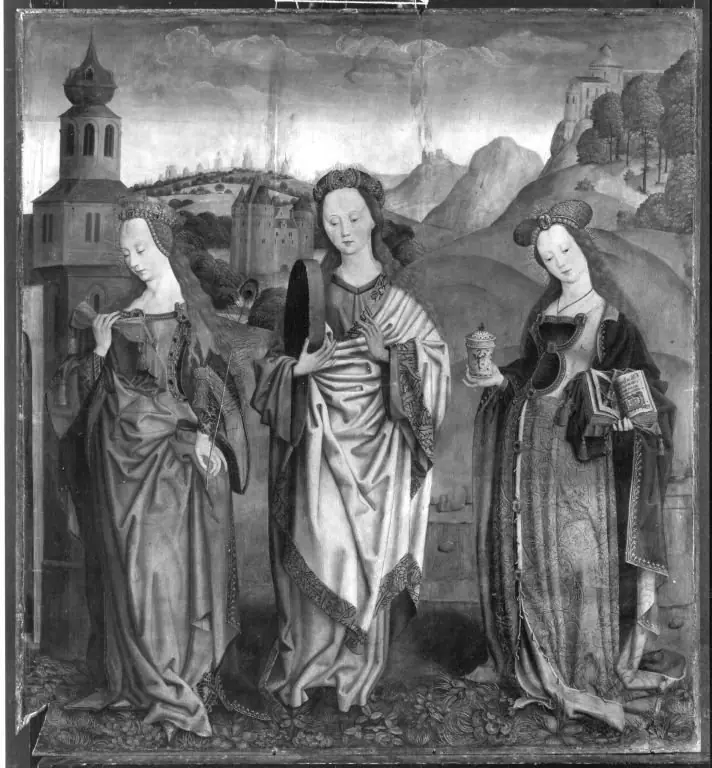
The panel, attributed to the workshop of the Master of the Holy Kinship the Elder, presents a small devotional grouping of three saints—Bartholomew, John the Baptist and John the Evangelist—rendered in a calm, landscape setting. The work is part of the collection of the Alte Pinakothek in Munich and exemplifies late Gothic devotional painting intended for private or chapel use.
Subject & Meaning
John the Evangelist bears a round dish with a cup, a symbol of the Eucharist and his association with the Gospel’s theological depth.
Bartholomäus is shown holding a long cloth, a traditional attribute recalling his martyrdom by flaying. John the Baptist appears youthful, clutching a scroll or book that alludes to his prophetic role. John the Evangelist bears a round dish with a cup, a symbol of the Eucharist and his association with the Gospel’s theological depth. Together they embody themes of martyrdom, prophecy, and the written word.
Technique & Style
Executed in tempera on panel, the figures are rendered with delicate modeling and fine linear detail characteristic of the Master of the Holy Kinship’s circle. The drapery folds and facial features are treated with a gentle chiaroscuro, while the background landscape—trees, a river, a distant castle—provides a serene spatial context without overwhelming the saints.
History & Provenance
The painting entered the Alte Pinakothek’s holdings in the early 19th century, acquired during the museum’s formative acquisitions of German medieval and early Renaissance works. Its attribution to the Master of the Holy Kinship the Elder rests on stylistic parallels with other known works from the same workshop, dated to the late 15th century.
Context
The composition reflects a devotional practice common in the Upper Rhine region, where groups of saints were depicted together for private contemplation. The inclusion of Bartholomew alongside the two Johns suggests a specific liturgical or patronal interest, perhaps linked to a local guild or chapel dedicated to these figures.
Artist & collection
Artist
Master of the Holy Kinship the Elder
This late medieval painter made small devotional panels, usually on oak, filled with saints and family scenes.