Artwork
Octava Spera (Eighth Sphere)
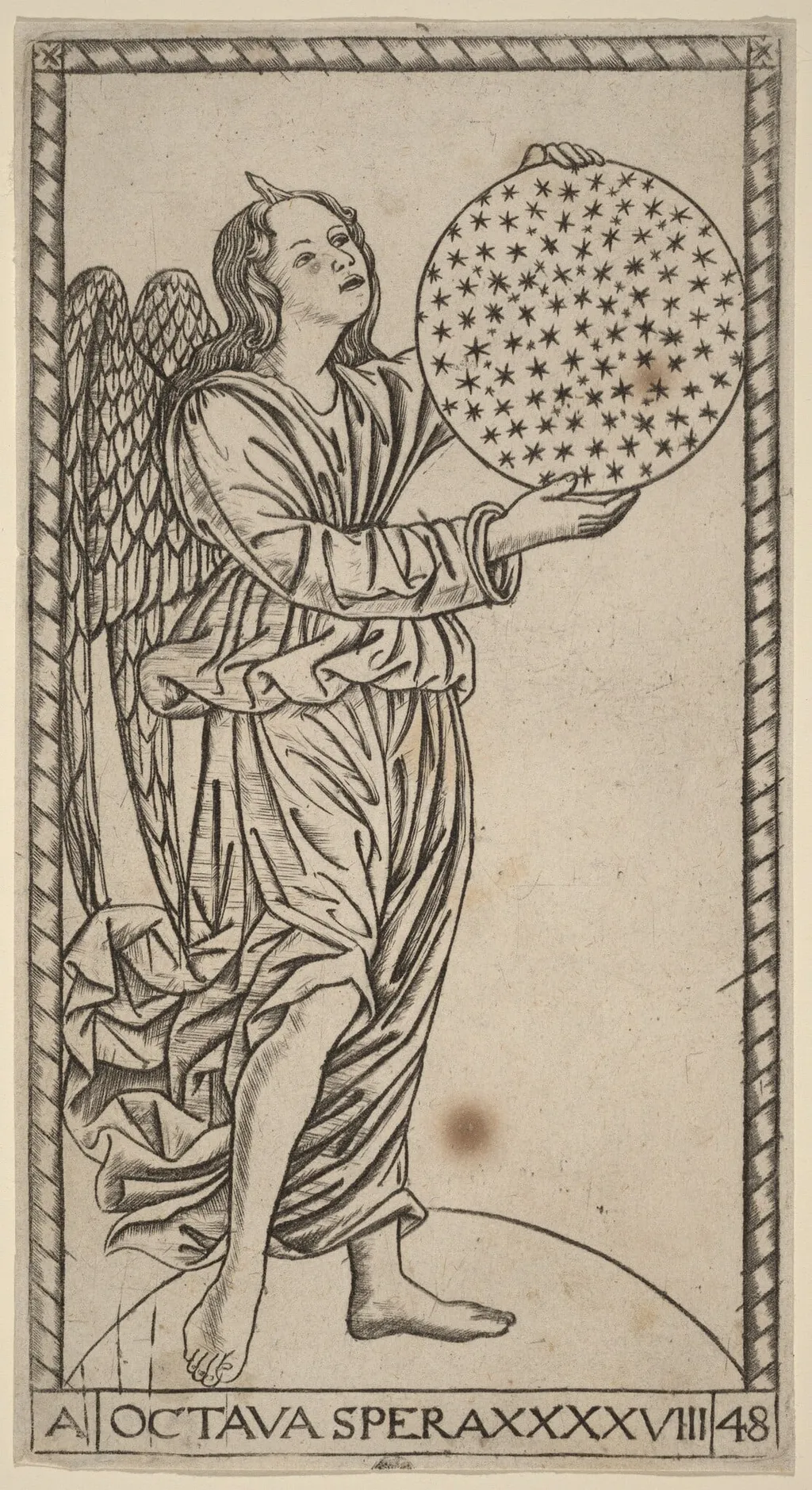
Octava Spera (Eighth Sphere) is an ink print by the Renaissance artist Master of the S-Series Tarocchi. It dates from 1470 and is held in the collection of the National Gallery of Art.
About this work
Overview
Octava Spera, also known as the Eighth Sphere, is a copperplate engraving produced around 1470 and attributed to the anonymous workshop identified as the Master of the S‑Series Tarocchi. The print measures roughly a modest size typical of late‑medieval devotional images and presents a singular figure against an unadorned background.
Subject & Meaning
The composition centers on a winged angel standing upon a globe, its robes flowing in a dignified drape. In the left hand the figure supports a circular disc studded with star motifs, while the right hand is lifted toward the heavens. The upward gaze and celestial symbols suggest a meditation on the heavens and the ordering of the cosmos.
Technique & Style
Executed with fine incised lines, the engraving relies on dense cross‑hatching to model the angel’s wings, fabric, and the textured surface of the sphere. The artist’s control of line weight creates a subtle gradation of tone, giving the figure a three‑dimensional presence despite the flat background. The overall aesthetic reflects the late Gothic attention to intricate detail.
History & Provenance
Octava Spera has been documented in several European collections since the 19th century, most recently appearing in a private catalogue of Renaissance prints.
The work belongs to a series of allegorical prints known as the S‑Series Tarocchi, a group of images that circulated in northern Italy during the late 15th century. Though the creator remains anonymous, the series is linked to a workshop that produced similarly themed engravings for a learned audience. Octava Spera has been documented in several European collections since the 19th century, most recently appearing in a private catalogue of Renaissance prints.
Artist & collection