Artwork
Genius of the Sun (from the Tarocchi, series B: Cosmic Principles & Virtues, #31)
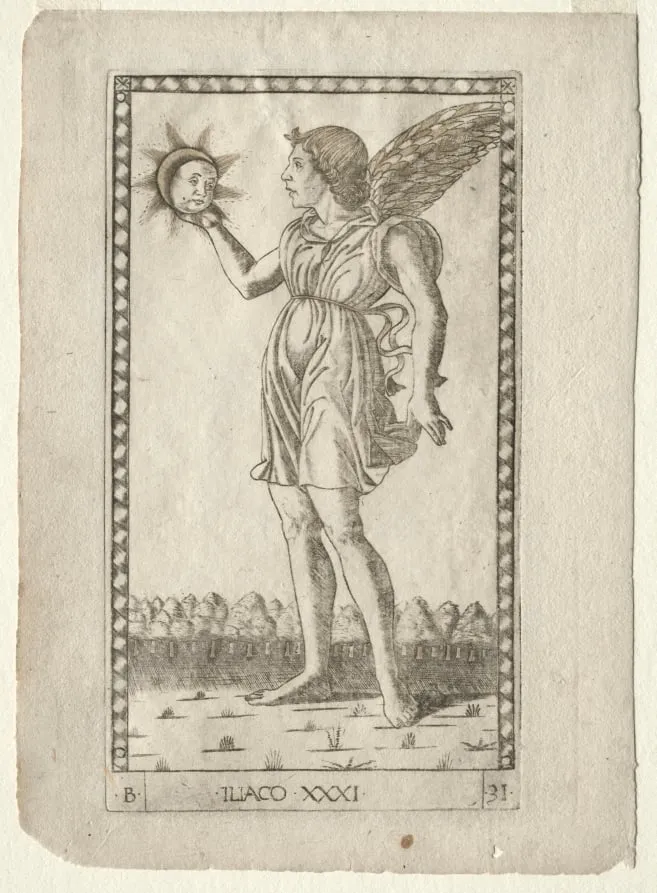
Genius of the Sun (from the Tarocchi, series B: Cosmic Principles & Virtues, #31) is a print by the Renaissance artist Master of the E-Series Tarocchi. It dates from 1467 and is held in the collection of the Cleveland Museum of Art.
About this work
This one represents the sun’s power, but the artist never signed their name, so we call them the *Master of the E-Series Tarocchi*.
A winged figure in a flowing robe holds a sunburst above their head. Golden rays spill across the sky, and tiny stars dot the dark background.
This print comes from a deck of cards called the *Tarocchi*—not for games, but for learning. Each card shows a different idea, like time, faith, or light. This one represents the sun’s power, but the artist never signed their name, so we call them the *Master of the E-Series Tarocchi*.
To see more strange and smart cards like this, look up *italy, ferrara, 15th century*.
Overview
This engraving is one of thirty-one prints from the Tarocchi series B, a set of allegorical cards produced in 15th-century Italy, likely in Ferrara. Unlike playing cards, these were designed for intellectual contemplation, illustrating abstract cosmic and moral concepts. The image depicts Iliaco, the Genius of the Sun, as a central figure in a sequence that opens the group with universal principles. The artist remains anonymous, conventionally referred to as the Master of the E-Series Tarocchi.
Subject & Meaning
Iliaco embodies the Sun as the animating soul of the cosmos, a concept rooted in Renaissance Neoplatonism. The winged youth, depicted in profile and turned left, holds a radiant sun-face aloft, symbolizing divine illumination and cosmic order. The surrounding stars and distant forest suggest the sun’s dominion over both celestial and terrestrial realms. This figure serves as a bridge between the material world and higher metaphysical truths, representing light as a generative, organizing force.
Technique & Style
Executed as a fine engraving, the image employs delicate linework to render the figure’s flowing robe and the sun’s radiating rays. The background is minimally detailed, with subtle stippling to suggest stars and depth, directing focus to the central form. The figure’s elongated proportions and stylized drapery reflect the elegant, courtly aesthetic of Ferrarese art. The use of gold ink or metallic pigment may have once heightened the sun’s luminosity, though much has faded over time.
History & Provenance
The Tarocchi series B emerged in the mid-to-late 15th century, possibly commissioned by a learned patron in Ferrara’s Este court. These prints were not mass-produced for play but circulated among humanists and artists as visual tools for philosophical study. The deck’s survival in fragmentary form suggests limited original production. No known signed copies exist, and the artist’s identity remains obscured, though stylistic links point to the region’s printmaking circles.
Context
This image reflects the intellectual climate of Renaissance Italy, where classical cosmology merged with Christian theology and Hermetic thought. The Sun as the world’s soul drew from Plato, Aristotle, and medieval Islamic scholars like Avicenna, filtered through contemporary humanist circles. The Tarocchi series aligned with broader trends in emblem books and moral allegory, serving as visual catechisms for elite audiences seeking to understand the harmony of the universe through symbolic imagery.
Legacy
Though the Tarocchi series was never widely disseminated, its imagery influenced later emblematic traditions and esoteric iconography. The fusion of celestial symbolism with moral virtue in these prints prefigured the allegorical systems of the Baroque period. Today, the surviving engravings are studied as rare artifacts of Renaissance visual philosophy, offering insight into how abstract ideas were rendered tangible in pre-modern Europe.
Artist & collection
Artist
Master of the E-Series Tarocchi
Master of the E-Series Tarocchi (b. 1400) was an Italian artist.

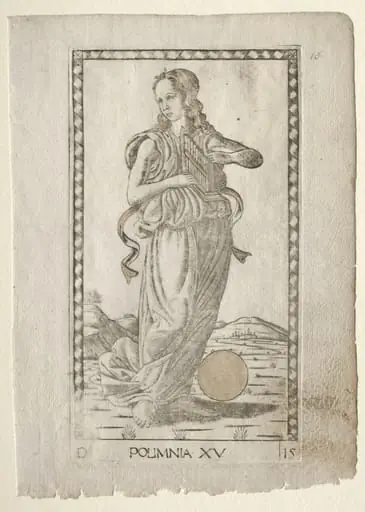 Polyhymnia (heroic hymns) (from the Tarocchi series D: Apollo and the Muses, #15)
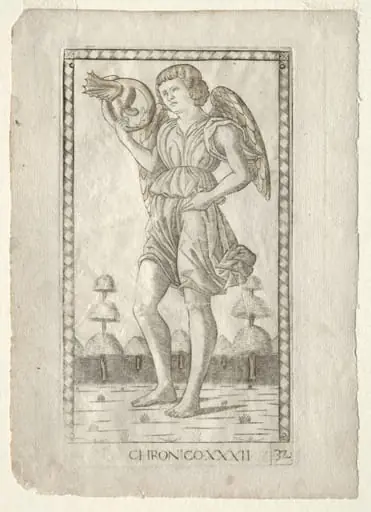 Genius of Time (from the Tarocchi, series B: Cosmic Principles & Virtues, #32)
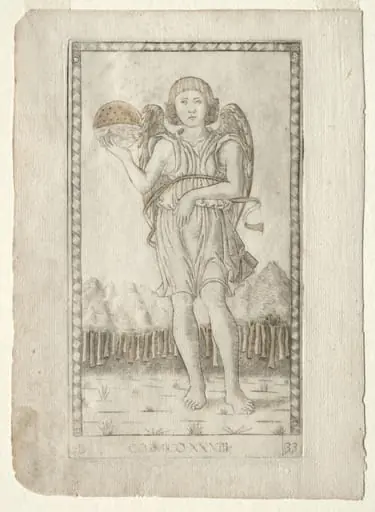 Genius of the World (from the Tarocchi, series B: Cosmic Principles & Virtues, #33)
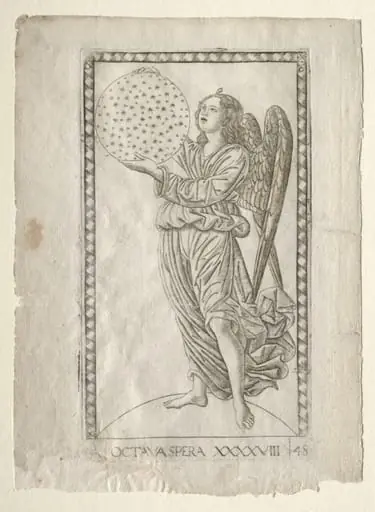 The Angel of the Eighth Sphere (from the Tarocchi, series A: Firmaments of the Universe, #48)
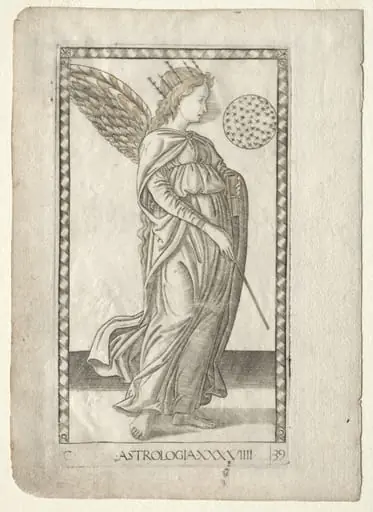 Astrology (from the Tarocchi, series C: Liberal Arts, #29)
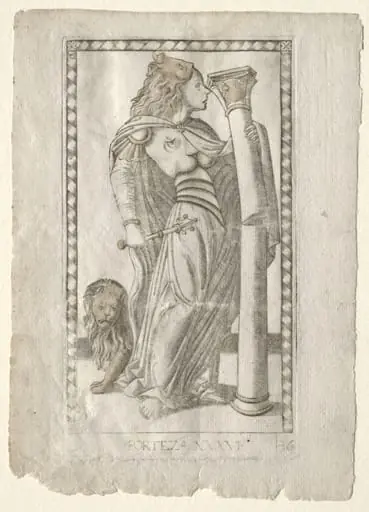 Forteza (from the Tarocchi, series B: Cosmic Principles & Virtues, #36)