Artwork
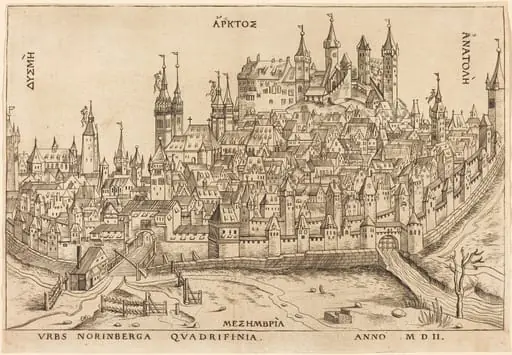
Nuremberg Chronicle: Topographical View of Basle, Switzerland
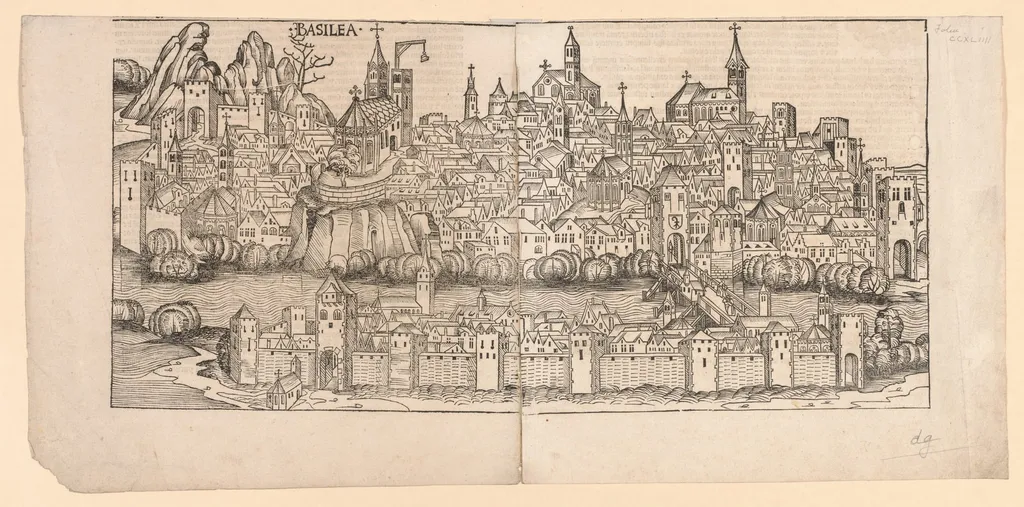
Nuremberg Chronicle: Topographical View of Basle, Switzerland is a print by the Renaissance artist Michael Wolgemut. It dates from 1493 and is held in the collection of the Cleveland Museum of Art.
About this work
Overview
The topographical view of Basel, included in the 1493 Nuremberg Chronicle, is a woodcut print produced in Michael Wolgemut’s Nuremberg workshop.
The topographical view of Basel, included in the 1493 Nuremberg Chronicle, is a woodcut print produced in Michael Wolgemut’s Nuremberg workshop. It forms part of a comprehensive illustrated history of the world, commissioned by Sebald Schreyer and Sebastian Kammermeister. Unlike standalone paintings, this image was mass-produced as a printed page, serving both informational and decorative purposes for contemporary readers interested in urban geography and global history.
Subject & Meaning
The print depicts Basel as a bustling riverside city, with its cathedral, bridges, and dense urban fabric rendered in careful detail. It reflects the 15th-century interest in documenting known cities as part of a broader Christian worldview, where geography and history were intertwined. The inclusion of Basel, a major trade and intellectual center, underscores its significance within the Holy Roman Empire and the emerging networks of printed knowledge.
Technique & Style
Executed as a woodcut, the image relies on incised lines to define architectural forms, with varying densities of line work suggesting texture and depth. Buildings are differentiated by roof shapes, tower heights, and window patterns, while the Rhine is rendered as a sinuous band. Color was likely added by hand after printing, though surviving copies vary. The style prioritizes clarity and legibility over naturalistic perspective, consistent with late medieval print conventions.
History & Provenance
The print was produced in Wolgemut’s workshop, one of the most active in Germany at the time, and appeared in the first edition of the Nuremberg Chronicle. The book was widely distributed across Europe, with hundreds of copies printed and sold. Many were later hand-colored by professional illuminators. The specific copy containing this view is held in multiple institutional collections, including the British Library and the Library of Congress.
Context
This image emerged during a period when printed city views were becoming tools of civic pride and scholarly inquiry. Basel, as a hub of humanist learning and printing, was a natural subject. The Chronicle itself combined biblical chronology with classical and contemporary history, reflecting the Renaissance synthesis of faith, antiquity, and emerging empirical observation. Such prints helped shape how Europeans visualized distant places before widespread travel.
Legacy
Wolgemut’s woodcuts for the Nuremberg Chronicle influenced the development of urban representation in print, setting precedents for later topographical atlases. Though not artistically innovative in perspective, the precision and systematic layout of these images contributed to the standardization of cartographic illustration. The Chronicle remains one of the most extensively illustrated incunabula, and its city views continue to be studied as early examples of visual documentation in print culture.
Artist & collection
Artist
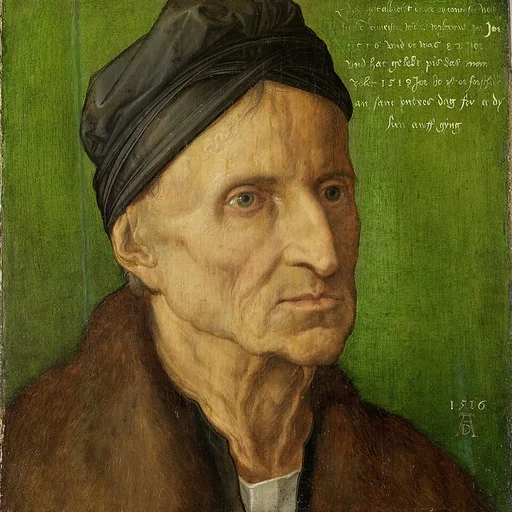
Michael Wolgemut (formerly spelt Wohlgemuth; 1434 – 30 November 1519) was a German painter and printmaker, who ran a workshop in Nuremberg.

![View of Nuremberg from the West [center section], by Hanns Lautensack](https://artifactworldgallery.com/img/hanns-lautensack--view-of-nuremberg-from-the-west-center-section--12422dca269411c0-w320.webp)
![View of Nuremberg from the East [center section], by Hanns Lautensack](https://artifactworldgallery.com/img/hanns-lautensack--view-of-nuremberg-from-the-east-center-section--7aaed3dd23c167ee-w320.webp)