Artwork
View of Nuremberg from the East [center section]
![View of Nuremberg from the East [center section], by Hanns Lautensack, ink, 1552](https://artifactworldgallery.com/img/hanns-lautensack--view-of-nuremberg-from-the-east-center-section--7aaed3dd23c167ee-w1024.webp)
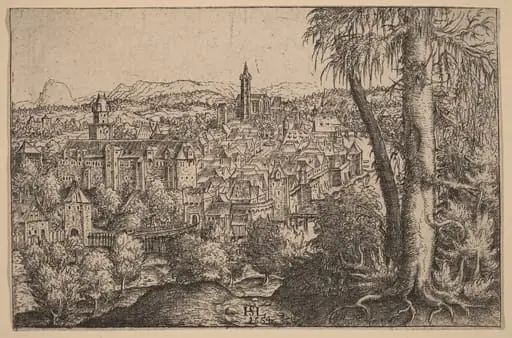
View of Nuremberg from the East [center section] is an ink print by the Renaissance artist Hanns Lautensack. It dates from 1552 and is held in the collection of the National Gallery of Art.
About this work
Overview
Created in 1552, this etching presents an eastern view of Nuremberg, rendered with a precise linear perspective that gives the urban scene a convincing sense of depth. The composition captures the city’s architecture, streets, and surrounding landscape, populated by numerous tiny figures and foliage that animate the view and attest to the artist’s observational care.
Subject & Meaning
The work functions as a topographical record, documenting Nuremberg’s eastern façade during the mid‑16th century. By populating the streets with pedestrians and adding trees, the artist conveys the bustling daily life of the city, offering a snapshot of its social and spatial organization rather than an idealised panorama.
Technique & Style
Executed in copperplate etching, the image relies on fine incised lines to render architectural detail and atmospheric effects. The artist’s use of a consistent vanishing point creates a coherent spatial illusion, while the delicate hatching conveys texture in stone, foliage, and human figures, exemplifying the technical proficiency of German printmakers of the period.
History & Provenance
The etching was produced by Hanns Lautensack, a Bamberg‑born draughtsman who worked mainly in Nuremberg before relocating to Vienna around 1556. Lautensack, the son of painter Paul Lautensack, typically signed his prints with a monogram, a practice evident on this piece, which has since circulated among European collections of early modern prints.
Context
Mid‑16th‑century Nuremberg was a thriving commercial hub, and its visual documentation was popular among artists and patrons. Lautensack’s work aligns with contemporary interests in accurate cityscapes, reflecting both the city’s civic pride and the broader Northern Renaissance emphasis on empirical observation and detailed representation.
Artist & collection
Artist
Hanns Lautensack (sometimes erroneously referred to as Hans Sebald Lautensack) (1524 – c.

![View of Nuremberg from the West [center section], by Hanns Lautensack](https://artifactworldgallery.com/img/hanns-lautensack--view-of-nuremberg-from-the-west-center-section--12422dca269411c0-w320.webp)
![View of Nuremberg from the East [left section], by Hanns Lautensack](https://artifactworldgallery.com/img/hanns-lautensack--view-of-nuremberg-from-the-east-left-section--53a897f84943df87-w320.webp) View of Nuremberg from the East [left section]
View of Nuremberg from the East [left section]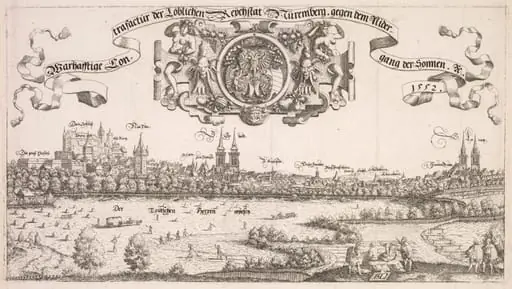 Panoramic View of Nuremberg: Center Portion
![View of Nuremberg from the East [right section], by Hanns Lautensack](https://artifactworldgallery.com/img/hanns-lautensack--view-of-nuremberg-from-the-east-right-section--cd9d20af411c0891-w320.webp) View of Nuremberg from the East [right section]
View of Nuremberg from the East [right section]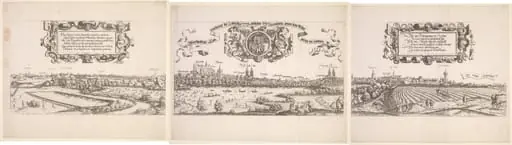 Panoramic View of Nuremberg
![View of Nuremberg from the West [right section], by Hanns Lautensack](https://artifactworldgallery.com/img/hanns-lautensack--view-of-nuremberg-from-the-west-right-section--8f7bb033ee717b8e-w320.webp) View of Nuremberg from the West [right section]
View of Nuremberg from the West [right section]![View of Nuremberg from the West [left section], by Hanns Lautensack](https://artifactworldgallery.com/img/hanns-lautensack--view-of-nuremberg-from-the-west-left-section--8ac5006101a371ac-w320.webp) View of Nuremberg from the West [left section]
View of Nuremberg from the West [left section]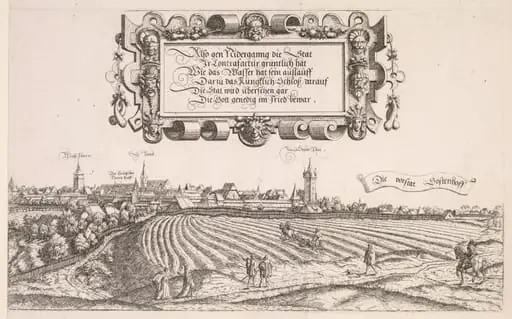 Panoramic View of Nuremberg: Right Portion
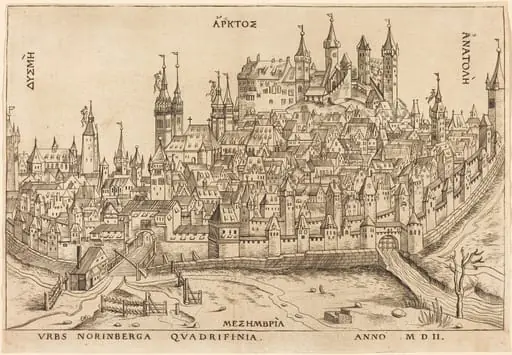 Nuremberg
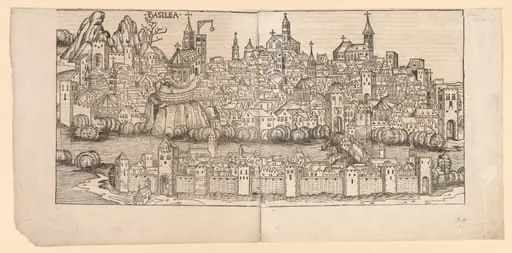 Nuremberg Chronicle: Topographical View of Basle, Switzerland