Artwork
Rustic Building among Roman Ruins
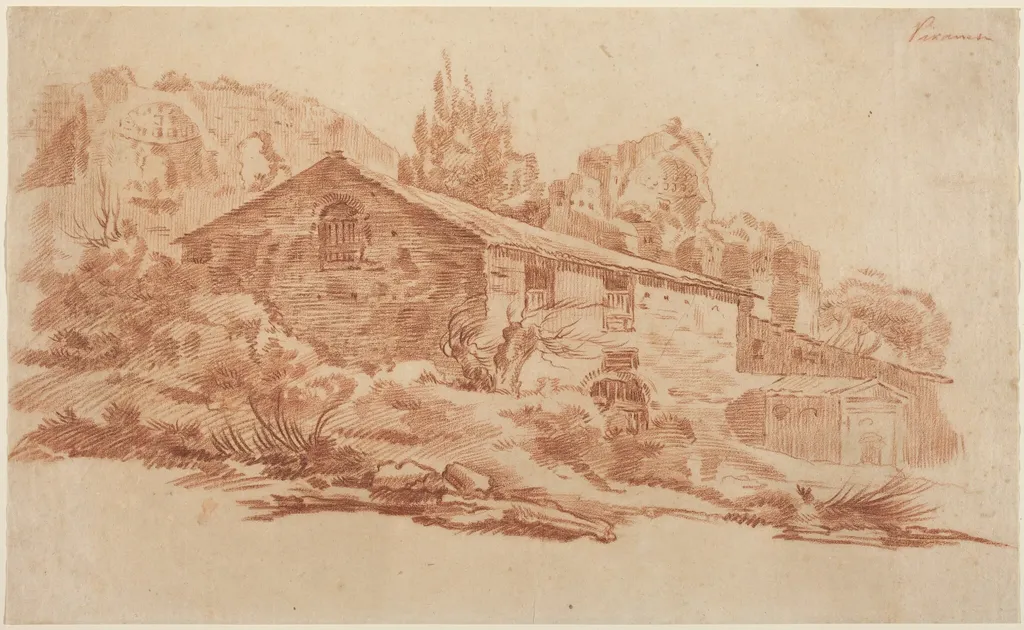
Rustic Building among Roman Ruins is a chalk drawing by the Baroque artist Aureliano Milani. It dates from 1712 and is held in the collection of the National Gallery of Art.
About this work
Overview
Created in 1712, this red chalk drawing by Aureliano Milani presents a quiet confrontation between rural architecture and the remnants of ancient Rome.
Created in 1712, this red chalk drawing by Aureliano Milani presents a quiet confrontation between rural architecture and the remnants of ancient Rome. Executed on laid paper, the work exemplifies the artist’s skill in capturing texture and atmosphere with minimal means. Its modest scale and intimate scale contrast with the grandeur of the ruins it depicts, suggesting contemplation rather than spectacle.
Subject & Meaning
The drawing centers on a simple, weathered structure nestled among crumbling Roman masonry. The juxtaposition of humble domestic life with the decay of imperial architecture implies a meditation on time, memory, and the persistence of the everyday. Nature—trees and shrubs—grows through the ruins, reinforcing a theme of organic renewal overtaking human-made monuments.
Technique & Style
Milani employed red chalk with precision, using varied pressure to model stone surfaces and foliage. The warm tones of the medium lend a soft luminosity to the scene, while delicate hatching defines the texture of walls and leaves. His approach reflects the Bolognese tradition of careful draftsmanship, blending observational detail with a restrained Baroque sensibility focused on harmony rather than drama.
History & Provenance
Milani, trained in Bologna under Cesare Gennari and Lorenzo Pasinelli, moved to Rome where he produced numerous drawings despite limited financial means. This work likely originated from his studies of antiquities in the Roman countryside, a common practice among artists seeking to reconcile classical forms with contemporary life. Its survival suggests it was valued as a study or personal record rather than a finished exhibition piece.
Context
In early 18th-century Rome, artists frequently sketched ruins as part of scholarly engagement with antiquity. Milani’s work aligns with a broader trend of topographical drawing that prioritized accuracy and atmospheric effect over idealization. Unlike grand historical paintings, this piece captures a quiet, unidealized moment, reflecting the growing interest in the everyday and the passage of time.
Legacy
Though Milani is not widely known today, this drawing exemplifies the quiet rigor of late-Baroque draftsmanship in Italy. It contributes to a lesser-known but significant body of work by artists who documented ruins not as monuments, but as lived environments. Its understated presence continues to inform studies of how artists engaged with historical space in the decades before the rise of Neoclassicism.
Artist & collection

Artist
Aureliano Milani (1675 – 1749) was an Italian painter of the late-Baroque period, active in Bologna and Rome both of which were part of the Papal States.

 Gardens of the Villa Mattei
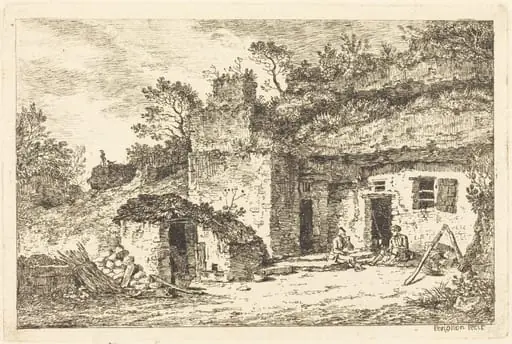 A Cottage with Two Men Seated at the Doorway
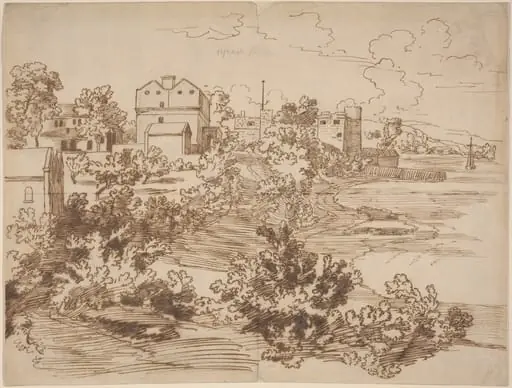 Upnor Castle
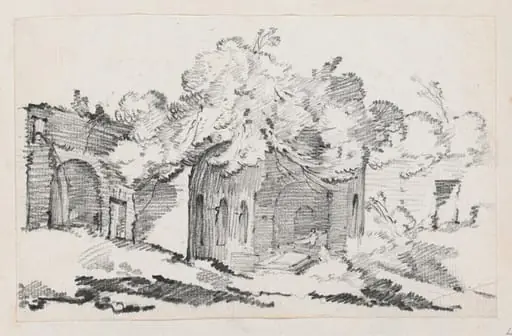 The Grotto of the Nymph Egeria
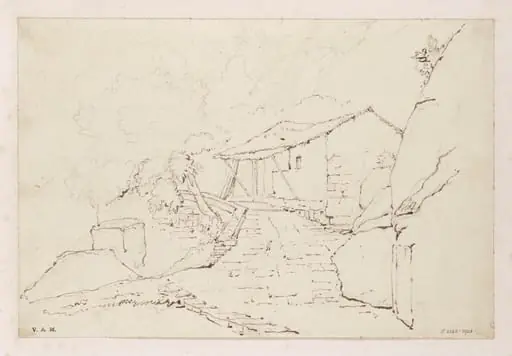 A small building on a rocky hillside, Macau
 An Alpine Village in Summertime
 A Shady Arbor in the Valley of Gragnano
 Rocks, and part of the Great Joss House, Macao
 Ruins of the Swedish Factory, Macao, 1831
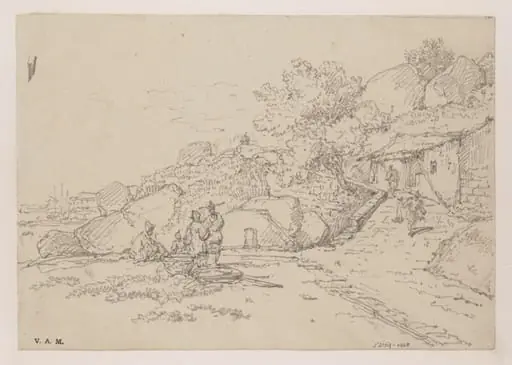 A small building on a rocky hillside, with a group of figures and the bay at left
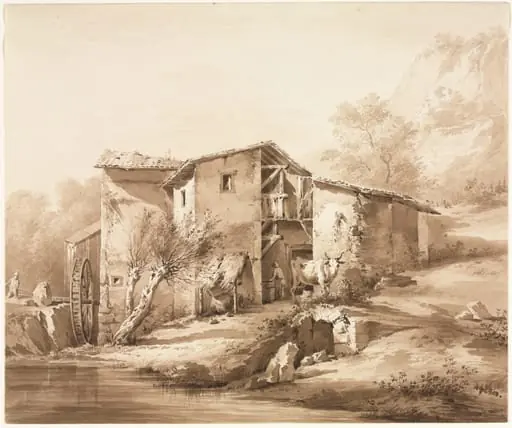 Landscape with Watermill
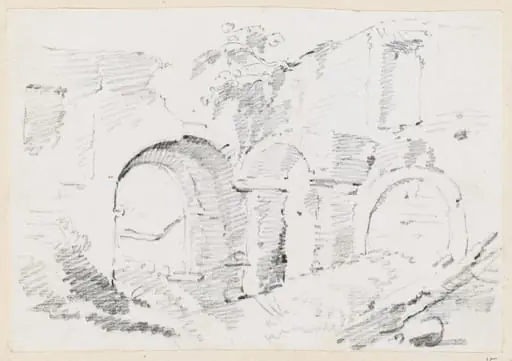 Roman Walls