Artwork
On the Road, A Lady of the Genkō Era (1313-34), from the series Thirty-Six Elegant Selections
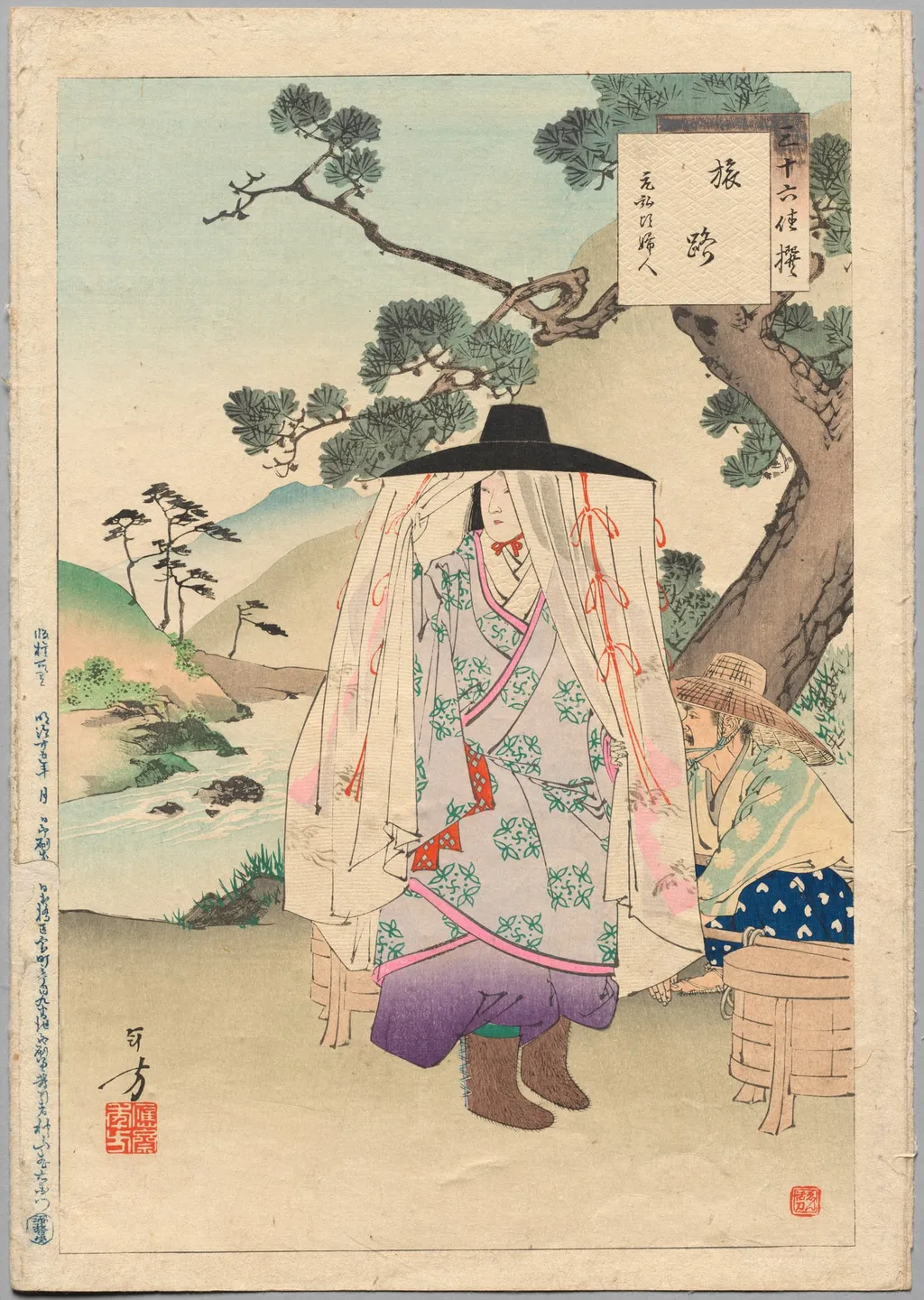
On the Road, A Lady of the Genkō Era (1313-34), from the series Thirty-Six Elegant Selections is a print by the Impressionist artist Mizuno Toshikata. It dates from 1894 and is held in the collection of the Cleveland Museum of Art.
About this work
At that time, Japan was rapidly modernizing, yet artists like Mizuno Toshikata still looked to the past.
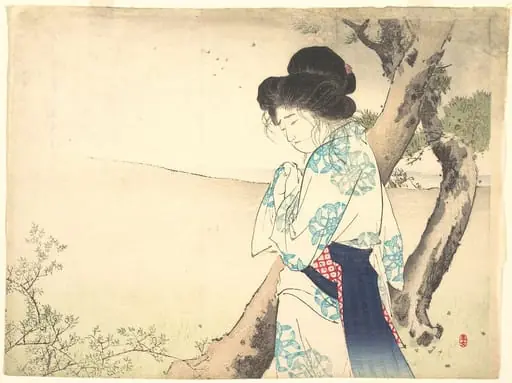
A woman in elegant Heian-era robes walks on a country road, holding a fan. Tall grass and trees frame her quiet path. She looks calm, apart from the world.
This print is part of a series showing women from different times in Japanese history. Though set in the distant Genkō era (1313–1334), it was made in 1894, during the Meiji period. At that time, Japan was rapidly modernizing, yet artists like Mizuno Toshikata still looked to the past. He once studied under Tsukioka Yoshitoshi, a leading figure in late Edo printmaking.
Look up the meiji period (1868–1912) to understand the world in which this image was created.
(Word count: 112)
Overview
“On the Road, A Lady of the Genkō Era (1313‑34)” is a woodblock print from Mizuno Toshikata’s 1894 series Thirty‑Six Elegant Selections. The series pairs a single female figure with a historical period, presenting a visual essay on Japanese chronology. This particular sheet depicts a woman in Heian‑style court dress walking along a rural lane, her composure contrasted with the surrounding tall grasses and trees.
Subject & Meaning
The figure represents a noblewoman from the Genkō era, a brief period of imperial rule in the early 14th century. By portraying her in a tranquil, solitary stroll, the image evokes an idealized vision of aristocratic poise and the timeless elegance associated with courtly life, inviting contemplation of Japan’s distant past.
Technique & Style
Executed in the late‑Meiji woodblock tradition, the print combines delicate line work for the kimono’s pattern with broader, flat areas of color that define the landscape. Toshikata’s handling of perspective—using the road’s vanishing point and the framing grasses—creates depth while maintaining the flat aesthetic characteristic of ukiyo‑e.
History & Provenance
Mizuno Toshikata (1859‑1910) was a prominent disciple of Tsukioka Yoshitoshi, the leading Edo‑period printmaker. After Yoshitoshi’s death, Toshikata succeeded him as a newspaper illustrator, bridging traditional printmaking with modern mass media. The print was produced in 1894, during the Meiji era’s rapid modernization, yet it reflects a nostalgic turn toward historical subjects.
Context
The Meiji period (1868‑1912) saw Japan embracing industrialization and Western influences while simultaneously cultivating a national identity rooted in historic imagery. Series such as Thirty‑Six Elegant Selections catered to a market eager for visual connections to a romanticized past, offering both educational and decorative value.
Legacy
While not as widely cited as Yoshitoshi’s works, Toshikata’s series contributes to the late‑19th‑century revival of historical genre prints. It illustrates how Meiji artists negotiated tradition and modernity, preserving classical motifs within a contemporary commercial framework.
Artist & collection


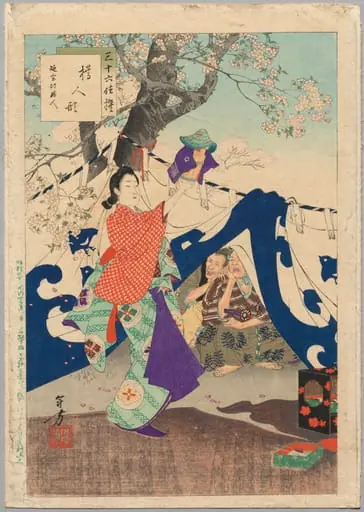 A Puppet Made from a Bucket, A Lady of the Enpō Era (1673–1681), from the series Thirty-six Elegant Selections
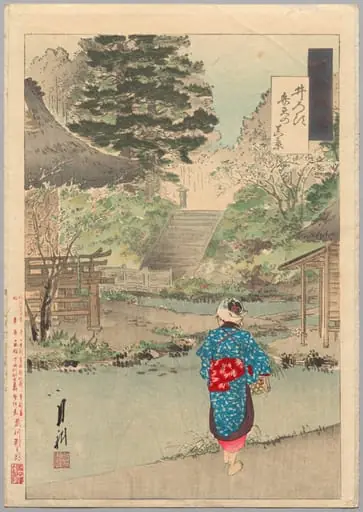 True View of Benten at Inokashira from the series Gekkō’s Miscellaney
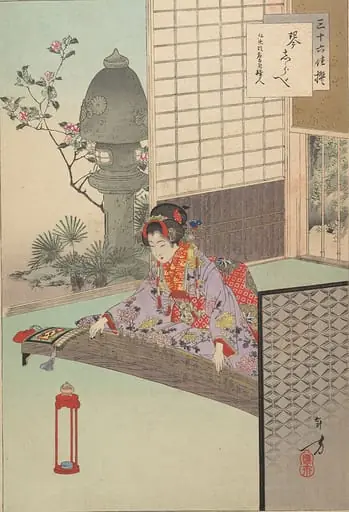
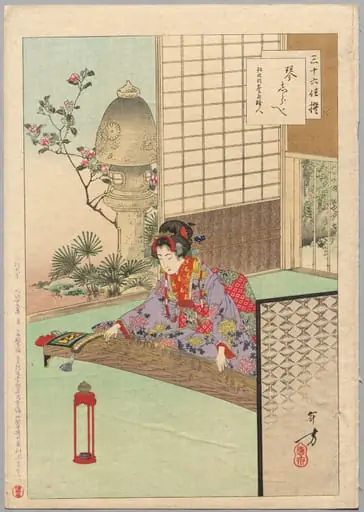 Playing the Koyo, A Lady from Nagoya of the Kōka Era (1844-48), from the series Thirty-six Elegant Selections
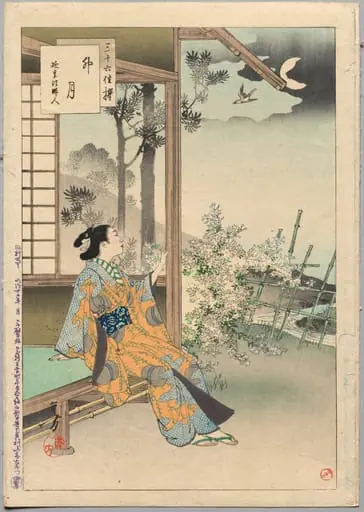 The Fourth Month, A Lady of the Enkyō Era (1744-48), from the series Thirty-six Elegant Selections
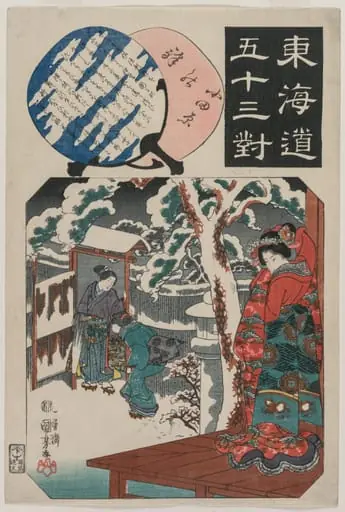 Odawara Station: Minamoto Yoritomo Visits the Daughter of Ito Nyudo (from the series Fifty-three Paired Illustrations for the Tokaido)
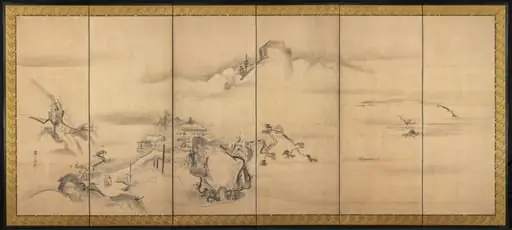 Eight Views of the Xiao and Xiang Rivers