Artwork
The Angel Appearing to Hagar in the Desert
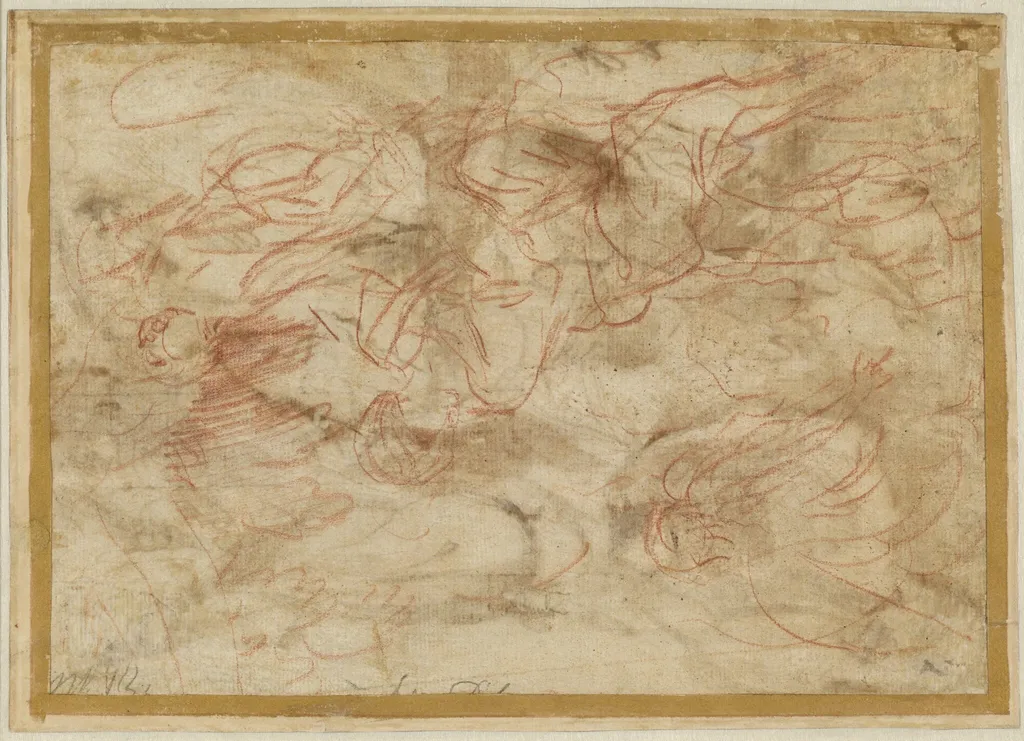
The Angel Appearing to Hagar in the Desert is a chalk drawing by the Baroque artist Pier Francesco Mola. It dates from 1660 and is held in the collection of the National Gallery of Art.
About this work
The painting is called The Angel Appearing to Hagar in the Desert.
It was made by Pier Francesco Mola around 1660.
The artist used red chalk on laid paper to create this work, which is part of the Baroque movement, a style known for dramatic lighting and intense emotions.
You can learn more about this style by looking into the movement: Baroque.
Overview
Mola, active in Rome during the High Baroque period, favored expressive draftsmanship over grand scale.
Created around 1660, this drawing by Pier Francesco Mola is a small-scale work in red chalk on laid paper, reflecting the artist’s interest in intimate religious subjects. Mola, active in Rome during the High Baroque period, favored expressive draftsmanship over grand scale. The piece belongs to a body of work that bridges preparatory studies and finished compositions, showcasing his skill in capturing fleeting moments with sensitivity.
Subject & Meaning
The drawing illustrates the biblical moment from Genesis when Hagar, abandoned in the desert with her son Ishmael, is visited by an angel who promises divine protection. Mola focuses on the emotional encounter between the weary woman and the celestial messenger, emphasizing vulnerability and revelation. The scene underscores themes of divine intervention in human despair, a common motif in Counter-Reformation art.
Technique & Style
Mola employed red chalk with fluid, expressive strokes to model form and suggest atmosphere. The loose handling contrasts with the tighter precision of many Roman contemporaries, lending the scene a sense of immediacy. Soft tonal gradations define the desert landscape and the figures’ drapery, while the angel’s presence is rendered with delicate, luminous lines that seem to emerge from the paper’s texture.
History & Provenance
The drawing has remained within private and institutional collections since the 17th century, though its early ownership is undocumented. It was likely produced as a standalone work rather than a study for a larger painting, indicating Mola’s recognition of the drawing’s artistic value. Its survival reflects continued appreciation for Baroque graphic art beyond major commissions.
Context
In mid-17th-century Rome, religious subjects dominated artistic production, especially among artists trained in the tradition of Caravaggio and Annibale Carracci. Mola’s approach, blending naturalism with emotional restraint, aligned with evolving tastes that favored intimate devotion over theatrical spectacle. This drawing exemplifies how biblical narratives were rendered for private contemplation rather than public display.
Legacy
Mola’s use of red chalk in this work influenced later draftsmen interested in expressive line and atmospheric depth. Though less celebrated than his frescoes, this drawing illustrates his contribution to the development of Baroque graphic art. It remains a quiet but significant example of how religious themes were explored through the subtleties of drawing rather than monumental painting.
Artist & collection

Artist
Pier Francesco Mola, called Il Ticinese was an Italian painter of the High Baroque, mainly active around Rome.

![Jael and Cisera? [verso], by Parmigianino](https://artifactworldgallery.com/img/parmigianino--jael-and-cisera-verso--59c94a4b5c5290be-w320.webp) Jael and Cisera? [verso]
Jael and Cisera? [verso] Coronation of the Virgin
 Resurrected Christ and Lamb of God (verso)
 Apotheosis of Saint George
![Sheet of Studies [recto and verso], by John Flaxman](https://artifactworldgallery.com/img/john-flaxman--sheet-of-studies-recto-and-verso--adecfee0d85e12e5-w320.webp) Sheet of Studies [recto and verso]
Sheet of Studies [recto and verso]![Sheet of Studies with the Drunken Pan and Nymphs [verso], by Jacob Jordaens](https://artifactworldgallery.com/img/jacob-jordaens--sheet-of-studies-with-the-drunken-pan-and-nymphs-verso--7da29549b59c490a-w320.webp) Sheet of Studies with the Drunken Pan and Nymphs [verso]
Sheet of Studies with the Drunken Pan and Nymphs [verso] The Flight into Egypt
 Sheet of Studies
![Kneeling Woman [verso], by Zanguidi, called Bertoia, Jacopo](https://artifactworldgallery.com/img/zanguidi-called-bertoia-jacopo--kneeling-woman-verso--fb904e93478d9417-w320.webp) Kneeling Woman [verso]
Kneeling Woman [verso] An Angel Carrying a Torch
 Venus Disarming Mars, Drapery Study (verso)
 The Last Judgment