Artwork
Jupiter couvre la Terre de Nuages pour jouir d'Io
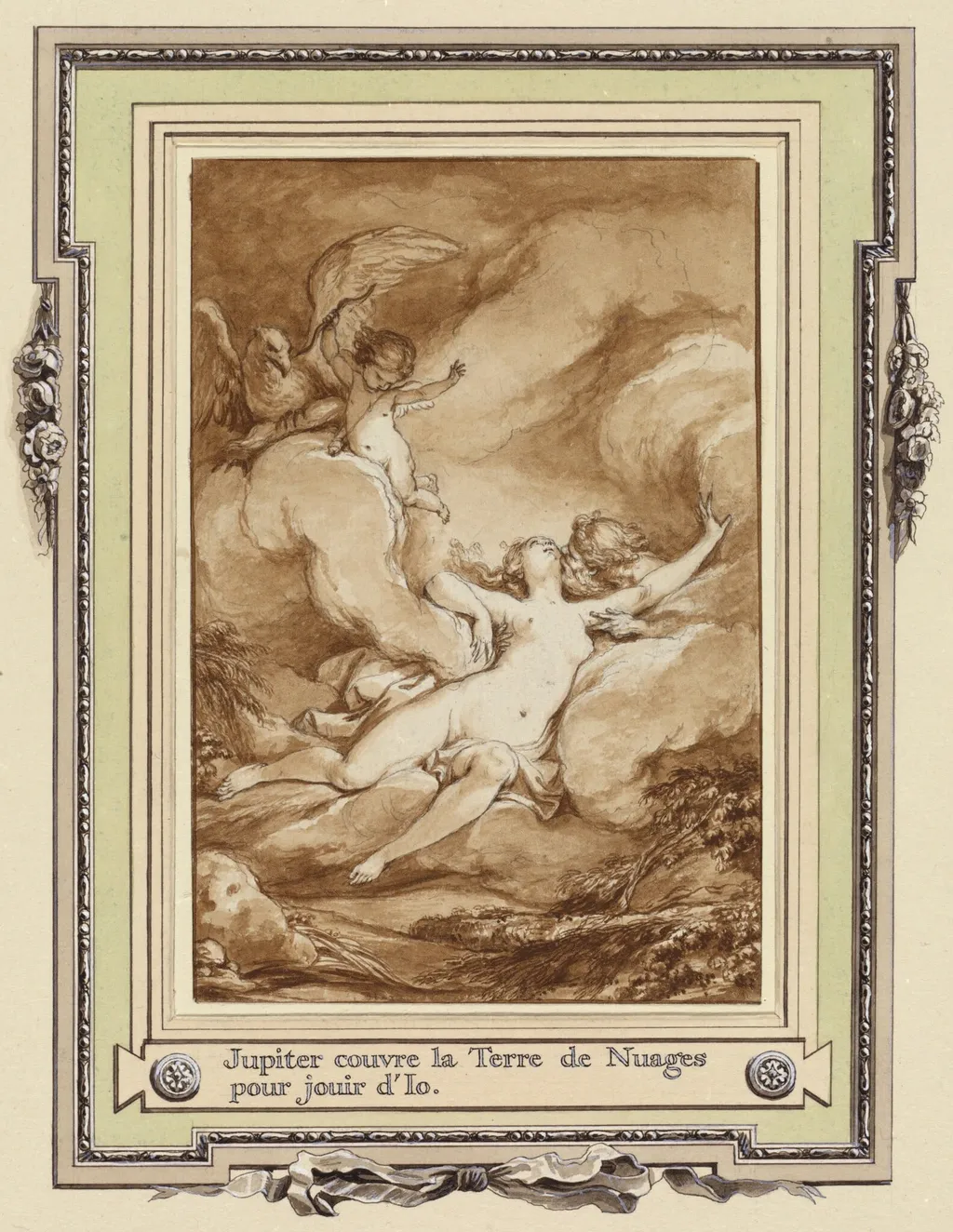
Jupiter couvre la Terre de Nuages pour jouir d'Io is an ink drawing by the Romanticist artist Charles Monnet. It dates from 1769 and is held in the collection of the National Gallery of Art.
About this work
Overview
The composition centers on a large male figure atop a bull, surrounded by two smaller human forms, all set against a sky dominated by swirling clouds.
Created in 1769 by Charles Monnet, this drawing depicts a scene from Greek mythology using pen, black ink, brush, brown ink, and wash over graphite. The composition centers on a large male figure atop a bull, surrounded by two smaller human forms, all set against a sky dominated by swirling clouds. The work is executed with delicate tonal gradations and precise linear detail, reflecting the artist’s command of ink techniques to suggest both weight and atmosphere.
Subject & Meaning
The scene illustrates the myth of Jupiter, who, to conceal his affair with the nymph Io from his wife Juno, shrouds the earth in clouds. The muscular figure represents Jupiter, the bull his transformed form, while Io is the woman restrained beneath him. A third figure, possibly a witness or attendant, observes from the periphery. The title explicitly links the visual elements to this classical narrative, emphasizing divine deception and the concealment of desire.
Technique & Style
Monnet employed layered washes to create atmospheric depth, particularly in the cloud-filled sky, while fine pen lines define the figures and terrain. Cross-hatching builds texture in the rocky ground and musculature, and graphite underdrawing guides the composition’s structure. The brown ink adds warmth and volume, contrasting with the sharpness of black ink outlines. The technique balances spontaneity with control, typical of 18th-century draftsmanship focused on narrative clarity.
History & Provenance
The drawing was completed in 1769, during Monnet’s active period as a French illustrator and decorative artist. It likely originated as a preparatory study or independent work for a larger commission, possibly related to mythological decoration. While its early ownership is undocumented, it has been preserved in institutional collections since at least the 19th century, reflecting its recognition as a refined example of French draftsmanship of the period.
Context
In mid-18th-century France, mythological subjects remained popular in academic art, often serving as vehicles for exploring human emotion and divine power. Monnet, though less known than his contemporaries, contributed to this tradition through detailed drawings intended for private or scholarly audiences. This work aligns with a broader interest in classical narratives, rendered with sensitivity to anatomy and naturalistic detail, even in intimate formats.
Legacy
The drawing endures as a quiet testament to the continued vitality of mythological themes in French drawing practice. Though not widely exhibited, it exemplifies the technical precision and narrative economy valued in academic circles. Its preservation highlights the importance of preparatory works in understanding artistic processes of the period, offering insight into how myth was visually interpreted beyond grand-scale paintings.
Artist & collection