Artwork
The Great Flood
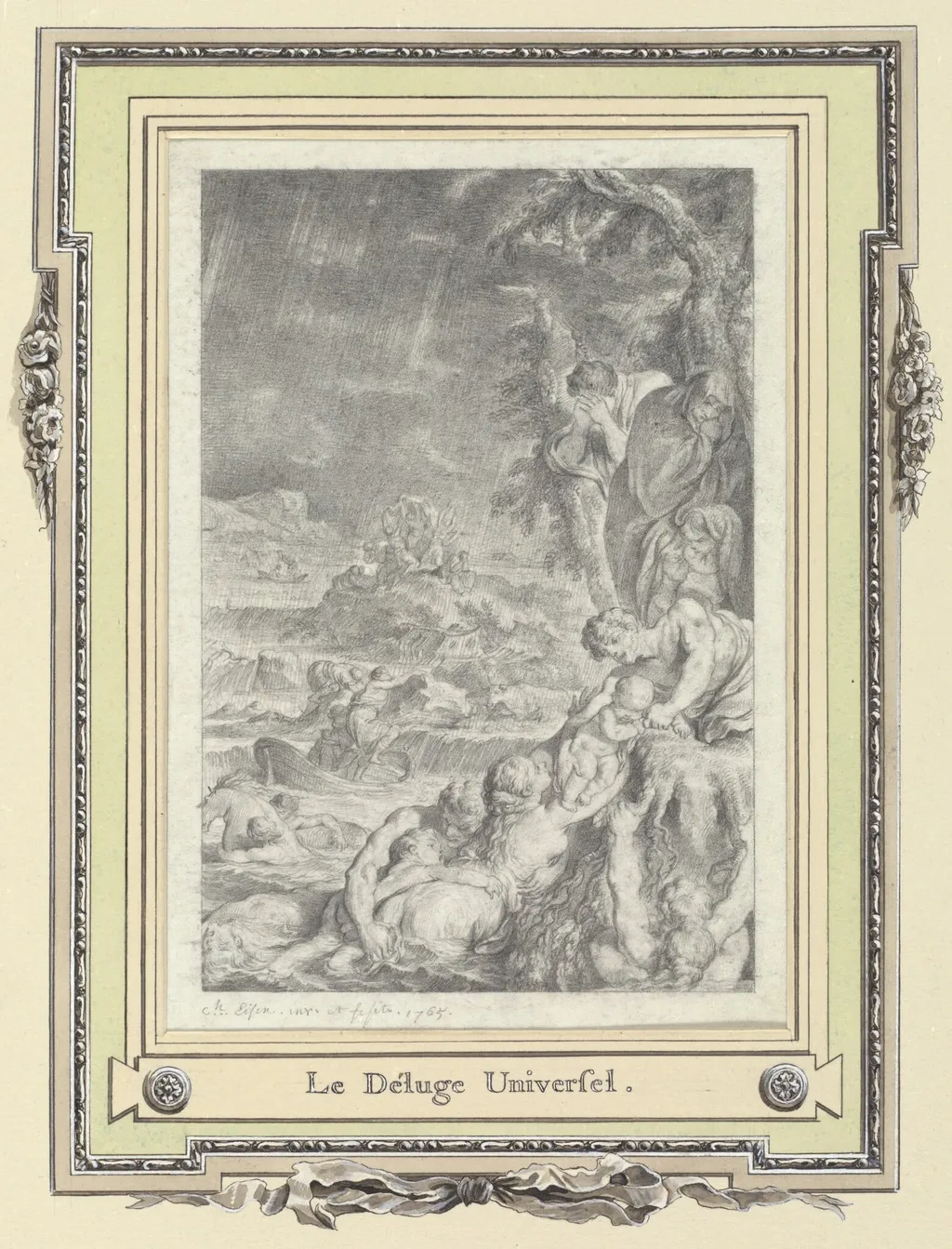
The Great Flood is a graphite drawing by the Romanticist artist Charles Eisen. It dates from 1765 and is held in the collection of the National Gallery of Art.
About this work
Overview
Charles Eisen’s drawing titled The Great Flood, executed in 1765, is a graphite work on vellum. Rendered in monochrome, the piece captures a tumultuous moment when rising waters overwhelm a populated landscape. The composition is dominated by frantic human and animal figures, precariously clinging to rocks or adrift in the surge, set against a sky heavy with dark clouds.
Subject & Meaning
The scene portrays a catastrophic inundation, emphasizing the vulnerability of people and livestock in the face of natural disaster.
The scene portrays a catastrophic inundation, emphasizing the vulnerability of people and livestock in the face of natural disaster. Expressions of fear and fatigue on the figures convey a collective panic, while the engulfed boats and collapsing structures suggest the sudden, indiscriminate power of floodwaters. The work can be read as a visual meditation on humanity’s fragility when confronted with elemental forces.
Technique & Style
Eisen employs graphite’s full tonal range to create stark chiaroscuro, juxtaposing deep shadows with sharply lit areas that suggest a faint, distant glow. The drawing’s lines are loose and sketchy, imparting a sense of immediacy and raw energy. This economical use of line and contrast heightens the drama, allowing the viewer to feel the urgency of the depicted chaos without reliance on color.
History & Provenance
Created in the mid‑eighteenth century, The Great Flood reflects the period’s growing interest in dramatic narrative drawing. While specific ownership records are limited, the work has been documented in several collections of Eisen’s drawings, indicating its inclusion in the artist’s broader output of illustrative studies that explored human response to extreme events.
Artist & collection