Artwork
Untitled
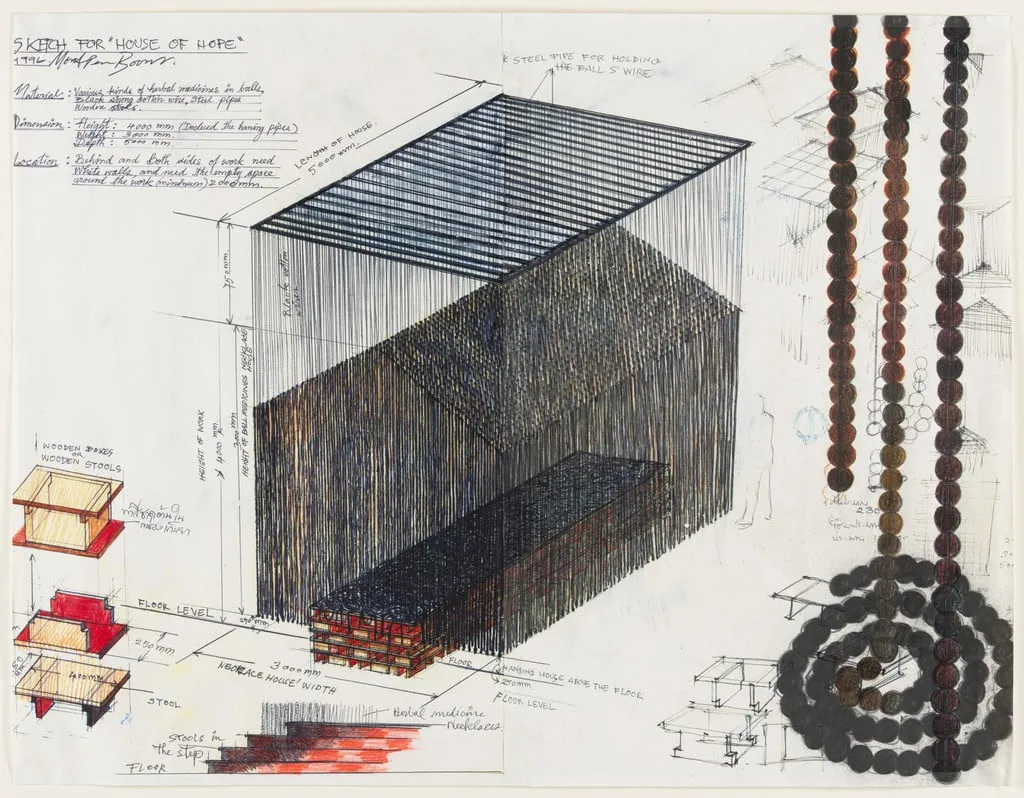
Untitled is a charcoal drawing by Montien Boonma. It dates from 1996 and is held in the collection of the Museum of Modern Art. Created in 1996, this work is a digital print augmented by hand-applied charcoal, crayon, ink, and white-out on two joined sheets.
About this work
Overview
It functions as a hybrid drawing—part architectural plan, part personal annotation—blending mechanical reproduction with intimate, tactile marks.
Created in 1996, this work is a digital print augmented by hand-applied charcoal, crayon, ink, and white-out on two joined sheets. It functions as a hybrid drawing—part architectural plan, part personal annotation—blending mechanical reproduction with intimate, tactile marks. The piece is held in the collection of The Museum of Modern Art, where it is cataloged as a drawing despite its mixed-media foundation.
Subject & Meaning
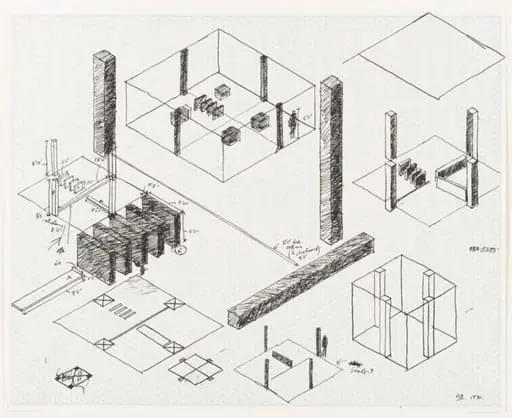
The drawing outlines a structure titled *House of Hope*, rendered not as an idealized vision but as a functional, almost utilitarian space. Elements like hanging wires, wooden stools, and a necklace suggest domestic life intertwined with spiritual or ritual undertones. The inclusion of personal objects alongside structural details implies a space designed for contemplation, memory, or healing, rather than mere shelter.
Technique & Style
The composition merges precise digital lines with erratic hand-drawn additions, creating a tension between order and spontaneity. Measurements and material notes—steel pipes, cloth—are inscribed directly onto the surface, treating the page as a working document. Close-up studies of colored beads anchor the composition’s right side, shifting focus from architecture to intimate, tactile detail.
History & Provenance
The work was produced during a period when Montien Boonma increasingly explored architecture as a vehicle for spiritual and sensory experience. It entered The Museum of Modern Art’s collection shortly after its creation, recognized for its unique synthesis of conceptual art, design, and personal ritual. No prior exhibition history is widely documented beyond its acquisition.
Context
Boonma’s practice in the 1990s moved away from traditional sculpture toward immersive, site-sensitive environments informed by Buddhist thought and Thai healing traditions. This drawing reflects that shift: it is not a proposal for construction but a meditation on space as a container for human presence, memory, and quiet ritual.
Legacy
The work exemplifies Boonma’s broader contribution to redefining drawing as a tool for embodied thought. Its blend of technical notation and poetic detail influenced later artists working at the intersection of architecture, performance, and spiritual practice. It remains a key example of how drawing can serve as both blueprint and meditation.
Artist & collection