Artwork
The Edge of the Swamp
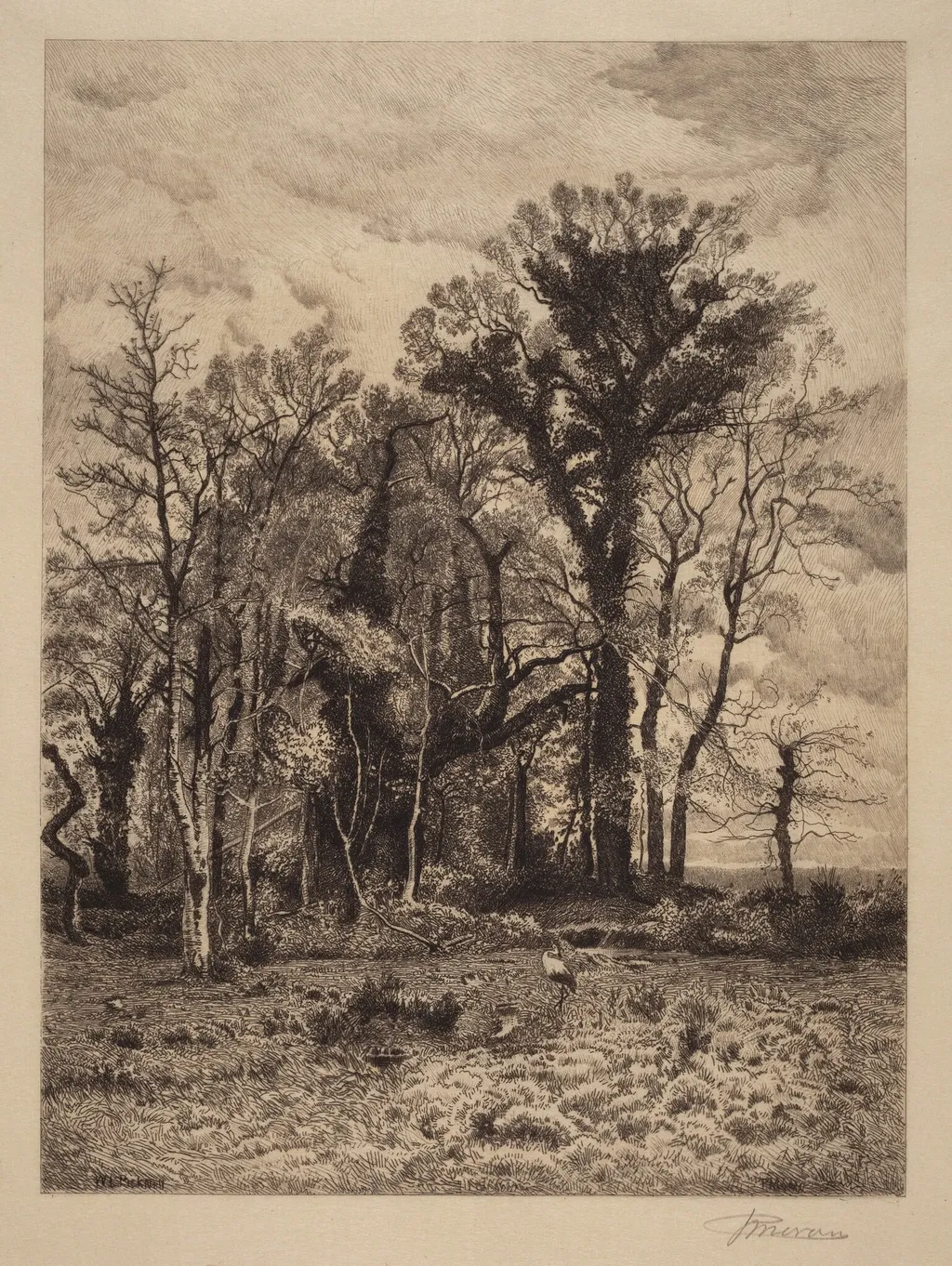
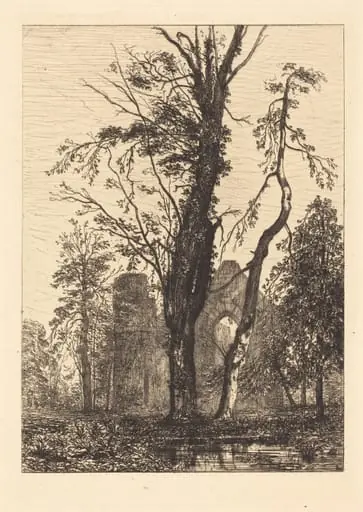
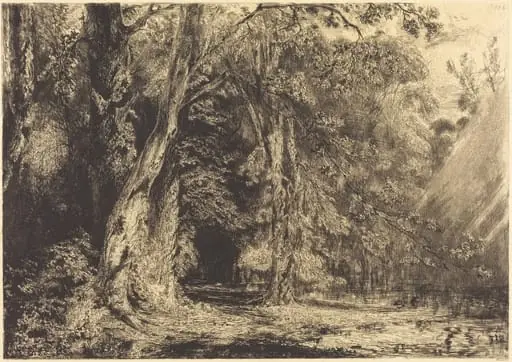
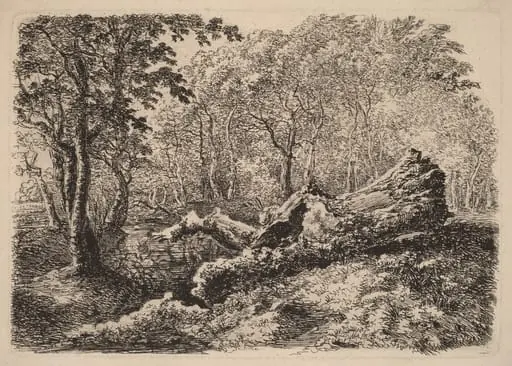
The Edge of the Swamp is an ink print by the Impressionist artist Peter Moran. It dates from 1886 and is held in the collection of the National Gallery of Art.
About this work
Overview
The composition emphasizes spatial depth and natural texture through the precision of etched lines, characteristic of late 19th-century American printmaking.
Created in 1886, The Edge of the Swamp is a black ink etching on wove paper by American artist Peter Moran. The work presents a quiet, unpopulated landscape centered on a solitary, gnarled tree, flanked by denser vegetation and receding into a distant stretch of water. The composition emphasizes spatial depth and natural texture through the precision of etched lines, characteristic of late 19th-century American printmaking.
Subject & Meaning
The scene captures a transitional zone between land and water, where vegetation grows thickly but yields to open space. The central tree, weathered and dominant, suggests endurance amid encroaching wetland. There is no human presence, and the mood remains contemplative rather than dramatic, reflecting an interest in the quiet rhythms of the natural world rather than its sublime or threatened aspects.
Technique & Style
Moran employed etching to render fine, controlled lines that define foliage, bark, and grass with delicate variation. The inked lines create contrast between dense undergrowth and the lighter, open ground, guiding the viewer’s eye from foreground to distant water. The use of wove paper, smooth and absorbent, enhances the clarity of the etched details, typical of technical prints produced for private collections in this period.
History & Provenance
The print was made during Moran’s active years in Philadelphia, where he was known for landscape etchings inspired by regional environments. Though not widely exhibited at the time, it was likely produced for sale through print dealers or art societies. Its survival in institutional collections suggests early recognition of its technical merit within American print circles.
Context
In the 1880s, American artists increasingly turned to intimate natural scenes as industrialization reshaped the landscape. Etching, once a reproductive medium, was revived by artists seeking personal expression. Moran’s work aligns with this movement, emphasizing observed detail over idealization, and reflecting a broader cultural interest in preserving the visual record of vanishing wild spaces.
Legacy
The Edge of the Swamp remains a representative example of late 19th-century American etching, valued for its restrained composition and technical discipline. While not widely reproduced in popular media, it continues to be studied for its contribution to the revival of etching as a fine art medium in the United States, particularly in regional landscape traditions.
Own this work as a print
Artist & collection
Artist
Peter Moran (March 4, 1841 – November 9, 1914) was a British-born American painter and etcher.

![Bosco [Woods], by Mosè Bianchi](https://artifactworldgallery.com/img/mose-bianchi--bosco-woods--c857997776805c86-w320.webp)