Artwork
Two Persian Horsemen
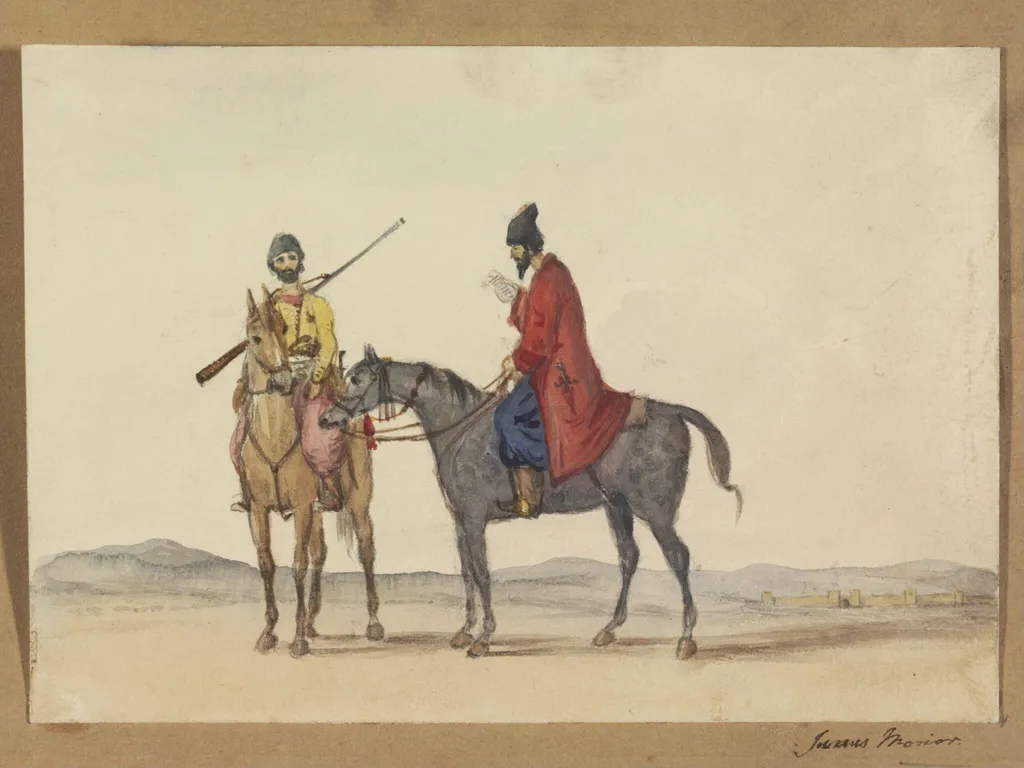
Two Persian Horsemen is a watercolor work on paper by the Orientalist artist James Justinian Morier. It dates from 1811 and is held in the collection of the Victoria and Albert Museum.
About this work
Overview
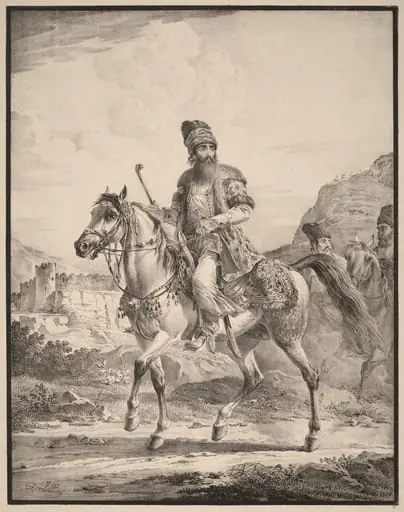
James Justinian Morier’s watercolour, dated 1811, portrays a pair of mounted figures dressed in Persian costume. The composition places the riders against a muted, distant landscape, their horses turned toward one another, creating a balanced visual dialogue.
Subject & Meaning
The two horsemen, one in a yellow jacket with a long rifle and the other in a red coat with blue trousers, are rendered in traditional Persian attire, suggesting a scene of travel or patrol within an Eastern setting. Their headgear and the detailed harnesses emphasize cultural specificity.
Technique & Style
Executed in watercolour, the work achieves a soft, atmospheric effect through blended washes and delicate tonal transitions. Morier’s handling of pattern—particularly the intricate designs on the clothing and tack—demonstrates a careful observational approach typical of early‑19th‑century Orientalist draftsmen.
History & Provenance
The painting is associated with the diplomatic Ouseley mission to Persia, and its visual style bears resemblance to contemporary sketches by J. D’Arcy. It entered the market when sold at Christie’s in February 1969, purchased from P. Heathcote‑Williams for £2 and 10 shillings.
Context
Created during a period of heightened British interest in Persia, the work reflects the era’s fascination with Eastern dress and customs, a theme recurrent in Morier’s broader oeuvre of diplomatic and travel illustrations.
Artist & collection
Artist
James Morier put watercolor to paper to capture scenes from Persia in the early 1800s.

![A Shaykh with his Son[?] on Mules, with their Sais [groom], by S. Bossi](https://artifactworldgallery.com/img/s-bossi--a-shaykh-with-his-son-on-mules-with-their-sais-groom--240d85ba529e2bf3-w320.webp) A Shaykh with his Son[?] on Mules, with their Sais [groom]
A Shaykh with his Son[?] on Mules, with their Sais [groom] Arabians and Turkoman Horse the property of Sir J. C - - with Persians
 Persian Kalian Bearer
 Two armed figures on horseback, probably Mamluks
![Mounted crusader [?] holding discussion with standing man, by Unknown](https://artifactworldgallery.com/img/unknown--mounted-crusader-holding-discussion-with-standing-man--9b99697bca24a72f-w320.webp) Mounted crusader [?] holding discussion with standing man
Mounted crusader [?] holding discussion with standing man![A Mounted Mamluk with his Sais [Groom], by S. Bossi](https://artifactworldgallery.com/img/s-bossi--a-mounted-mamluk-with-his-sais-groom--93e3f53d48765120-w320.webp) A Mounted Mamluk with his Sais [Groom]
A Mounted Mamluk with his Sais [Groom]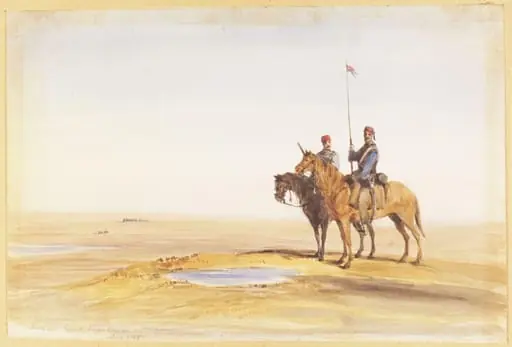 Turkish Piquets
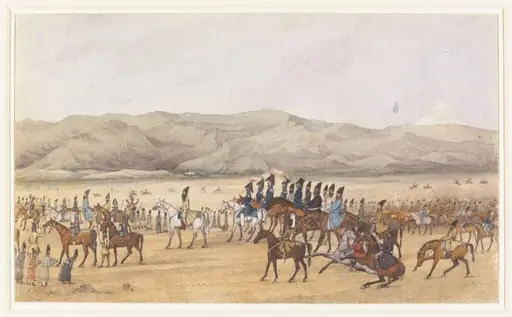 Istakball or public entry of H. R. H. Abbas Mirza at Tehran after the Campaign in Khorassan on the 15th. of June 1833
![A Pasha travelling with his escort[?], by Anonymous Greek artist](https://artifactworldgallery.com/img/anonymous-greek-artist--a-pasha-travelling-with-his-escort--01de32b8fcf30843-w320.webp) A Pasha travelling with his escort[?]
A Pasha travelling with his escort[?]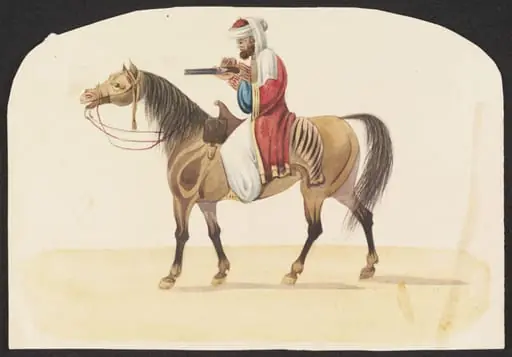 Mounted horseman loading gun
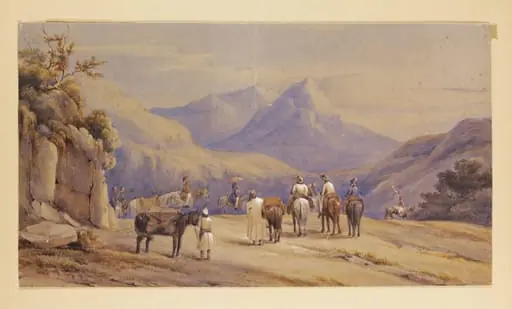 Ousreff Pasha returning to Joannina
 A Persian on Horseback