Artwork
Istakball or public entry of H. R. H. Abbas Mirza at Tehran after the Campaign in Khorassan on the 15th. of June 1833
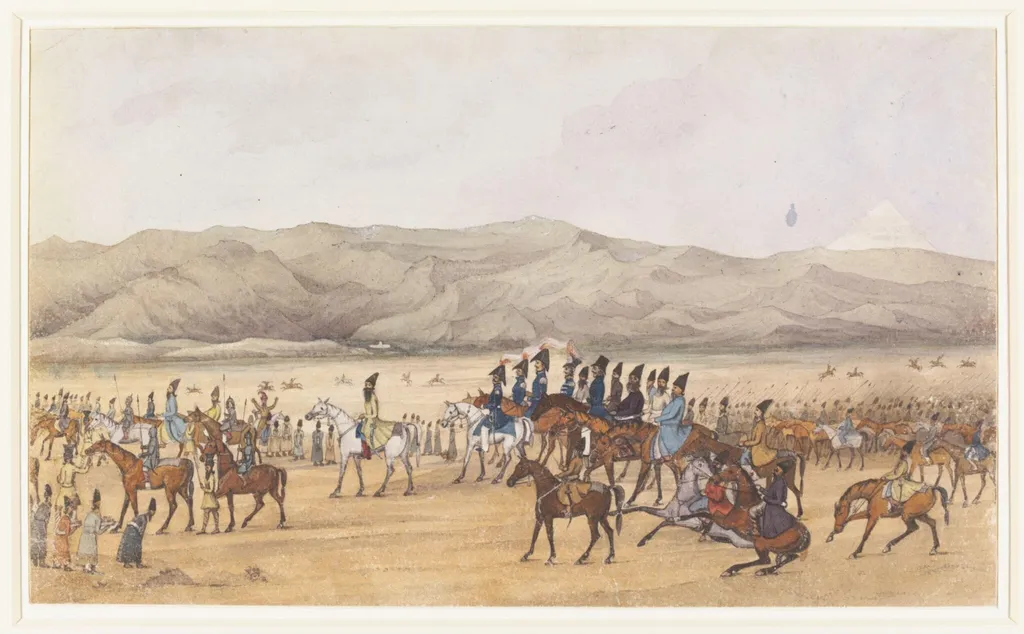
Istakball or public entry of H. R. H. Abbas Mirza at Tehran after the Campaign in Khorassan on the 15th. of June 1833 is a watercolor work on paper by the Patna School of Painting artist Godfrey Thomas Vigne. It dates from 1833 and is held in the collection of the Victoria and Albert Museum.
About this work
Overview
The event, known as Istakball, was a formal public welcome rooted in court tradition.
This watercolour captures the ceremonial reception of Abbas Mirza, crown prince of Qajar Iran, upon his return to Tehran on June 15, 1833, after a military campaign in Khorassan. The event, known as Istakball, was a formal public welcome rooted in court tradition. Painted by British traveler and artist Godfrey Thomas Vigne, the work serves as a visual record of a significant political moment, rendered with observational detail and a documentary intent.
Subject & Meaning
The scene centers on Abbas Mirza, mounted on a white horse and holding a symbol of authority, surrounded by attendants, soldiers, and onlookers. The composition emphasizes his prominence amid a diverse gathering of figures in varied attire, reflecting social hierarchy and the ceremonial nature of the occasion. The open landscape underscores the public character of the event, reinforcing the prince’s visibility and legitimacy as a ruler in the eyes of the populace.
Technique & Style
Vigne employed loose, fluid brushwork and muted watercolour tones to suggest movement and spatial depth. The soft blending of hues conveys atmospheric distance, particularly in the rolling hills and pale sky, while brighter garments on key figures draw the eye toward the central procession. The technique balances precision in detail with a sense of immediacy, characteristic of travel sketches made on-site rather than studio reconstructions.
History & Provenance
Created during Vigne’s travels in Persia, the watercolour was later held within his family until its acquisition by the Victoria and Albert Museum in 1971 from his great-nephew. Vigne documented his journeys in published accounts, including *Travels in Kashmir* (1842), and his visual records offer rare Western eyewitness perspectives of Qajar court rituals. The painting’s survival and institutional preservation reflect its value as a historical document.
Context
In 1833, Abbas Mirza was a central figure in Qajar politics, known for his military reforms and efforts to modernize Iran’s armed forces. His return from Khorassan, following a campaign to quell unrest, was a moment of political significance. The Istakball ceremony reinforced his status and the monarchy’s presence, blending Persian tradition with emerging state rituals. Vigne’s depiction captures this intersection of ceremony and power during a period of transition.
Legacy
As one of the few surviving Western visual records of a Qajar royal ceremony, the watercolour contributes to the understanding of 19th-century Persian court culture through an outsider’s lens. It remains a key reference for scholars studying cross-cultural documentation and the role of visual media in political representation. The piece continues to be studied for its historical accuracy and stylistic approach to ethnographic observation.
Artist & collection


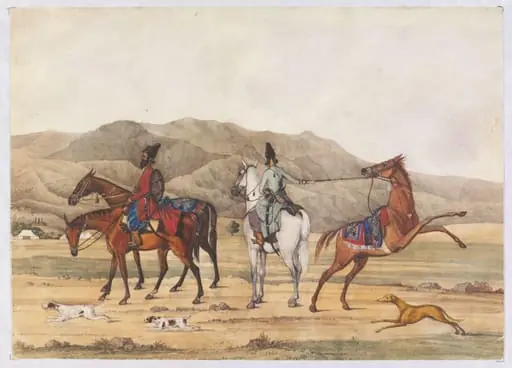 Arabians and Turkoman Horse the property of Sir J. C - - with Persians
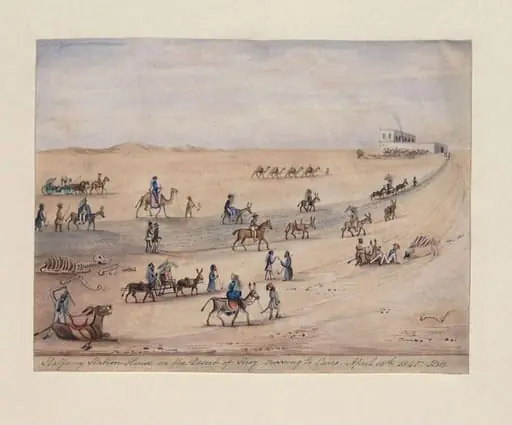 A halfway station house in the desert of Suez crossing to Cairo
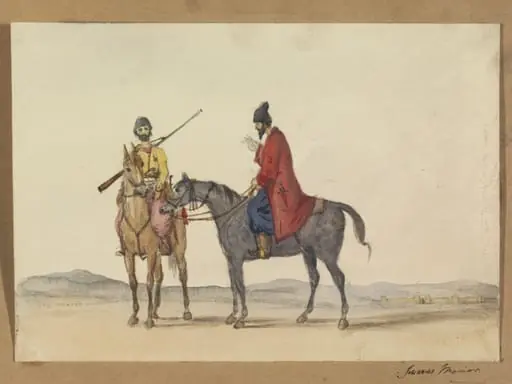 Two Persian Horsemen
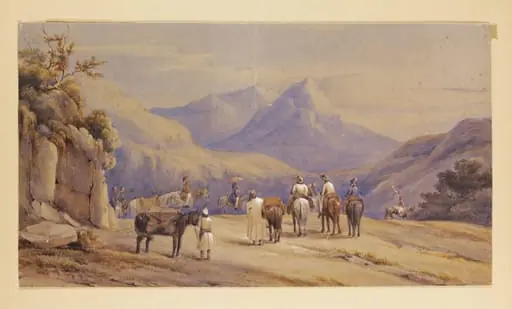 Ousreff Pasha returning to Joannina
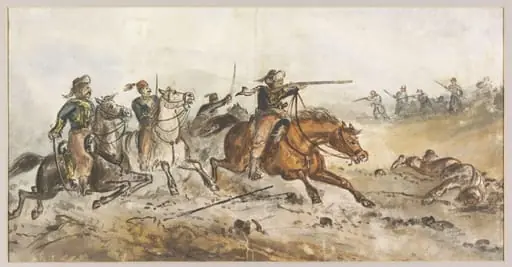 Turkish irregular cavalry charging Russian infantry
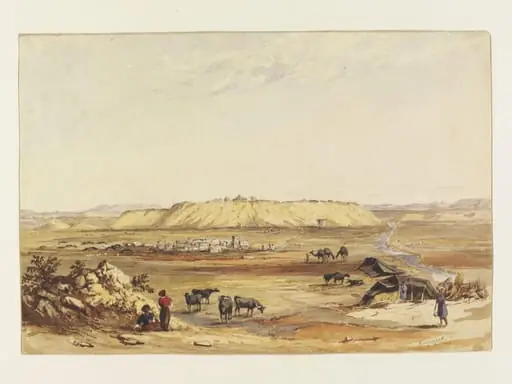 Kouyunjick
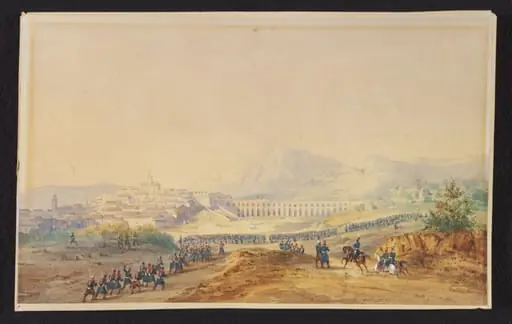 French troops at Médéa, Algeria
![A Pasha travelling with his escort[?], by Anonymous Greek artist](https://artifactworldgallery.com/img/anonymous-greek-artist--a-pasha-travelling-with-his-escort--01de32b8fcf30843-w320.webp) A Pasha travelling with his escort[?]
A Pasha travelling with his escort[?]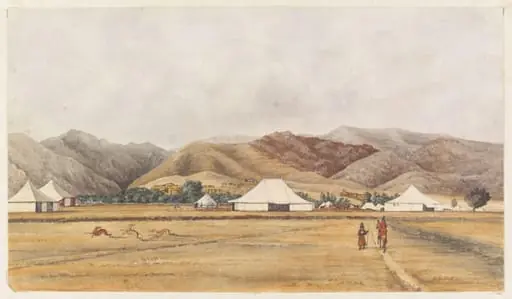 Camp at Aveen near Tehran
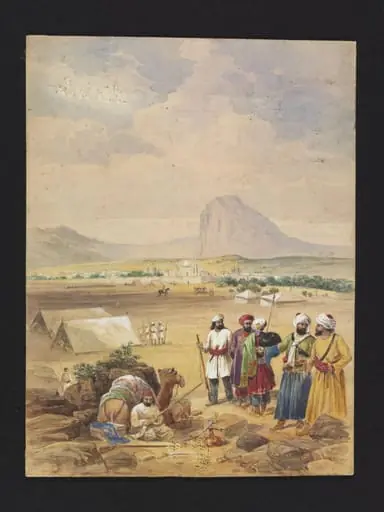 City of Candahar