Artwork
A Leaf from the Kelmscott Chaucer
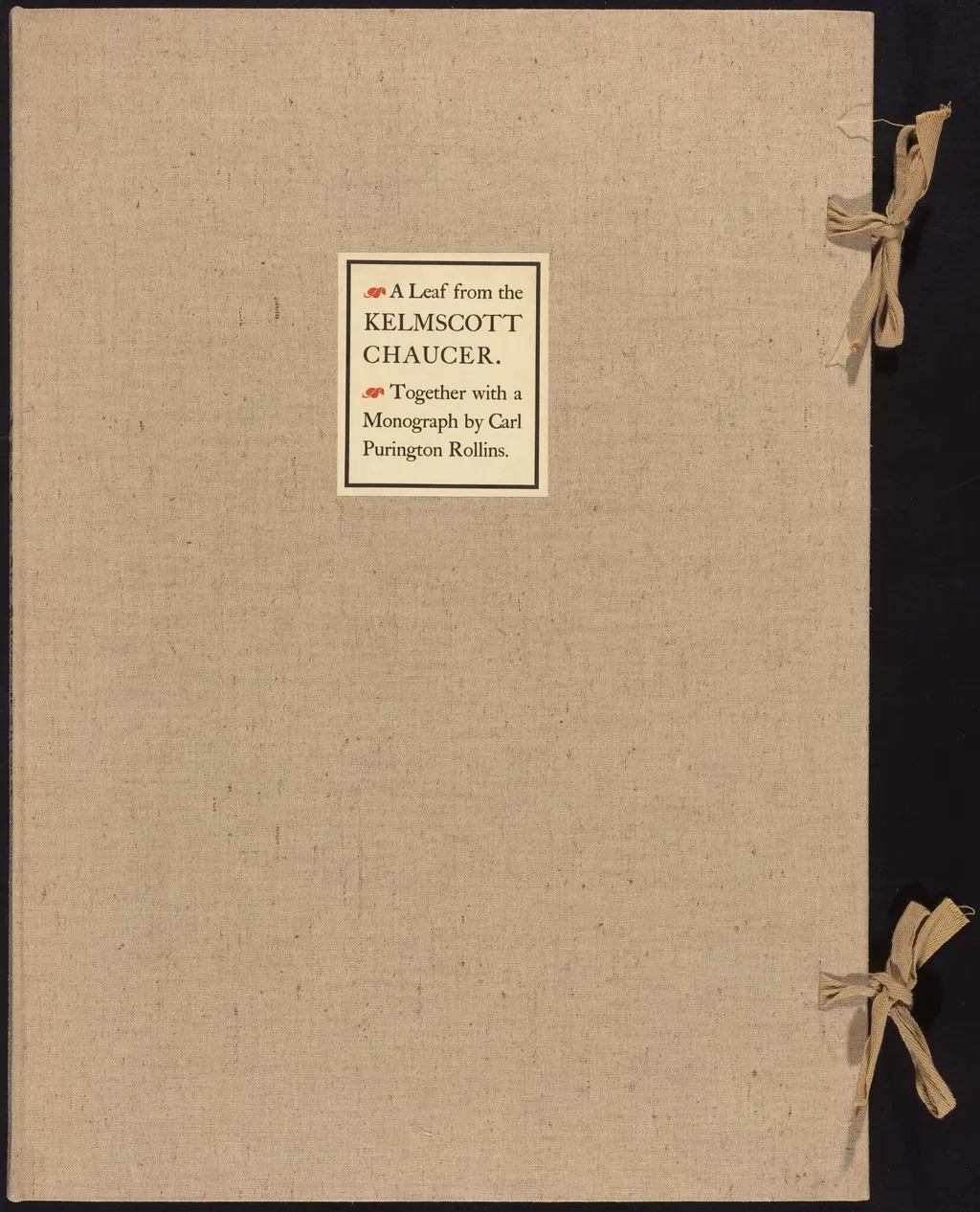
A Leaf from the Kelmscott Chaucer is a print by the Impressionist artist William Morris. It dates from 1896 and is held in the collection of the National Gallery of Art.
About this work
Overview
Created in 1896, this printed leaf is a fragment of William Morris’s illustrated edition of Geoffrey Chaucer’s works, known as the Kelmscott Chaucer. The piece consists of a single page of laid paper bearing text set in Morris’s own Chaucer and Troy typefaces, rendered in black and red ink and accented with ornamental initials.
Subject & Meaning
The leaf presents a passage from Chaucer, framed by Morris’s medieval-inspired decorative initials. By pairing the 14th‑century poet with his own typographic designs, Morris sought to revive the visual richness of early book production and to underscore a cultural continuity between medieval literature and the Arts and Crafts ideals of his time.
Technique & Style
Morris employed hand‑set movable type in two of his proprietary fonts—Chaucer, a blackletter style, and Troy, a Roman type—printing the page in two contrasting inks. The decorative initials, executed in red, echo illuminated manuscript motifs, while the use of laid paper reinforces the tactile quality associated with pre‑industrial bookmaking.
History & Provenance
Issued as part of the Kelmscott Chaucer, a limited‑edition work produced by Morris’s Kelmscott Press, the leaf exemplifies his broader project of integrating design, craftsmanship, and socialist principles. Original copies were distributed to subscribers and collectors; surviving examples are now held in major libraries and museums that document the Arts and Crafts movement.
Artist & collection

Artist
William Morris (24 March 1834 – 3 October 1896) was an English textile designer, poet, artist, writer, and socialist activist associated with the British Arts and Crafts movement.