Artwork
Sidon Castle
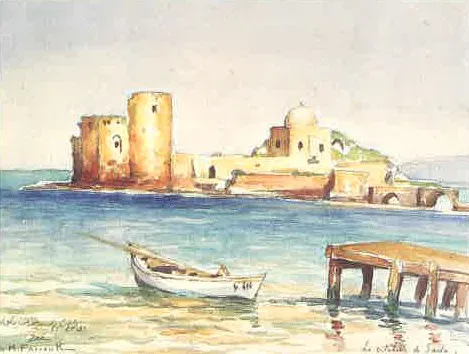
Sidon Castle is a watercolor painting by Moustafa Farroukh. It dates from 1939 and is held in the collection of the Sursock Museum.
About this work
Overview
The composition avoids dramatic elements, favoring a restrained palette and gentle brushwork that reflect the artist’s sensitivity to light and atmosphere.
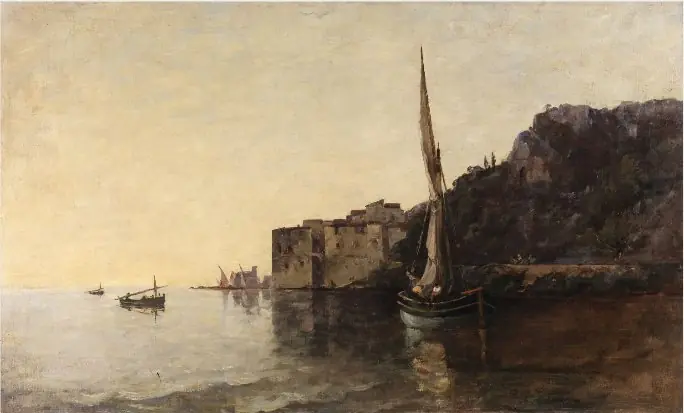
Created around 1939 by Lebanese artist Moustafa Farroukh, *Sidon Castle* is a watercolor painting that captures a quiet coastal scene. It presents the historic Sea Castle of Sidon, a medieval structure on a small island, framed by calm waters and a modest dock. The composition avoids dramatic elements, favoring a restrained palette and gentle brushwork that reflect the artist’s sensitivity to light and atmosphere.
Subject & Meaning
The painting centers on Sidon’s Sea Castle, a landmark with roots in the Crusader era, rendered not as a monument but as a quiet presence within the landscape. A single boat and a wooden dock suggest human activity without intrusion. The scene conveys stillness and continuity, evoking the enduring relationship between the Lebanese coast and its architectural heritage, without overt narrative or symbolism.
Technique & Style
Farroukh employed watercolor with a light, fluid hand, allowing layers of pale gray-blue and soft aqua to blend naturally on the paper. The castle’s stone architecture is suggested through subtle tonal shifts rather than sharp lines. Gentle washes define the sea and sky, creating a sense of atmospheric depth. The technique emphasizes transparency and restraint, characteristic of his approach to landscape and architecture.
History & Provenance
Painted during a period of growing cultural self-awareness in Lebanon, the work emerged from Farroukh’s broader engagement with national identity through art. He produced over two thousand paintings and authored several texts, including a biography. *Sidon Castle* is held in the collection of the Sursock Museum in Beirut, a key institution preserving modern Lebanese art from the early 20th century.
Context
In the late 1930s, Lebanese artists like Farroukh turned to local landscapes and heritage sites as subjects, moving away from European academic traditions. *Sidon Castle* reflects this shift, portraying a familiar coastal landmark with personal observation rather than idealized grandeur. The work aligns with a broader regional movement seeking to define modern identity through indigenous scenery and quiet realism.
Legacy
Farroukh’s watercolors, including *Sidon Castle*, contributed to the foundation of modern Lebanese painting by demonstrating how everyday views could carry cultural weight. His focus on light, place, and restraint influenced later generations of artists in Lebanon. The painting remains a reference point in discussions of national visual culture, valued for its quiet authenticity rather than spectacle.
Artist & collection
Artist
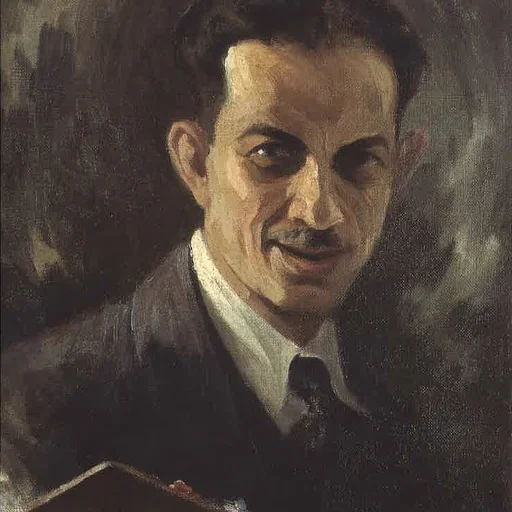
Moustafa Farroukh (Arabic: مصطفى فروخ; 1901 – 1957) was one of Lebanon's most prominent painters of the 20th century.