Artwork
Spring at Cardross
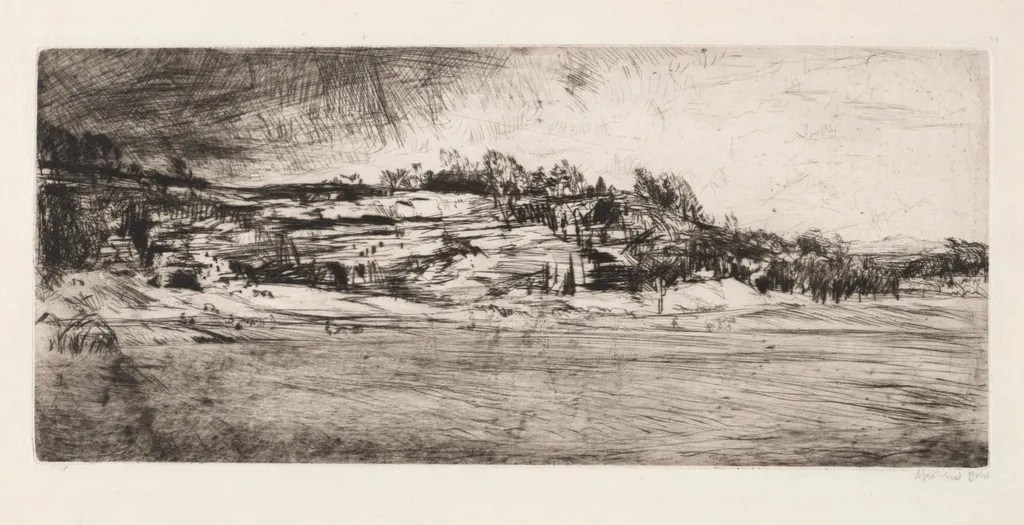
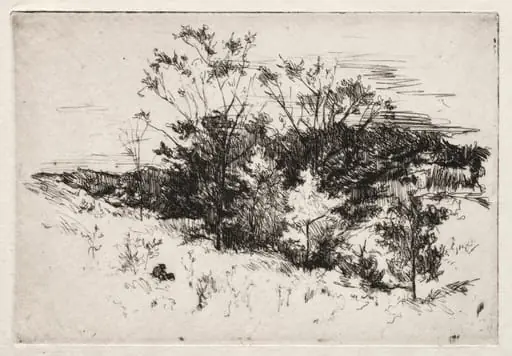
Spring at Cardross is a print by Muirhead Bone. It dates from 1900 and is held in the collection of the Cleveland Museum of Art.
About this work
Overview
The print captures a sweeping view of Dumbartonshire’s countryside, translating architectural precision into a lyrical depiction of natural form.
Muirhead Bone, an architect by training, turned to printmaking in 1898, quickly distinguishing himself through his mastery of drypoint. Spring at Cardross, among his earliest works in the medium, reveals a precise yet evocative handling of line and tone. The print captures a sweeping view of Dumbartonshire’s countryside, translating architectural precision into a lyrical depiction of natural form.
Subject & Meaning
The scene depicts a quiet, open landscape in springtime, with rolling hills, scattered trees, and soft atmospheric shifts suggesting seasonal renewal. There is no human presence, allowing the land itself to serve as the subject. Bone’s focus on the quiet grandeur of rural Scotland reflects a contemplative engagement with place, rooted in observation rather than narrative.
Technique & Style
Bone employed drypoint to create fine, incised lines that hold ink densely, producing rich darks against the paper’s natural tone. He used abbreviated, deliberate strokes to suggest form and distance, avoiding detail in favor of suggestive rhythm. Plate-tone—the faint ink residue left on the plate’s surface—enhances the hazy depth of the landscape, subtly modulating light and shadow.
History & Provenance
Created shortly after Bone began printmaking, Spring at Cardross emerged from his early experiments with the medium. It was produced in a small edition, likely circulated among collectors and artists in Glasgow’s emerging print circles. The work’s survival in institutional collections attests to its early recognition as a significant example of British printmaking at the turn of the century.
Context
Bone’s shift from architecture to printmaking coincided with a broader revival of interest in etching and drypoint in Britain. His training informed his compositional clarity, but his subject matter aligned with contemporary movements that valued intimate, topographical views over grand historical themes. This work reflects a quiet rebellion against academic conventions in favor of direct, personal observation.
Legacy
Spring at Cardross established Bone as a leading figure in early 20th-century British printmaking. His ability to merge architectural discipline with atmospheric sensitivity influenced a generation of landscape printmakers. The work remains a touchstone for its restrained technique and its quiet assertion of the dignity of everyday scenery.
Artist & collection
Artist
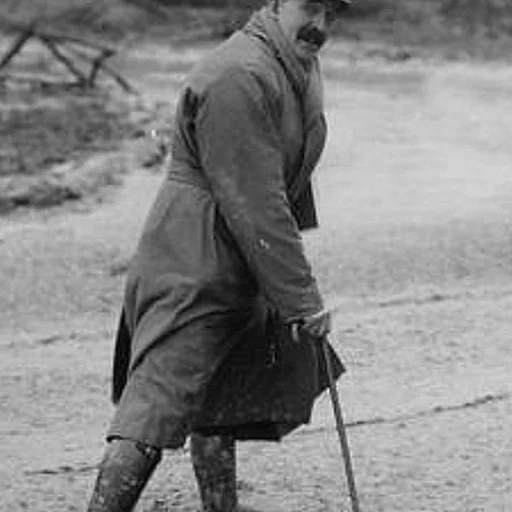
Sir Muirhead Bone (23 March 1876 – 21 October 1953) was a Scottish etcher and watercolourist who became known for his depiction of industrial and architectural subjects and his work as a war artist in both the First and Second World Wars.

 Miami River, near Cincinnati, Ohio
 Third Study for 'The Ballantrae Road'
![Landscape [Paesaggio], by Carlo Paolo Agazzi](https://artifactworldgallery.com/img/carlo-paolo-agazzi--landscape-paesaggio--e606f4ada87d2052-w320.webp) Landscape [Paesaggio]
Landscape [Paesaggio] Dünenlandschaft (Landscape with Dunes)
 The Chapel Saint-Michel at l'Estre
 Chaumières anglaises (English Cottages)
 Le Petit Pont
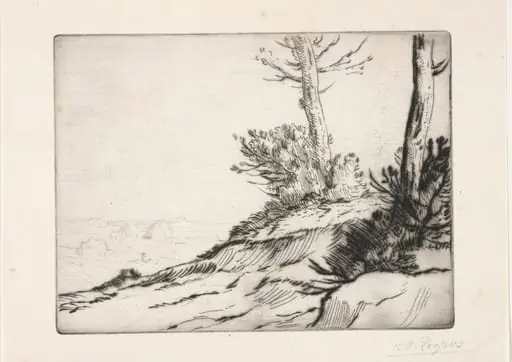 La butte aux broussailles
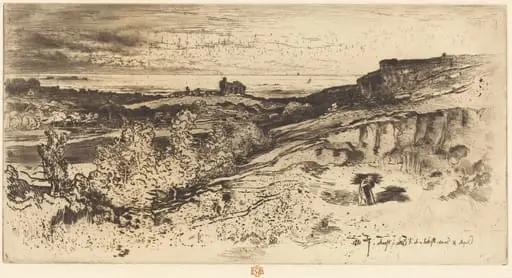 La Chapelle Saint-Michel à l'Estre
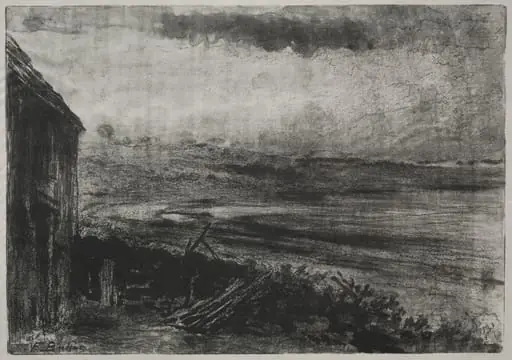 Fisherman's thatched cottage
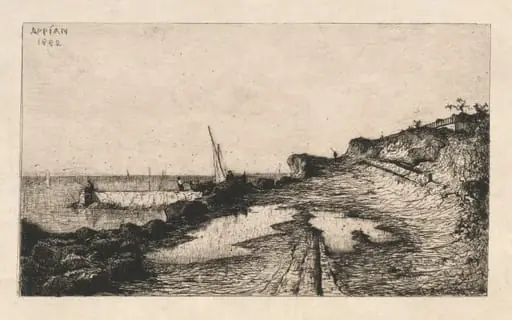 Environs of Carqueronne (Environs de Carqueronne)
 Autumn Landscape