Artwork
Queen Mary I of England
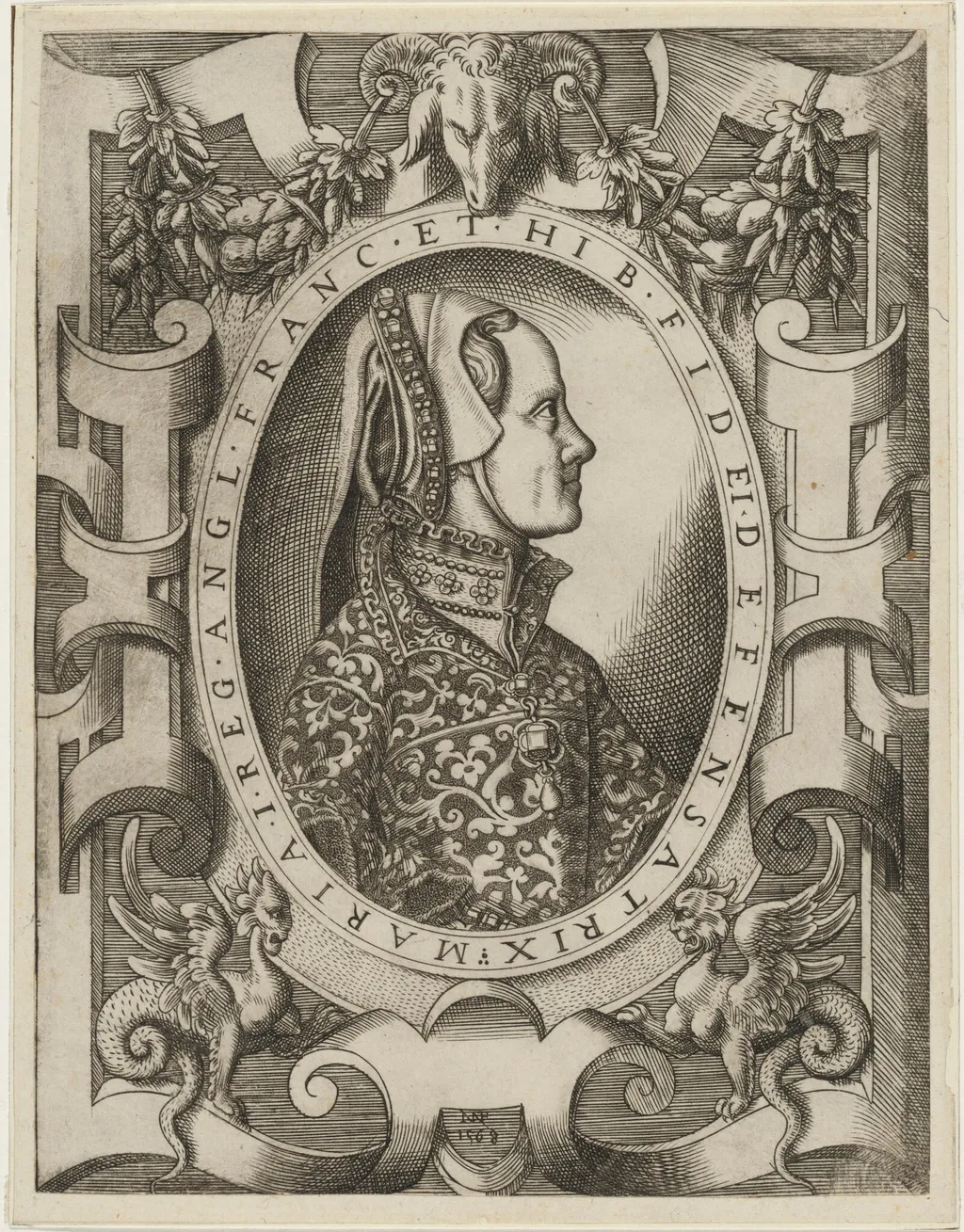
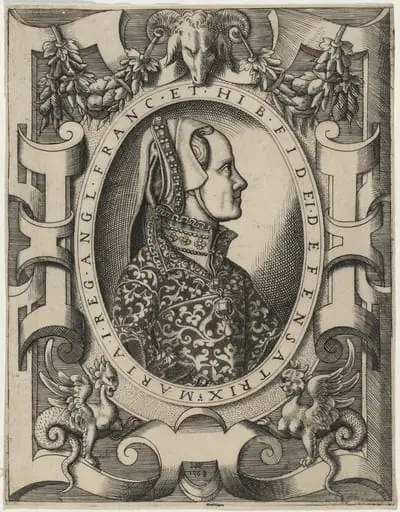
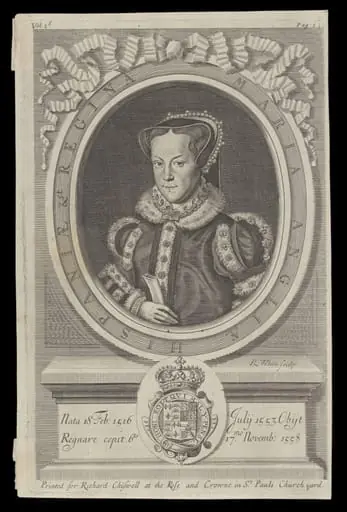
Queen Mary I of England is an ink print by the Renaissance artist Niccolò Nelli. It dates from 1568 and is held in the collection of the National Gallery of Art.
About this work
Overview
The image was produced using an etching technique, allowing for intricate linework that captures both likeness and regal form.
This 1568 engraving by Niccolò Nelli depicts Queen Mary I of England in profile, rendered in fine black-and-white lines. The portrait is enclosed within a circular frame adorned with ornamental lettering and decorative motifs. The composition emphasizes precision and detail, characteristic of mid-16th-century Northern European printmaking traditions. The image was produced using an etching technique, allowing for intricate linework that captures both likeness and regal form.
Subject & Meaning
The portrait presents Mary I as a sovereign figure, her short hair and high collar reflecting contemporary Tudor fashion. The inclusion of her name within the border reinforces her identity and authority. The elaborate surrounding patterns—scrolls, foliage, and stylized script—serve not merely as decoration but as symbolic extensions of her royal status, aligning her with classical and ecclesiastical traditions of power.
Technique & Style
Executed through meticulous engraving, the work employs fine, controlled lines to model form and texture. The ruffled collar and lace are rendered with delicate cross-hatching, while the background swirls are composed of continuous, hand-drawn curves. This level of detail reflects the Renaissance emphasis on craftsmanship and the printmaker’s skill in translating portraiture into reproducible form, without the use of color or shading beyond tonal variation.
History & Provenance
Created in 1568, the engraving emerged during a period when printed portraits of monarchs were used to reinforce political legitimacy. Nelli, an Italian artist active in England, likely produced this image for distribution among court circles or diplomatic recipients. Its survival suggests it was valued as a formal representation of Mary’s reign, though its exact early ownership remains undocumented.
Context
In the late 1560s, England was navigating religious and political instability following the Reformation. Portraits of Mary I, the first reigning queen, were rare and carefully controlled. This engraving aligns with broader European practices of using print to circulate royal imagery, particularly in Catholic regions where her rule was still symbolically significant despite her declining influence.
Legacy
Though not widely reproduced, the engraving stands as a rare visual record of Mary I’s later years, capturing her appearance and the aesthetic priorities of her court. It reflects the role of print in shaping public perception of monarchy during a transitional era. Today, it remains a valuable artifact for understanding how royal identity was visually constructed in early modern England.
Artist & collection