Artwork
Cover
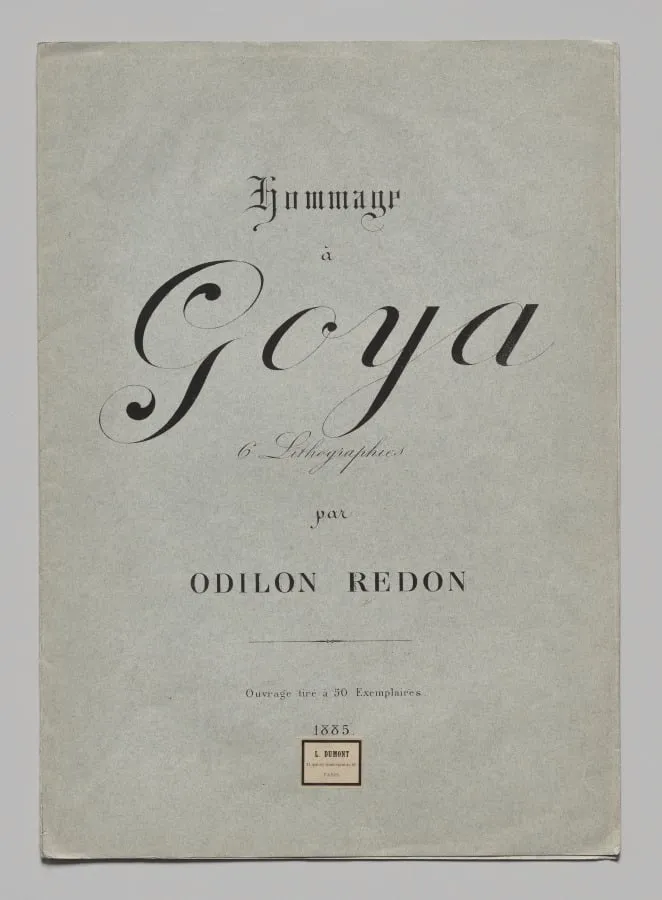
Cover is a print by the Impressionist artist Odilon Redon. It dates from 1885 and is held in the collection of the Cleveland Museum of Art.
About this work
Overview
The series was conceived as a tribute to Francisco de Goya, whose exploration of the irrational and psychological resonated with Redon.
Odilon Redon produced numerous lithographic portfolios during his career, often grouping prints under unified themes. Among these, Homage to Goya stands as an early example of his engagement with lithography. The series was conceived as a tribute to Francisco de Goya, whose exploration of the irrational and psychological resonated with Redon. The Cleveland Museum of Art acquired several complete sets from the 1920s, including original bindings—an uncommon preservation given the typical dispersal of such works over time.
Subject & Meaning
The six lithographs in Homage to Goya do not form a linear narrative but instead evoke a mood of quiet introspection. Each image, though visually distinct, contributes to an atmosphere of solitude and inner vision. The cover, featuring a solitary floating eye beneath a heavy sky, serves as a metaphor for perception beyond the visible—reflecting Goya’s fascination with dreams and the unconscious. Together, the images suggest the solitary nature of artistic creation, where meaning emerges from ambiguity rather than clarity.
Technique & Style
Redon employed lithography to achieve subtle tonal gradations, avoiding sharp outlines in favor of soft, smoky transitions. The cover image, with its pale eye suspended in a dark, atmospheric field, relies entirely on nuanced shading to suggest depth and emotion. This approach echoes the sfumato technique of Renaissance painting, where forms dissolve into light and shadow. The small scale of the print invites intimate viewing, reinforcing its contemplative character and the tactile experience of handling the portfolio.
History & Provenance
Homage to Goya was created during Redon’s formative years in lithography, around the 1880s. While many such portfolios were later disassembled and sold individually, the Cleveland Museum of Art secured several complete sets in the 1920s, including their original covers and bindings. This acquisition preserved the integrity of Redon’s intended presentation, offering rare insight into how his printed works were originally experienced—as cohesive, handheld objects rather than isolated images.
Context
Redon’s work emerged in the wake of Symbolist literature and the growing interest in psychological states in late 19th-century art. Goya’s later, darker prints—particularly the Black Paintings and Disasters of War—provided a precedent for exploring fear, dreams, and the uncanny. Redon, though French and working in a different medium, aligned with this tradition by rejecting literal representation in favor of evocative, open-ended imagery that invited personal interpretation.
Legacy
Homage to Goya exemplifies Redon’s role in bridging 19th-century Romanticism and early 20th-century Surrealism. His use of dreamlike imagery and atmospheric lithography influenced later artists seeking to express inner worlds beyond rational depiction. Though not widely exhibited in his lifetime, the preservation of complete sets like the one in Cleveland ensures that his approach to printmaking as a vehicle for psychological depth remains accessible for study and reflection.
Artist & collection
Artist
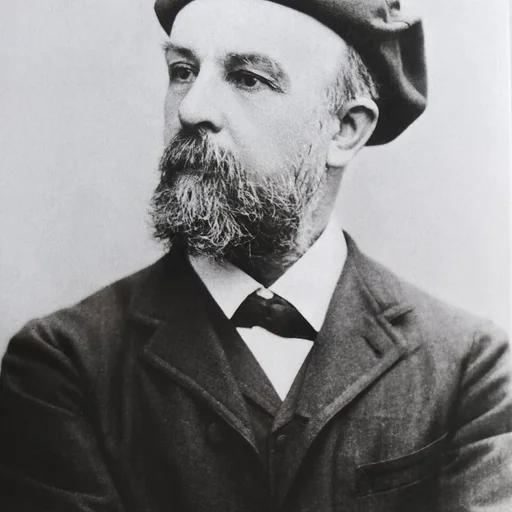
Born Bertrand-Jean Redon on 20 April 1840 in Bordeaux, the artist adopted the name Odilon from his mother, Marie-Odile.