Artwork
Inceste d'âmes; Mineur et soldat
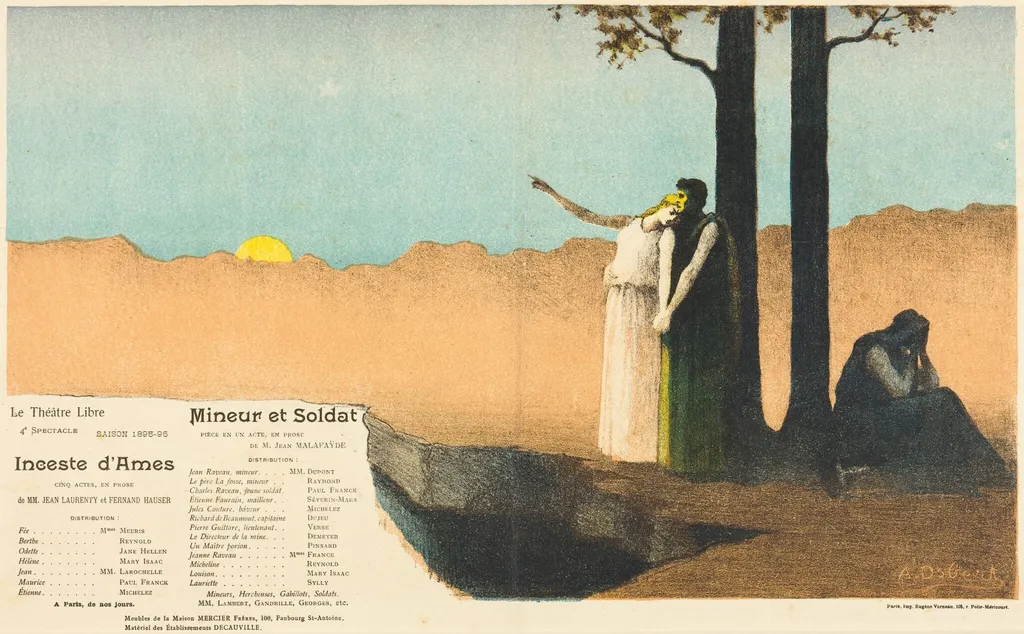
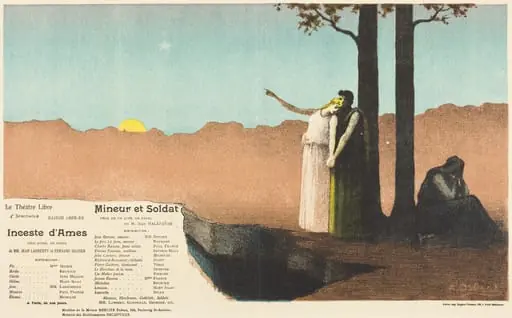
Inceste d'âmes; Mineur et soldat is an ink print by the Impressionist artist Alphonse Osbert. It dates from 1896 and is held in the collection of the National Gallery of Art.
About this work
Overview
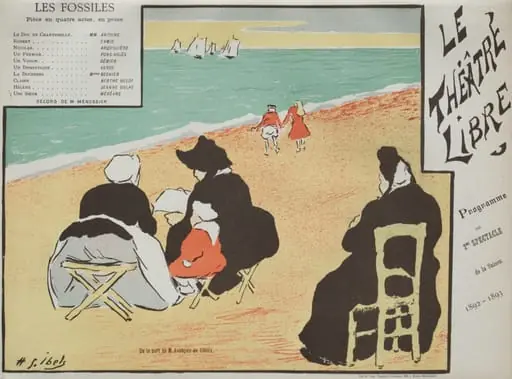
Alphonse Osbert’s lithograph titled Inceste d’âmes; Mineur et soldat dates from 1896. Executed as a four‑color print on wove paper, the work functions as a theatrical poster, announcing two productions—Inceste d’âmes and Mineur et soldat—through its bold graphic design.
Subject & Meaning
A low, luminous yellow sun dominates the horizon, casting a flat light over sandy hills and sparse trees, reinforcing the arid atmosphere.
The image presents a stark, desert‑like landscape populated by two women. One figure, dressed in a flowing white garment, raises an arm in a gesture that suggests yearning or invitation, while the other sits with her head supported by her hand, evoking contemplation or fatigue. A low, luminous yellow sun dominates the horizon, casting a flat light over sandy hills and sparse trees, reinforcing the arid atmosphere.
Technique & Style
Osbert employed the lithographic process, a planographic method in which the image is drawn with greasy media on a stone or metal plate and then transferred to paper. By limiting the palette to four solid colors, he achieved a striking contrast and simplified forms characteristic of late‑19th‑century commercial art, where clarity and immediacy were essential for public advertising.
History & Provenance
Created in the final decade of the 1800s, the print was likely produced for distribution in French theater circles to promote the two named plays. Its survival on wove paper indicates it was intended for relatively wide circulation, typical of poster prints that were displayed in public venues and later collected as ephemera.
Context
The work belongs to a period when French poster art was flourishing, with artists such as Jules Chéret and Henri de Toulouse‑Lautrec redefining graphic design for mass audiences. Osbert’s use of vivid color blocks and simplified silhouettes aligns with this movement, reflecting both commercial imperatives and the aesthetic trends of the Belle Époque.
Artist & collection


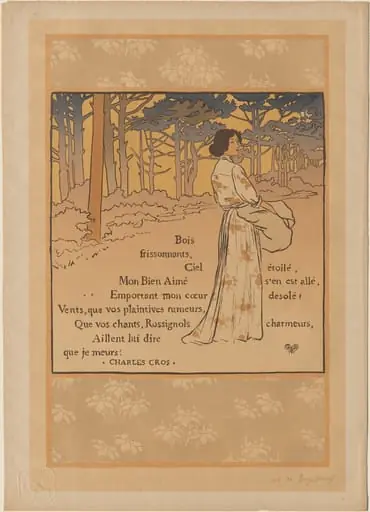 Trembling Woods (Bois frissonnants)
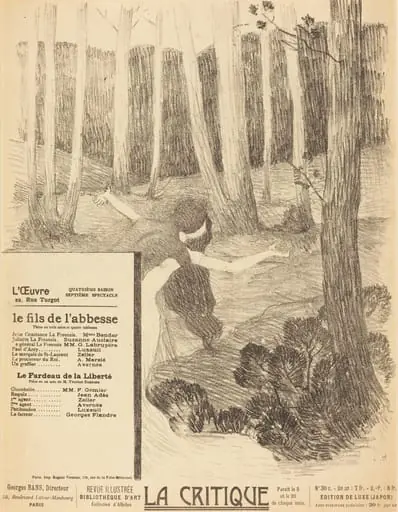 Le Fils de l'abbesse; Le Fardeau de la liberté
 Untitled
 Croquis pris aux Champs Elysées
 a) Le baiser du drapeau (recto); b) Study of Le baiser du drapeau (verso)
 Boubouroche; Valet de coeur
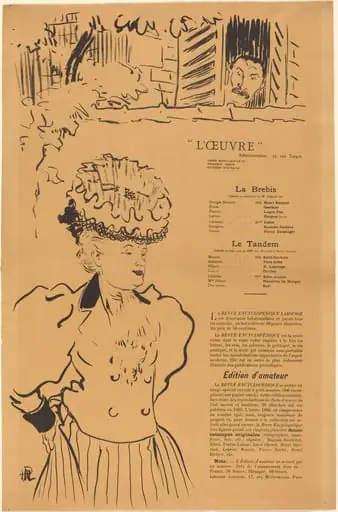 La Brebis; Le Tandem
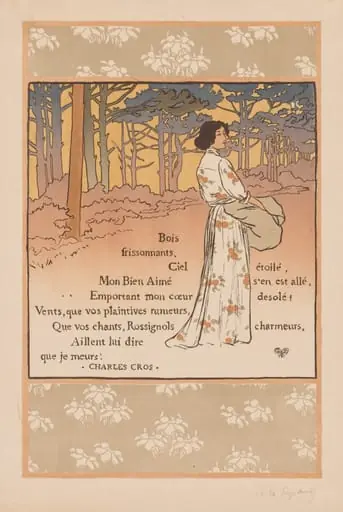 Trembling Woods
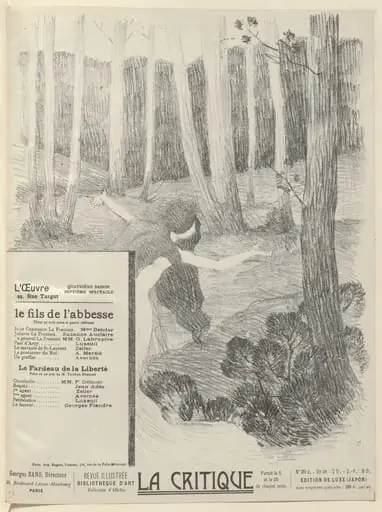 Untitled
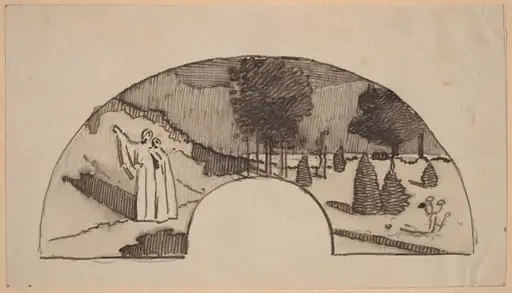 Study for an Archway
 Les Fossiles (Program from Théâtre Libre)