Artwork
Untitled
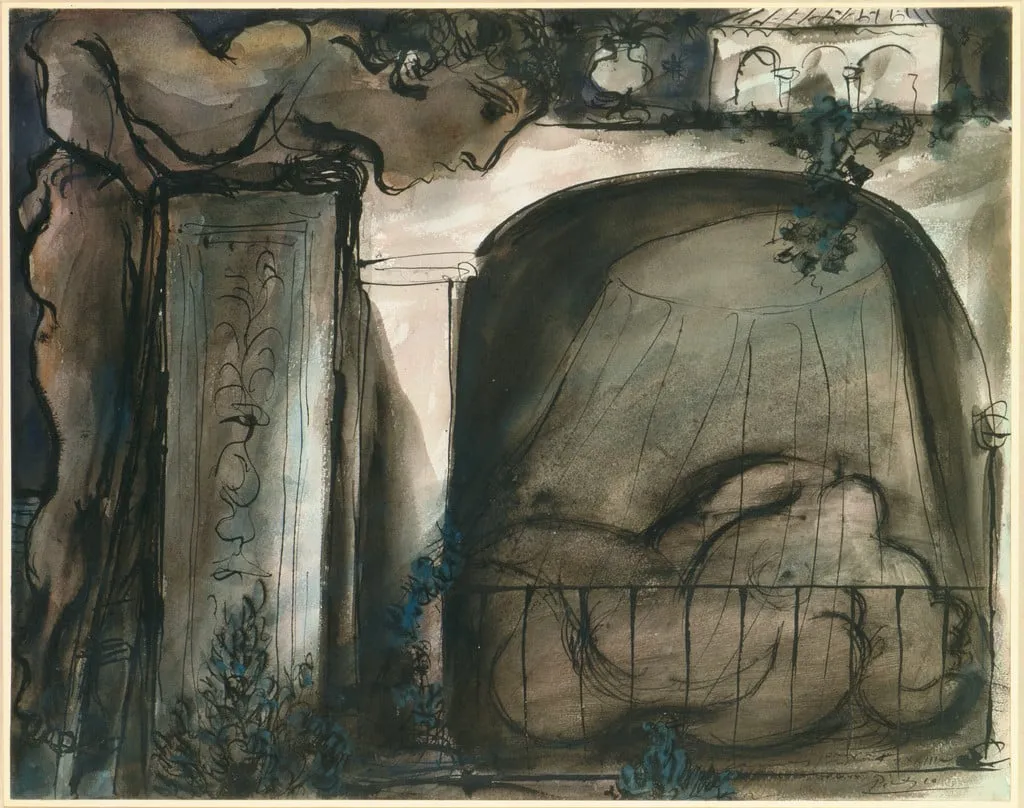
Untitled is a watercolor drawing by Pablo Picasso. It dates from 1933 and is held in the collection of the Museum of Modern Art.
About this work
Overview
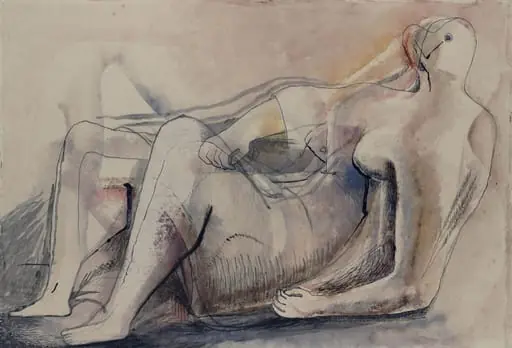
Created in 1933, this watercolor and ink drawing by Pablo Picasso is a compact yet evocative work on paper. Executed during a phase of intense formal inquiry, it reflects his ongoing engagement with abstraction and suggestive form. The piece resides in the collection of The Museum of Modern Art, where it contributes to the broader narrative of modernist experimentation in the early 20th century.
Subject & Meaning
The faint suggestion of a streetscape in the background introduces a sense of place without narrative clarity, inviting interpretation rather than definition.
Two vertical forms, one textured and the other fractured, dominate the composition, evoking architectural remnants or sculptural fragments. Behind them, a blurred, rounded mass suggests a reclining human figure, rendered ambiguously to blur the line between object and body. The faint suggestion of a streetscape in the background introduces a sense of place without narrative clarity, inviting interpretation rather than definition.
Technique & Style
Picasso employed loose, fluid brushwork and diluted ink to create a sense of immediacy and transience. Watercolor washes in muted earth tones—browns, grays, and blues—build a subdued atmosphere, while thin, sketchlike lines define forms without rigid contour. The technique prioritizes suggestion over detail, aligning with a mode of drawing that values intuition and spontaneous gesture.
History & Provenance
The work entered The Museum of Modern Art’s collection as part of its commitment to documenting Picasso’s prolific output across media. While its exact provenance prior to acquisition is not widely documented, its inclusion in the museum’s holdings reflects its significance as an example of Picasso’s graphic work from the early 1930s, a period marked by personal and artistic transition.
Context
In 1933, Picasso was navigating the aftermath of Cubism’s initial innovations and exploring more personal, symbolic imagery. This drawing coincides with his engagement with Surrealist ideas and a growing interest in mythic and archetypal forms. The work’s ambiguity and fragmented structure reflect broader artistic currents in Europe, where traditional representation was being reimagined through psychological and formal disruption.
Legacy
This drawing exemplifies Picasso’s ability to distill complex visual ideas into minimal, evocative forms. Its influence lies in its demonstration of how drawing could function as a space for exploration rather than finished statement. It continues to be studied for its economy of means and its role in bridging Cubist structure with the emotional resonance of later modernist practices.
Artist & collection
Artist
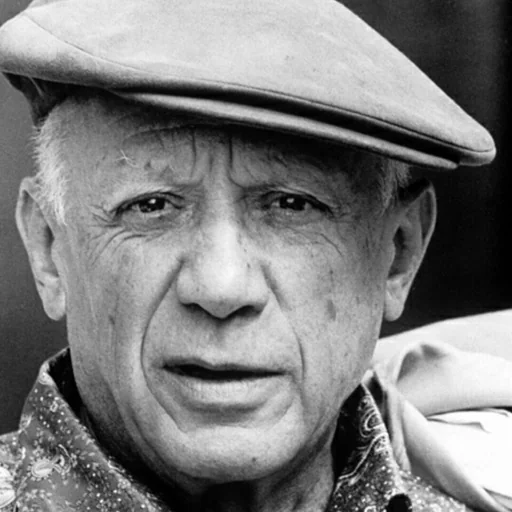
Pablo Ruiz Picasso (25 October 1881 – 8 April 1973) was a Spanish painter and sculptor who spent most of his adult life in France.