Artwork
Print Collection
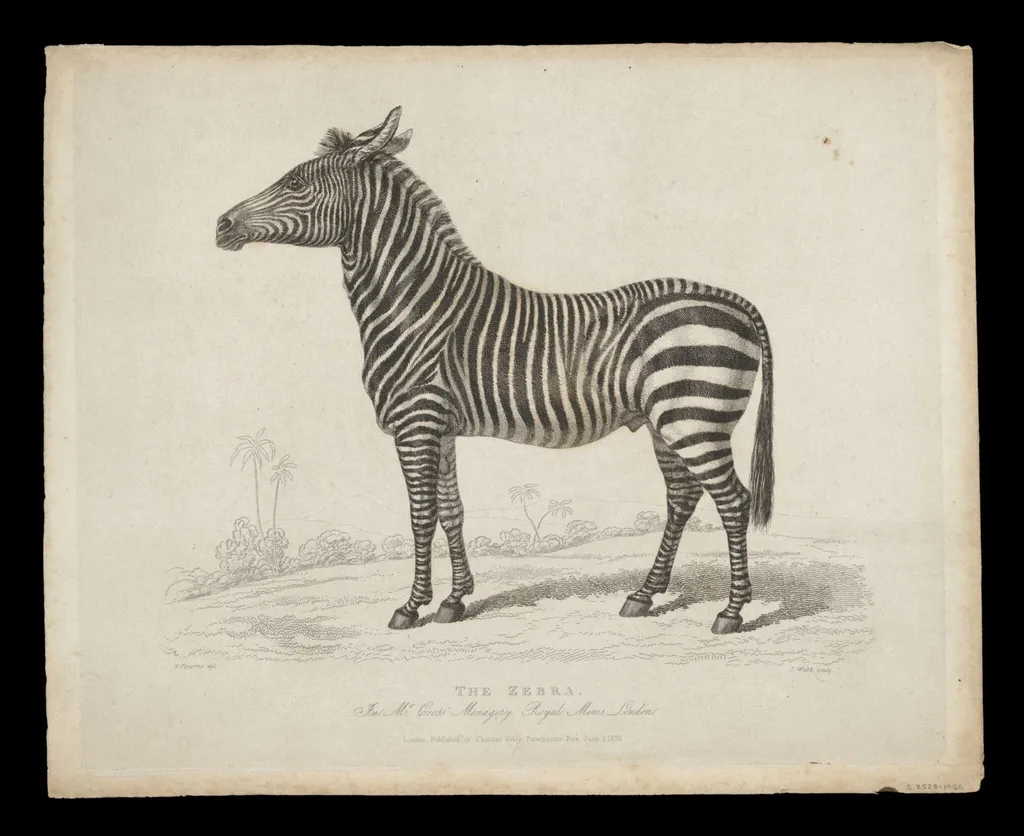
Print Collection is a print by the Romanticist artist Panormo. It dates from 1 and is held in the collection of the Victoria and Albert Museum. A printed image from the early 19th century portrays a zebra housed in the Royal Menagerie at the Tower of London.
About this work
Overview
A printed image from the early 19th century portrays a zebra housed in the Royal Menagerie at the Tower of London. Created as a commercial print, it was produced and distributed by Thomas Kelly of London, reflecting public interest in exotic animals displayed in urban collections during the period.
Subject & Meaning
The zebra, an uncommon sight in Britain at the time, is shown in a confined enclosure, emphasizing its status as a curiosity rather than a wild creature. The image serves as a record of zoological display practices, illustrating how exotic animals were presented to the public as objects of wonder within institutional settings.
Technique & Style
The print is executed in a detailed, linear style typical of topographical and zoological illustrations of the era. Line work defines the animal’s form and the enclosure’s structure, with minimal shading, prioritizing clarity and documentation over artistic embellishment.
History & Provenance
Produced by Thomas Kelly, a known publisher of prints in early 1800s London, the image likely circulated as a souvenir or educational item. It corresponds with the Royal Menagerie’s operation at the Tower until its closure in the 1830s, making it a visual artifact of a now-defunct public institution.
Context
During the early 19th century, the Royal Menagerie attracted thousands of visitors annually, offering a rare glimpse of non-European wildlife. Such prints helped extend the menagerie’s reach beyond its physical walls, feeding a broader cultural fascination with natural history and imperial acquisition.
Legacy
This print survives as a modest but tangible link to the history of early modern zoological display. It documents how exotic animals were framed for public consumption, offering insight into evolving attitudes toward wildlife, captivity, and the role of institutions in shaping natural knowledge.
Artist & collection
Artist
This printmaker left only one dated sheet from 1829, a single page of everyday scenes titled “Print Collection.” The style is crisp and flat, typical of early 19th-century British print shops, where artists copied shop…