Artwork
The Elephant.
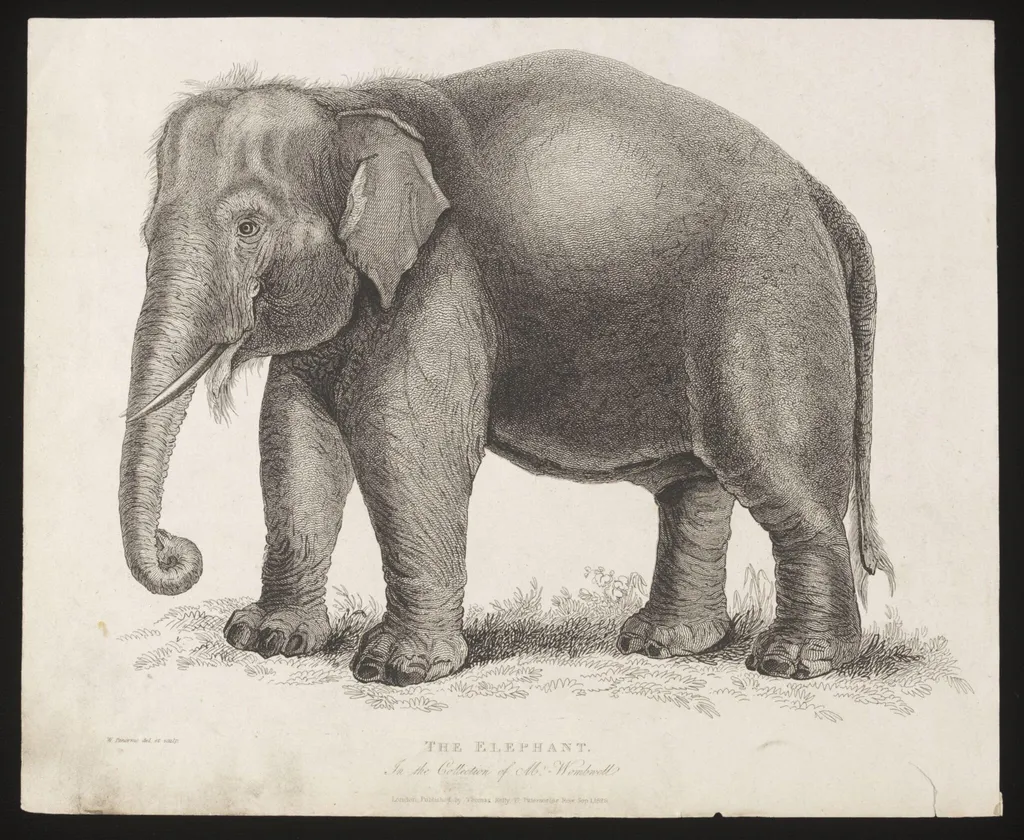
The Elephant. is a print by the Romanticist artist W. Panormo. It dates from 5 and is held in the collection of the Victoria and Albert Museum. This black-and-white print, titled 'The Elephant,' was created by W.
About this work
If you're interested in learning more about the artistic style used in this print, you might want to explore the technique of chiaroscuro.
This image shows a detailed black and white print of an elephant. The elephant is standing on grass, facing left, with its trunk curled up and its tusks visible. Its large ears and wrinkled skin are also depicted.
The print is titled "The Elephant" and was created by Panormo, W. in 1829. It is a part of the Romanticism movement and is held at the Victoria and Albert Museum. The image features a range of tones, from light to dark, which adds depth and texture to the elephant's form.
If you're interested in learning more about the artistic style used in this print, you might want to explore the technique of chiaroscuro.
Overview
This black-and-white print, titled 'The Elephant,' was created by W. Panormo in 1849. It depicts a solitary elephant in profile, facing left, standing on a grassy ground. The work is part of the Victoria and Albert Museum’s collection and reflects the 19th-century fascination with exotic animals displayed in traveling menageries. Though stylistically detailed, it is not tied to any specific public event involving elephants at the time.
Subject & Meaning
The subject is likely one of the elephants owned by George Wombwell, a well-known proprietor of traveling animal exhibitions in early 19th-century Britain. The animal is portrayed with dignity and quiet presence, emphasizing its physicality rather than theatricality. The image serves as a documentary record of a creature familiar to the British public through spectacle, not through scientific study or natural habitat.
Technique & Style
Panormo employed fine linear engraving to render the elephant’s wrinkled skin, large ears, and curved tusks with precision. Subtle gradations of tone create volume and texture, suggesting an awareness of chiaroscuro without overt dramatic contrast. The background is minimal, focusing attention entirely on the animal’s form, a common approach in zoological illustration of the period.
History & Provenance
The print was produced in 1849, the same year a tragic incident occurred at Coventry Great Fair involving Wombwell’s nephew and an elephant — though the depicted animal is not confirmed to be the same. The work likely originated as a commercial illustration for Wombwell’s menagerie, circulated to promote public exhibitions. It entered the Victoria and Albert Museum’s collection as part of its broader archive of graphic arts and natural history imagery.
Context
In the mid-19th century, exotic animals like elephants were rare sights in Britain, drawn from colonial territories and exhibited for public entertainment. Panormo’s print reflects the intersection of commerce, curiosity, and emerging natural history interests. While Romanticism emphasized emotion and nature, this work aligns more closely with the observational tradition of zoological illustration than with idealized Romantic landscapes.
Legacy
The print endures as a quiet artifact of Victorian popular culture, capturing an animal that symbolized both wonder and exploitation. It contributes to historical records of how exotic creatures were visually represented before modern zoology and conservation ethics took hold. Its preservation in the V&A underscores its value as a document of social and visual history rather than artistic innovation.
Artist & collection
Artist
This printmaker carved a single scene in 1829: The Elephant, a sharp little etching showing an animal standing on a flat, empty ground.