Artwork
Elephant
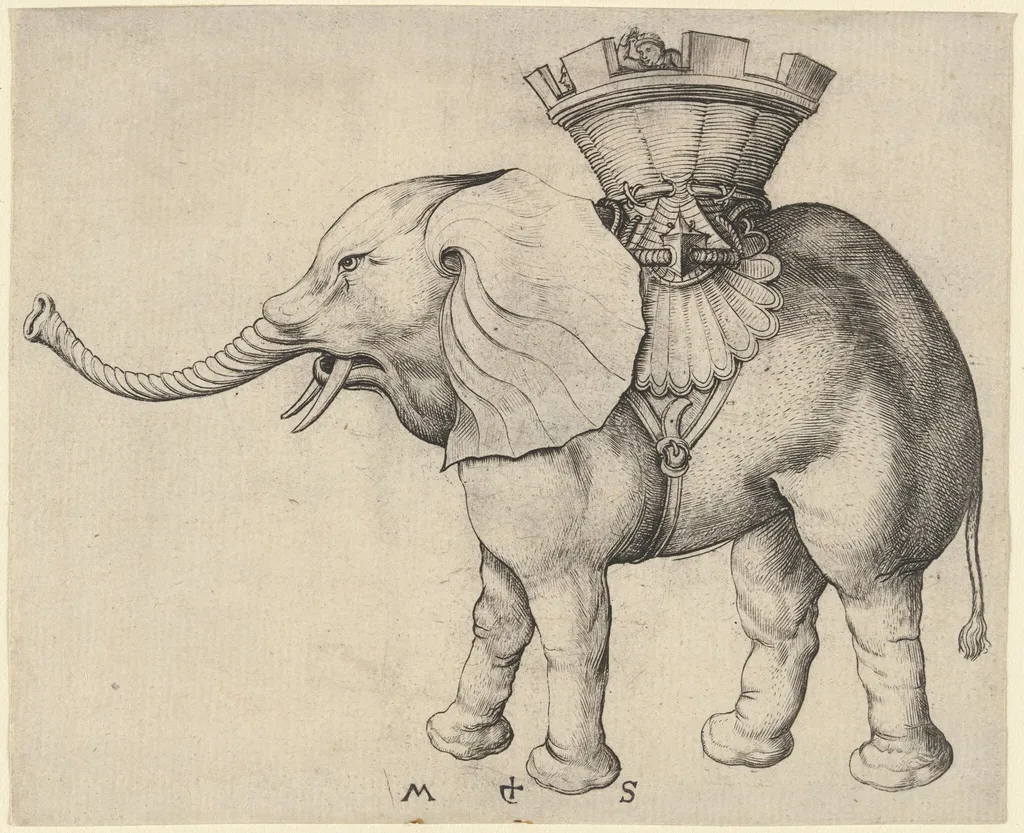
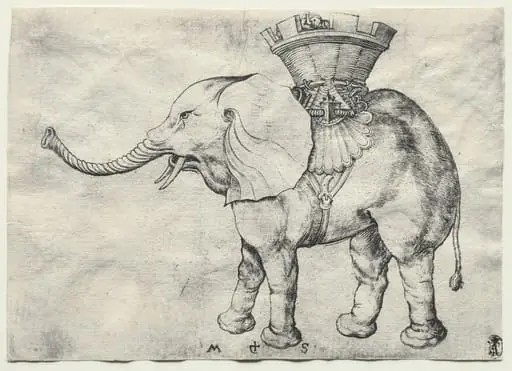
Elephant is an ink print by the Renaissance artist Martin Schongauer. It dates from 1485 and is held in the collection of the National Gallery of Art.
About this work
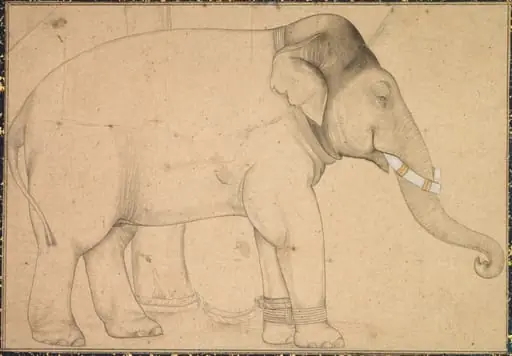
This engraving shows a full-body view of an elephant. The animal stands sideways with big ears and tusks. Shading uses tiny lines to show wrinkles and muscles.
Martin Schongauer was a German printmaker. He worked before 1500 and made this using a metal plate. The lines create deep shadows and smooth skin at the same time.
Look for Schongauer, Martin next.
Overview
Created circa 1485, this copper‑plate engraving presents a solitary elephant in profile. The animal occupies the entire field, its massive ears and curved tusks rendered with meticulous attention to surface texture. The work exemplifies the Northern Renaissance’s fascination with natural observation, offering a rare European depiction of an exotic creature before the age of global travel.
Subject & Meaning
The print portrays a full‑body view of an elephant, standing sideways as if observed from a distance. While no explicit narrative accompanies the image, the detailed rendering suggests an intent to document the animal’s anatomy and distinctive features, reflecting contemporary curiosity about distant fauna and the desire to convey knowledge through visual means.
Technique & Style
Executed on a metal plate, the engraving employs fine, parallel hatching to model the elephant’s skin, musculature, and the deep shadows beneath its folds. The precision of the linework, likely informed by Schongauer’s training as a goldsmith, creates a delicate balance between texture and tonal depth, achieving a convincing sense of volume within the constraints of the medium.
Context
Martin Schongauer, an Alsatian artist active in the late fifteenth century, was the pre‑eminent printmaker north of the Alps before Albrecht Dürer’s emergence.
Martin Schongauer, an Alsatian artist active in the late fifteenth century, was the pre‑eminent printmaker north of the Alps before Albrecht Dürer’s emergence. His oeuvre, comprising roughly 116 surviving engravings, demonstrates the Northern Renaissance’s shift toward empirical observation, especially in the representation of animals, which were often rendered from second‑hand accounts or travelers’ sketches.
History & Provenance
The engraving survives in several museum collections, attesting to its wide circulation among collectors of early prints. While specific ownership records from the artist’s workshop are lacking, the work’s inclusion in later catalogues of Northern Renaissance prints confirms its recognition as a significant example of Schongauer’s output.
Artist & collection

Artist
Martin Schongauer, also known as Martin Schön or Hübsch Martin by his contemporaries, was an Alsatian engraver and painter.