Artwork
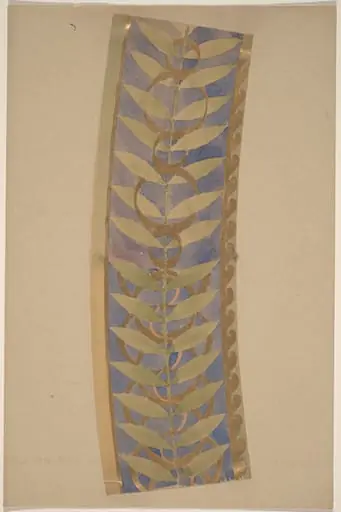
Tracing of a Border Design
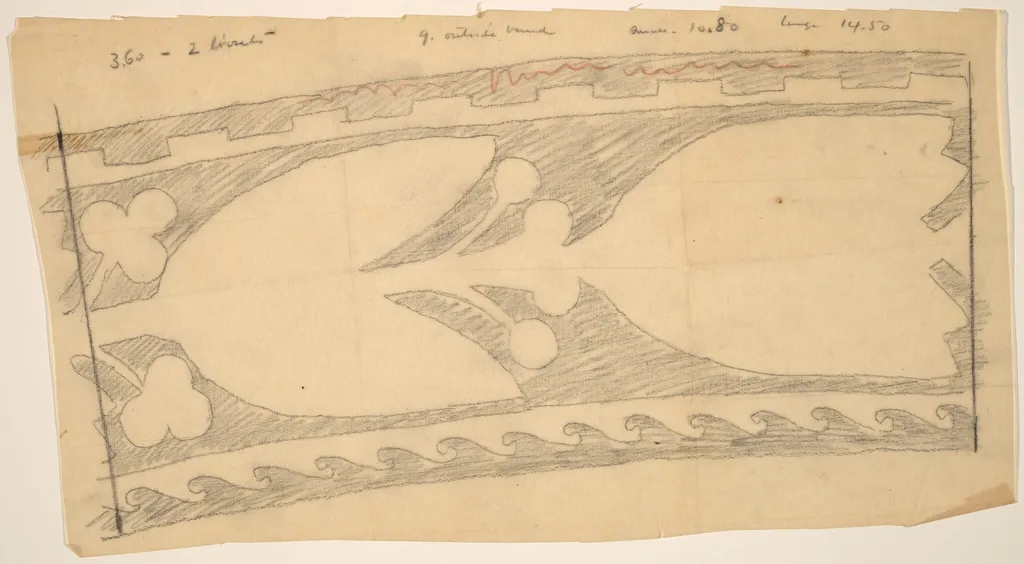
Tracing of a Border Design is a graphite drawing by the Impressionist artist Charles Sprague Pearce. It dates from 1894 and is held in the collection of the National Gallery of Art.
About this work
Overview
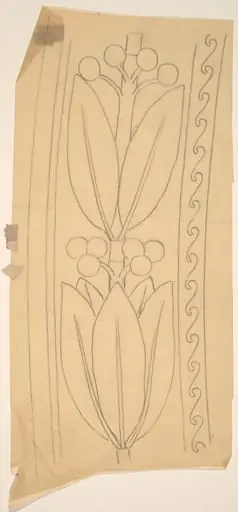
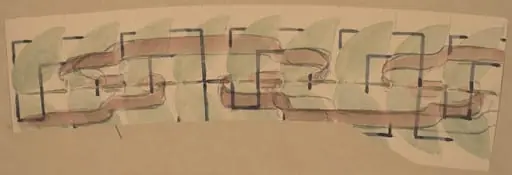
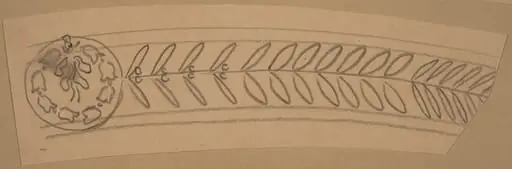
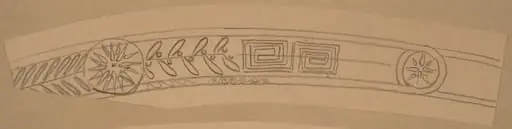
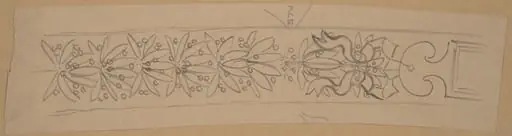
Charles Sprague Pearce’s 1894 drawing, titled Tracing of a Border Design, is executed in graphite and red pencil on a sheet of yellow tracing paper.
Charles Sprague Pearce’s 1894 drawing, titled Tracing of a Border Design, is executed in graphite and red pencil on a sheet of yellow tracing paper. The work records a decorative border composed of repetitive motifs, arranged in two horizontal bands at the top and bottom, with larger central elements that suggest stylized foliage. The paper bears measurement notations in its corners, indicating its function as a preparatory study rather than a finished composition.
Subject & Meaning
The drawing presents a symmetrical ornamental scheme intended for use as a decorative frame. Repeating swirls and loops line the upper and lower margins, while two broader, leaf‑like forms occupy the central field. The design’s simplicity and repetition point to a utilitarian purpose—providing a template for a larger decorative program—rather than conveying narrative content.
Technique & Style
Pearce employed graphite for the primary line work, achieving a range of values through varied pressure and cross‑hatching. Selective accents in red pencil highlight the upper band, adding visual contrast. The use of tracing paper allows the underlying layout to be easily transferred, while the yellow hue of the support subtly influences the overall tonal balance of the sketch.
History & Provenance
Created in 1894, the piece reflects Pearce’s practice of producing detailed preparatory drawings for decorative commissions. The presence of measurement marks suggests it was part of a design process for a larger project, though the final application remains undocumented. The drawing has survived in a worn condition, indicating frequent handling during its original use.
Artist & collection

Artist
Charles Sprague Pearce (1851–1914) was an American artist, born in Boston.

![Studies for a Lunette [recto], by Charles Sprague Pearce](https://artifactworldgallery.com/img/charles-sprague-pearce--studies-for-a-lunette-recto--07c43c96c8ad1d74-w320.webp)
![Study for a Border Design [recto], by Charles Sprague Pearce](https://artifactworldgallery.com/img/charles-sprague-pearce--study-for-a-border-design-recto--d1721a9baf3d1e3d-w320.webp)