Artwork
Drumurile bătătorite ale moților
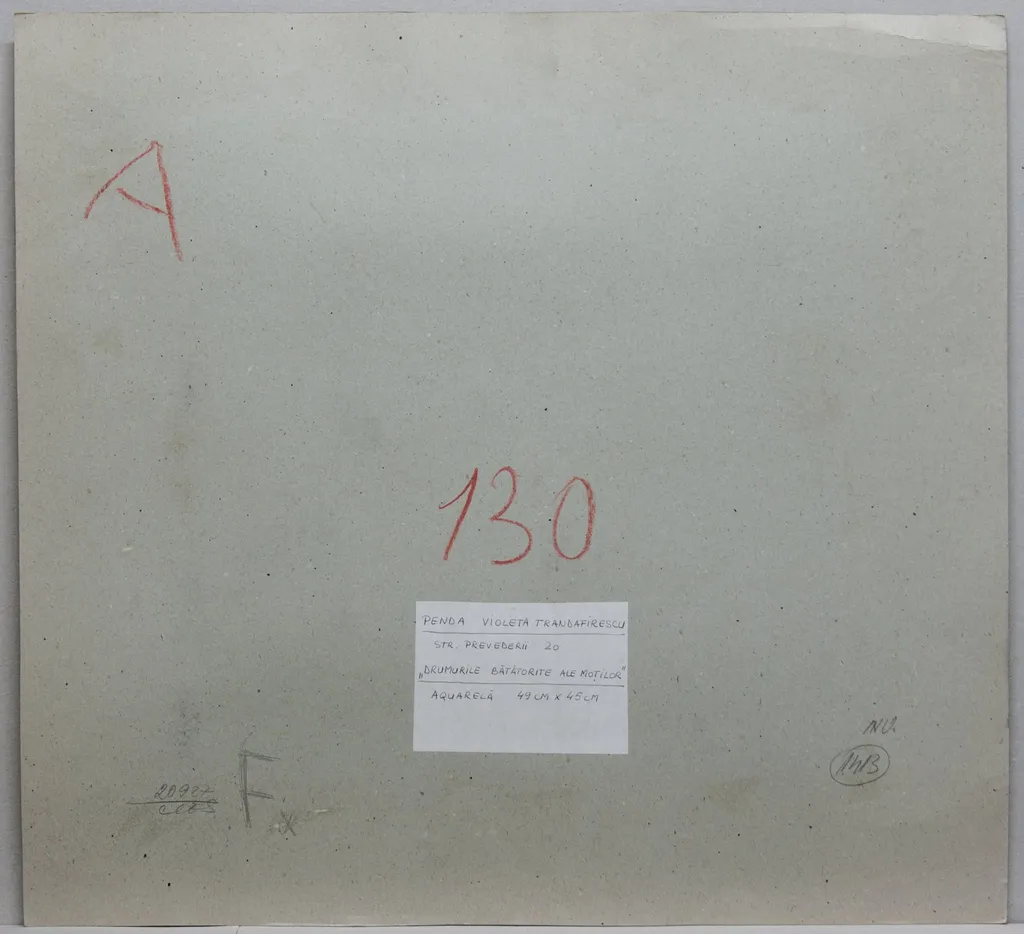
Drumurile bătătorite ale moților is a print by Violeta Penda. It dates from 1950 and is held in the collection of the Gavrila Simion Eco-Museum Research Institute Tulcea.
About this work
Overview
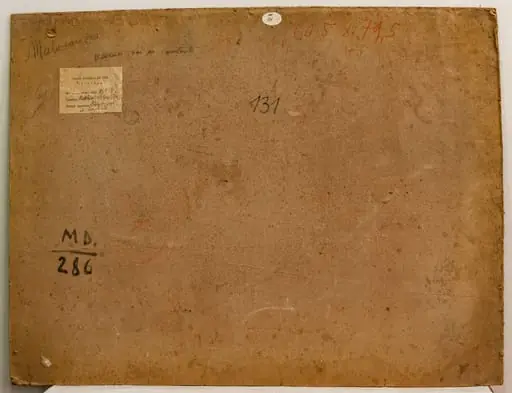
Created around 1950 by Violeta Penda, this work is a small square sheet of paper with a light gray background marked by fine black speckles.
Created around 1950 by Violeta Penda, this work is a small square sheet of paper with a light gray background marked by fine black speckles. At its center lies a white rectangular field containing handwritten text in an unfamiliar script and a red numeral '130' above it. In the bottom-left corner, faint, illegible annotations appear, suggesting the piece may have served as a study, label, or archival fragment rather than a finished composition.
Subject & Meaning
The handwritten text and red number imply a cataloging or indexing function, possibly tied to ethnographic documentation. The title, 'Drumurile bătătorite ale moților,' references worn paths associated with elders or traditional figures, hinting at cultural memory or oral history. The work may reflect Penda’s interest in preserving vernacular traditions, using minimal visual elements to evoke the weight of inherited landscapes and practices.
Technique & Style
Penda employed simple materials: paper, ink, and a red numeral, favoring restraint over ornamentation. The speckled gray background suggests a textured or aged surface, possibly achieved through deliberate staining or layering. The stark contrast between the white central rectangle and the muted field creates a sense of isolation, reinforcing the quiet gravity of the handwritten elements and their implied cultural context.
History & Provenance
The work is held in the collection of the Museum of Ethnography, indicating its classification as a cultural artifact rather than a conventional artwork. Its presence there suggests it was acquired as part of a broader effort to document folk traditions in mid-20th century Romania. The handwritten annotations and numerical marker point to institutional use, possibly as a label or field note within a larger collection.
Context
In postwar Romania, ethnographic documentation gained renewed attention as part of state-led cultural preservation efforts. Penda, working within this framework, may have used such minimal formats to record oral or material traditions that were at risk of fading. The work’s ambiguity—part document, part art—reflects the blurred boundaries between scholarly record and artistic expression during this period.
Legacy
Though not widely exhibited, the piece contributes to understanding how artists like Penda engaged with ethnography not as passive observers but as interpreters of cultural texture. Its quiet, unadorned form invites reflection on the materiality of memory and the role of handwriting in preserving intangible heritage, influencing later approaches to archival art in Eastern Europe.
Artist & collection
Artist
Violeta Penda crafted scenes from rural Romania, blending everyday life with the land around it.
Museum
Gavrila Simion Eco-Museum Research Institute Tulcea
Continue through works from the same source collection.
 Ființe fantastice printre ciulini
 COPACUL DIN SALONIC
 Piață turcească
 Generator de hazard
 Cap de turc
 Peisaj din Tulcea
 S 32 - Peisaj la Sulina (Dunăre și maluri pierdute în pete de culoare)
 Peisaj cu copaci printre care se văd acoperișurile gri și roșii. În dreapta, printre copaci, se ridică înalt turnul alb al unei biserici. În plan îndepărtat, blocuri, în spatele cărora se ridică furnale profilate pe un deal înalt albastru. Cerul învolburat albastru-violet. Copacii colorați în culorile toamnei. Semnat și datat cu negru, stânga jos: Craiu (19)70 ?.
 Compoziție
 La târg în Muscel
 S 33 - Peisaj la Sulina (Dunăre și faleză cu tufe de flori grena)
 Blocuri noi în Constanța