Artwork
S 32 - Peisaj la Sulina (Dunăre și maluri pierdute în pete de culoare)
S 32 - Peisaj la Sulina (Dunăre și maluri pierdute în pete de culoare) is a print by Medi Wechsler Dinu. It dates from 1958 and is held in the collection of the Gavrila Simion Eco-Museum Research Institute Tulcea.
About this work
Overview
Though labeled as a landscape, the surviving artifact is a fragmentary sheet of paper bearing only two numerical markings: 'S 32' in the upper left and 'NR.
S 32 - Peisaj la Sulina is a work by Romanian painter Medi Wechsler Dinu, dated approximately 1958. Though labeled as a landscape, the surviving artifact is a fragmentary sheet of paper bearing only two numerical markings: 'S 32' in the upper left and 'NR. IND. 3440' in the lower right. The paper shows signs of age, including minor stains and tears, suggesting it may have served as a cataloging label or study note rather than a finished painting.
Subject & Meaning
The title references a view of Sulina along the Danube, a location known for its shifting wetlands and muted horizons. However, no visual depiction of this scene survives in the extant material. The work’s title implies an interest in atmospheric dissolution—land and water merging into color fields—but the current artifact offers no imagery, leaving the intended composition unknown.
Technique & Style
Wechsler Dinu’s known style involved expressive, non-representational brushwork, often dissolving forms into patches of color. While this piece bears no painted marks, its designation as a landscape suggests it may have originated as a preparatory note or sketch fragment. The absence of pigment or drawn elements indicates the surviving object is likely a documentation label, not the artwork itself.
History & Provenance
The object is listed in the collection of the Museum of Ethnography, though its status as a painting is unverified by visual evidence. The numerical codes suggest it was part of an archival system, possibly used to catalog studies or lost works. No documentation confirms whether a painted version of this composition still exists or was ever completed.
Context
In late 1950s Romania, artists like Wechsler Dinu navigated state-imposed aesthetic constraints while pursuing personal expression. His Jewish heritage and abstract leanings placed him at the margins of official culture. This fragment may reflect a private exploration of landscape, recorded briefly before being archived as a reference rather than exhibited as art.
Legacy
The survival of this fragment underscores the fragility of artistic records under political pressure. Though no painted version is known, the label preserves Wechsler Dinu’s engagement with the Danube’s ephemeral terrain. It stands as a quiet testament to works lost, incomplete, or never publicly seen—testimony to an artist’s unseen labor.
Artist & collection
Artist
Margareta "Medi" Dinu, née Wechsler (January 4, 1909 – July 18, 2016) was a Romanian classical painter of Jewish origin.
Museum
Gavrila Simion Eco-Museum Research Institute Tulcea
Continue through works from the same source collection.
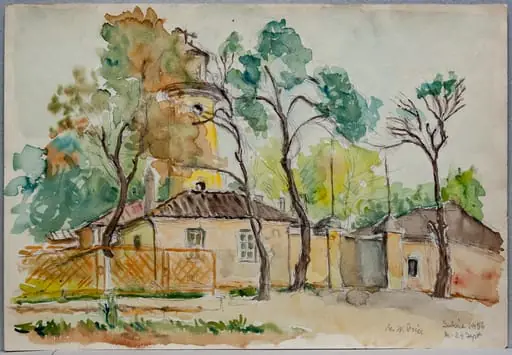 S 38 - Peisaj la Sulina (Stradă cu case și pomi)
 S6 - Peisaj la Sulina (Malul Dunării și case)
 S 28 - Peisaj la Sulina (Intrare de casă cu flori)
 S 9 - Peisaj la Sulina
 S 12 - Peisaj la Sulina (Stradă și 2 case)
 S4 - Peisaj la Sulina (Ochi de apă cu bărci și case)
 S 19 - Peisaj la Sulina (Casă și copaci)
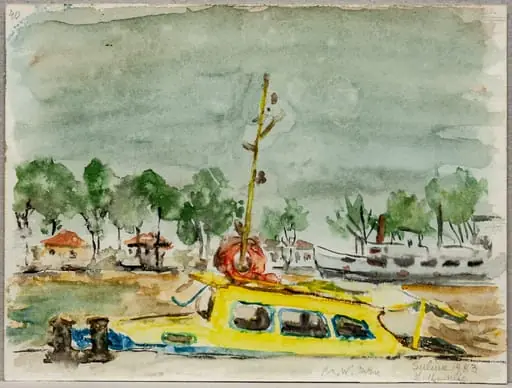 S 27 - Peisaj la Sulina (Dunăre, vapor în prim plan, case în planul doi)
 S 33 - Peisaj la Sulina (Dunăre și faleză cu tufe de flori grena)
 S 35 - Peisaj la Sulina (Maluri de Dunăre la răsărit)
 S 29 - Peisaj la Sulina (Vas pe Dunăre)
 S5 - Peisaj la Sulina (Stradă cu pomi și casă)
 S1 - Peisaj la Sulina (Casă și pomi)
 S 25 - Pe Dunăre la Sulina (Ponton și vapor pierdut în ceață pe Dunăre)
 S 18 - Peisaj la Sulina (Răsărit de soare pe Dunăre)