Artwork
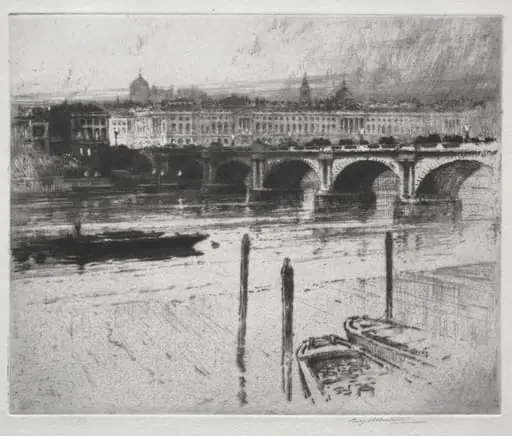
Waterloo Bridge and Somerset House
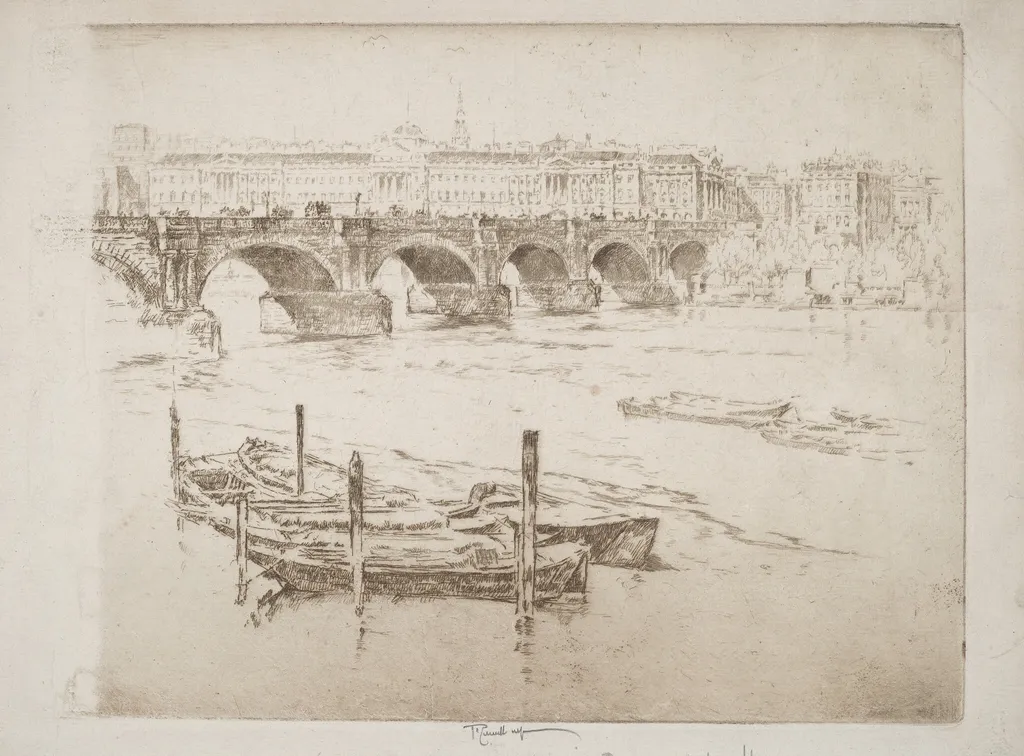
Waterloo Bridge and Somerset House is an ink print by Joseph Pennell. It dates from 1905 and is held in the collection of the National Gallery of Art.
About this work
Overview
Created in 1905, *Waterloo Bridge and Somerset House* is an etching by American artist Joseph Pennell, who lived and worked extensively in Europe.
Created in 1905, *Waterloo Bridge and Somerset House* is an etching by American artist Joseph Pennell, who lived and worked extensively in Europe. The print depicts a stretch of the River Thames in London, framing two major architectural landmarks. Pennell, trained under James Lambdin and Thomas Eakins, developed a precise, observational style influenced by James McNeill Whistler. This work exemplifies his interest in urban landscapes and the quiet rhythms of city life.
Subject & Meaning
The scene captures Waterloo Bridge and Somerset House along the Thames, rendered not as monuments but as integrated elements of daily activity. Figures cross the bridge, boats drift on the water, and windows in the buildings emit faint light, suggesting evening. The empty gondola, moored near the foreground, adds a stillness amid motion. Pennell presents London not as a spectacle but as a lived-in environment, where architecture and routine coexist.
Technique & Style
Pennell employed fine, controlled etching lines to render intricate details: the texture of stone on the bridge, the weave of ropes on the gondola, and the subtle ripples of water. The composition balances dense foreground elements with the atmospheric recession of the far shore. His use of light and shadow, particularly in the glowing windows, conveys time without overt drama. The technique prioritizes clarity and observation over expressive flourish, reflecting his commitment to documentary precision.
History & Provenance
Pennell produced this etching during a period of sustained focus on British urban scenes, following his move to London in the early 1900s. It was likely made as part of a series documenting the city’s infrastructure and waterways. The work entered public collections shortly after its creation, reflecting its reception among print collectors and institutions interested in modern etching. Pennell often collaborated with his wife, Elizabeth Robins, though this piece stands as a solitary visual record.
Context
In early 20th-century London, etching experienced a revival as artists sought to capture the changing urban landscape with technical rigor. Pennell’s work aligned with this movement, distinguishing itself through its attention to mundane, transient moments. Unlike romanticized views of the Thames, his etching avoids idealization, instead presenting the river as a working artery—populated, weathered, and quietly functional.
Legacy
Pennell’s etchings, including this one, contributed to the recognition of printmaking as a serious medium for urban documentation. His precise technique and unembellished perspective influenced later generations of topographical artists and documentary illustrators. While not widely exhibited today, his works remain in institutional collections as examples of early modern printmaking’s engagement with everyday city life.
Own this work as a print
Artist & collection
Artist
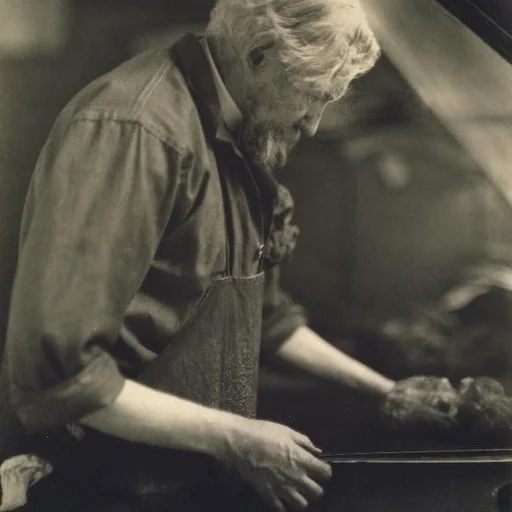
Joseph Pennell (July 4, 1857 – April 23, 1926) was an American draftsman, etcher, lithographer, and illustrator for books and magazines.