Artwork
With the Desert Column, 1885 Supper time.
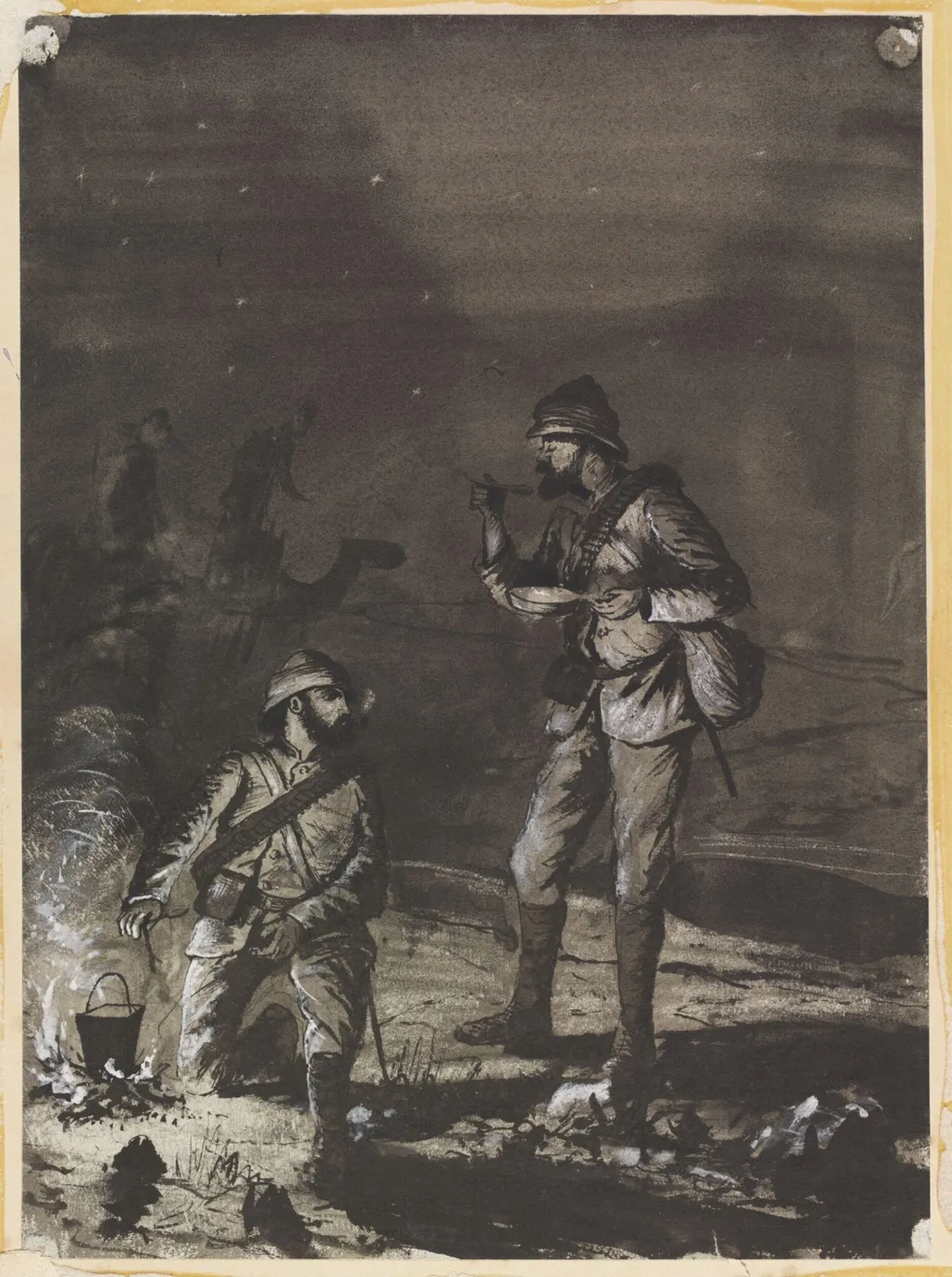
With the Desert Column, 1885 Supper time. is a watercolor work on paper by the Impressionist artist William S. Perry. It dates from 1885 and is held in the collection of the Victoria and Albert Museum. Created in 1885, this watercolour by William S.
About this work
Overview
Part of a series of twenty-seven works documenting military life, the piece focuses on the daily routines of soldiers rather than battle.
Created in 1885, this watercolour by William S. Perry captures a quiet moment during the British military campaigns in Egypt. Part of a series of twenty-seven works documenting military life, the piece focuses on the daily routines of soldiers rather than battle. Its intimate scale and subdued palette reflect a documentary intent, aligning with contemporary illustrated journals that sought to convey the realities of imperial campaigns through visual reportage.
Subject & Meaning
Two exhausted soldiers are shown at supper in a rugged, shadowed encampment. One sits slumped, head bowed; the other stands, holding a plate and hat, suggesting a pause in the rhythm of duty. The absence of ceremony or triumph underscores the monotony and physical strain of service in a hostile environment. The scene resists heroism, instead emphasizing endurance, hunger, and the quiet resilience of ordinary men in an unforgiving landscape.
Technique & Style
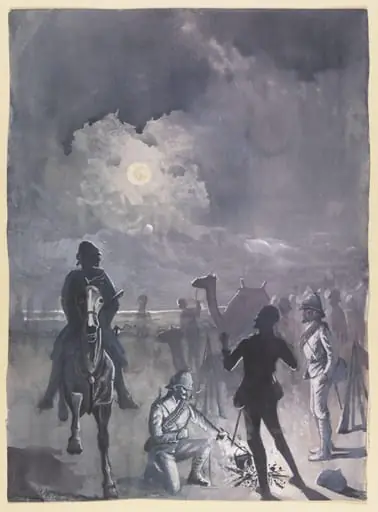
Perry employed rapid, loose brushwork and diluted watercolour to evoke the dim, uneven light of a desert night. Dark washes dominate the background, blurring forms into indistinct silhouettes of comrades and supplies. Stark contrasts between shadow and faint highlights—chiaroscuro applied with restraint—heighten the sense of isolation and fatigue. The rough texture of the paper and minimal detail reinforce the immediacy of a field sketch rather than a polished composition.
History & Provenance
The work originated as part of a commissioned series documenting British military operations in Egypt between 1882 and 1885. Perry, likely attached to the forces as an artist-correspondent, produced these images for publication in periodicals like *The Illustrated London News*. The series was intended for public consumption, offering civilians a visual record of campaigns distant from home, though often filtered through official perspectives.
Context
During the 1880s, British public interest in imperial campaigns surged, fueled by illustrated newspapers eager to depict exotic theaters of war. Perry’s watercolours responded to this demand, balancing journalistic accuracy with emotional restraint. Unlike grand battle scenes, his focus on mundane moments—meals, rest, waiting—reflected a growing trend toward humanizing soldiers, even as the political aims of the campaigns remained unchallenged in the imagery.
Legacy
Perry’s series, including this work, contributed to a visual archive of British military life in Egypt that predates photography’s dominance in war reporting. While not widely exhibited in his lifetime, these watercolours now serve as understated historical documents, offering a quiet counterpoint to the glorified narratives of empire. Their modesty and observational honesty give them enduring value as records of everyday soldiering under harsh conditions.
Artist & collection
Artist
A British watercolour artist active in the 1880s, William S. Perry painted scenes from Egypt’s military outposts in vivid, portable washes. His sheets include Outpost duty at El Gubat. Night. (1886) and Outpost duty at…

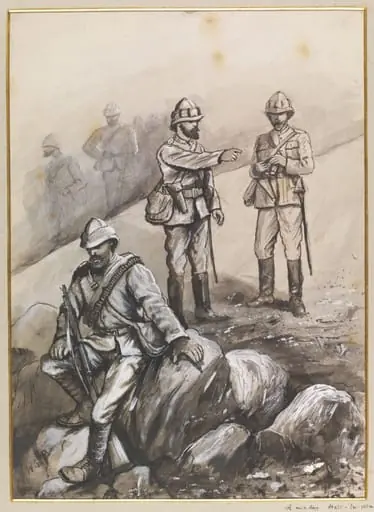 A mid-day Halt - Dec. 1884
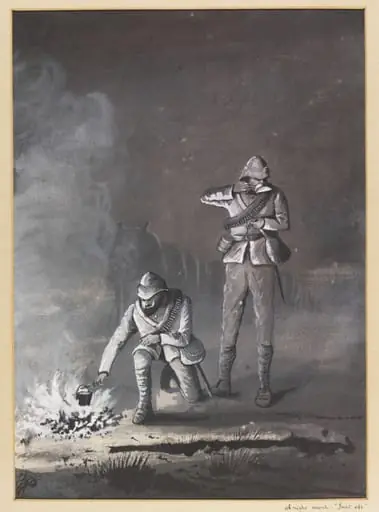 A night march - Just off
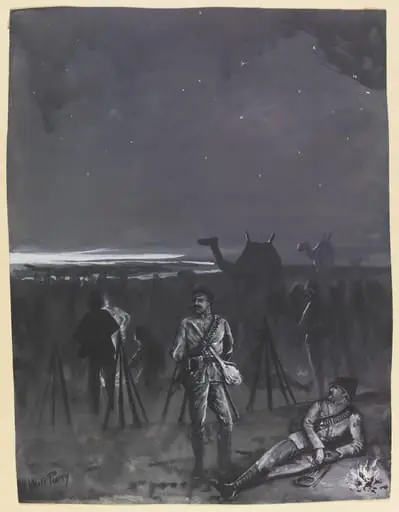 Scene With Soldiers At Night
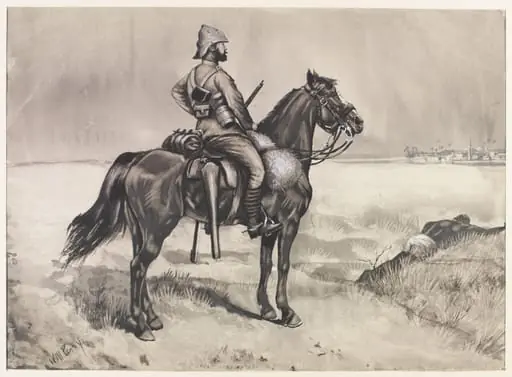 19th Hussars - Vedette at Metemneh 1885
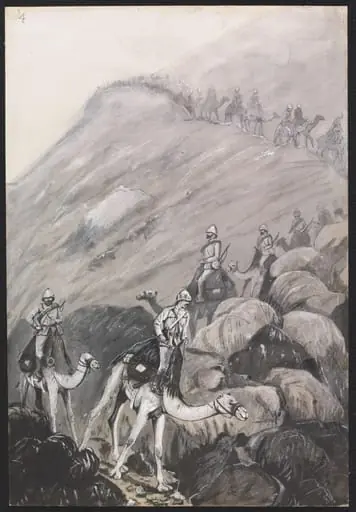 Coming Down a Steep place
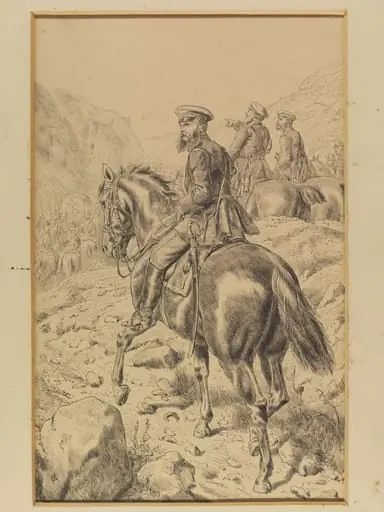 Portrait of Field Marshal Joseph Vladimirovich Gourko
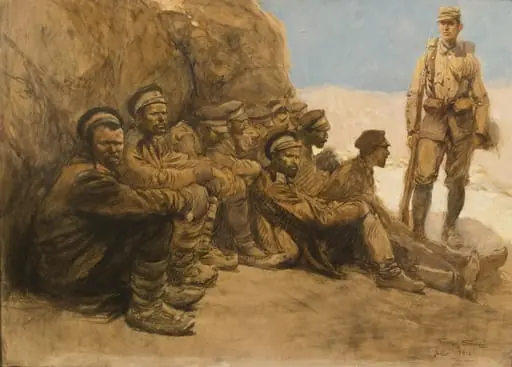 Υδατογραφία Βούλγαρων στρατιωτών, αιχμάλωτων του ελληνικού στρατού στην Κρέσνα
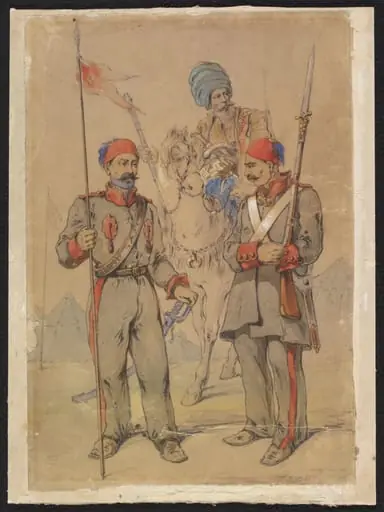 Turkish Soldiers in Summer uniform
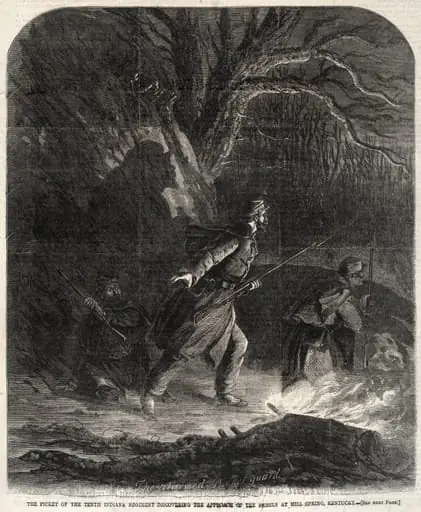 The Picket of the Tenth Indiana Regiment discovering the Approach of the Rebels at Mill Spring, Kentucky
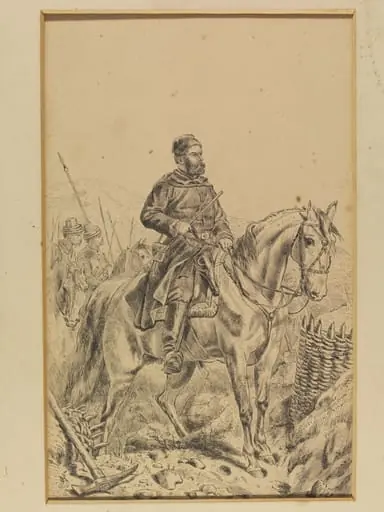 Osman Pasha